Microsoft Fabric continues to strengthen its approach to responsible AI by embedding governance, security, transparency, and compliance directly into the data and AI lifecycle. Recent announcements at FabCon and SQLCon 2026 introduce new capabilities that help enterprises scale AI while maintaining trust, accountability, and regulatory compliance.
Key advancements include the general availability of Fabric Data Agents, which enable domain-specific AI agents to securely access governed enterprise data while inheriting Fabric’s existing security, compliance, and auditing controls. Another major milestone is the general availability of OneLake Security, built on OneLake, which delivers centralized row-level and column-level security that can be consistently enforced across SQL, Spark, Power BI, and AI workloads.
These innovations build on the unified Microsoft Fabric platform, where data integration, analytics, governance, and AI operate within a single SaaS environment. Combined with Microsoft Purview capabilities such as Data Loss Prevention (DLP), Information Protection, Insider Risk Management (IRM), and Data Security Posture Management (DSPM) for AI, Fabric provides enterprises with greater visibility.
Let’s explore how it handles AI interactions, stronger protection for sensitive data, improved auditability, and more consistent governance across AI, analytics, copilots, and agents.
Key Takeaways
- Microsoft Fabric’s improved approach for enterprises to scale AI, copilots, and agents while maintaining transparency, accountability, and compliance.
- OneLake Security is now generally available, providing centralized row-level and column-level security controls across Fabric workloads.
- Expanded DSPM for AI capabilities improve visibility into AI interactions, sensitive data exposure risks, and policy compliance.
- Fabric Data Agents are now generally available, enabling governed deployment of agentic AI on enterprise data.
Why Enterprises Still Struggle to Scale AI Responsibly
Many enterprises successfully pilot AI initiatives but face significant obstacles when moving to production.
Common challenges include:
- Fragmented data spread across multiple platforms and business units
- Inconsistent governance and security policies
- Limited visibility into data lineage and model inputs
- Difficulty auditing AI-generated recommendations and decisions
- Growing regulatory requirements around privacy, explainability, and accountability
Without a governed data foundation, AI systems can produce inconsistent outcomes, increase compliance risk, and reduce stakeholder confidence. Microsoft Fabric addresses these challenges by embedding governance directly into the analytics and AI lifecycle rather than treating it as a separate process.
The Data Foundation that Responsible AI Needs
Microsoft’s responsible AI framework is built on six core principles:
| Responsible AI Principle |
Microsoft Fabric Capability |
| Trust |
Governed access to mastered enterprise datasets |
| Reliability & Safety |
Monitoring, observability, and controlled deployment processes |
| Privacy & Security |
OneLake Security, Microsoft Purview, DLP, Information Protection |
| Inclusiveness |
Unified access to data and analytics across teams |
| Transparency |
End-to-end lineage and data traceability |
| Accountability |
Policy enforcement, auditing, and governance controls |
In practice, these principles only hold if the data ecosystem supporting AI is built to enforce them. That is the gap traditional architectures struggle with—governance layered on top after the fact, creating silos between data, security, and AI teams with limited end-to-end visibility.
Industries such as banking, healthcare, insurance, and the public sector experience these challenges most acutely. Regulators expect auditability. Privacy frameworks require strong access controls. Business leaders need AI-generated insights they can trust. Fabric takes a fundamentally different approach by embedding governance, security, and compliance into the platform from the start.
What’s New in Microsoft Fabric for Responsible AI
Recent innovations highlighted in the Fabric March 2026 Feature Summary reinforce Microsoft’s vision for governed enterprise AI at scale.
A Governed Data Foundation for AI with Upgraded OneLake
OneLake sits at the center of Microsoft Fabric’s architecture, providing a unified data lake that serves as a single source of truth for analytics and AI workloads.
By consolidating enterprise data into one governed environment, enterprises can establish consistent policies, security controls, and lineage tracking across the entire AI lifecycle.
Key benefits include:
- Single source of truth for enterprise data
- Consistent governance across analytics and AI workloads
- End-to-end lineage and traceability
- Reduced data duplication and silos
- Greater trust in AI-generated outcomes
Fabric’s lineage capabilities enable enterprises to track how data moves across pipelines, notebooks, semantic models, dashboards, and AI processes. This provides a clear chain of evidence for compliance investigations, model validation, and business decision-making.
Governance and Security by Design with Microsoft Purview
Fabric’s integration with Microsoft Purview transforms governance from a separate operational task into a built-in platform capability. Purview brings together Information Protection, Data Loss Prevention (DLP), Insider Risk Management (IRM), and Data Security Posture Management for AI (DSPM for AI) across the Fabric estate.
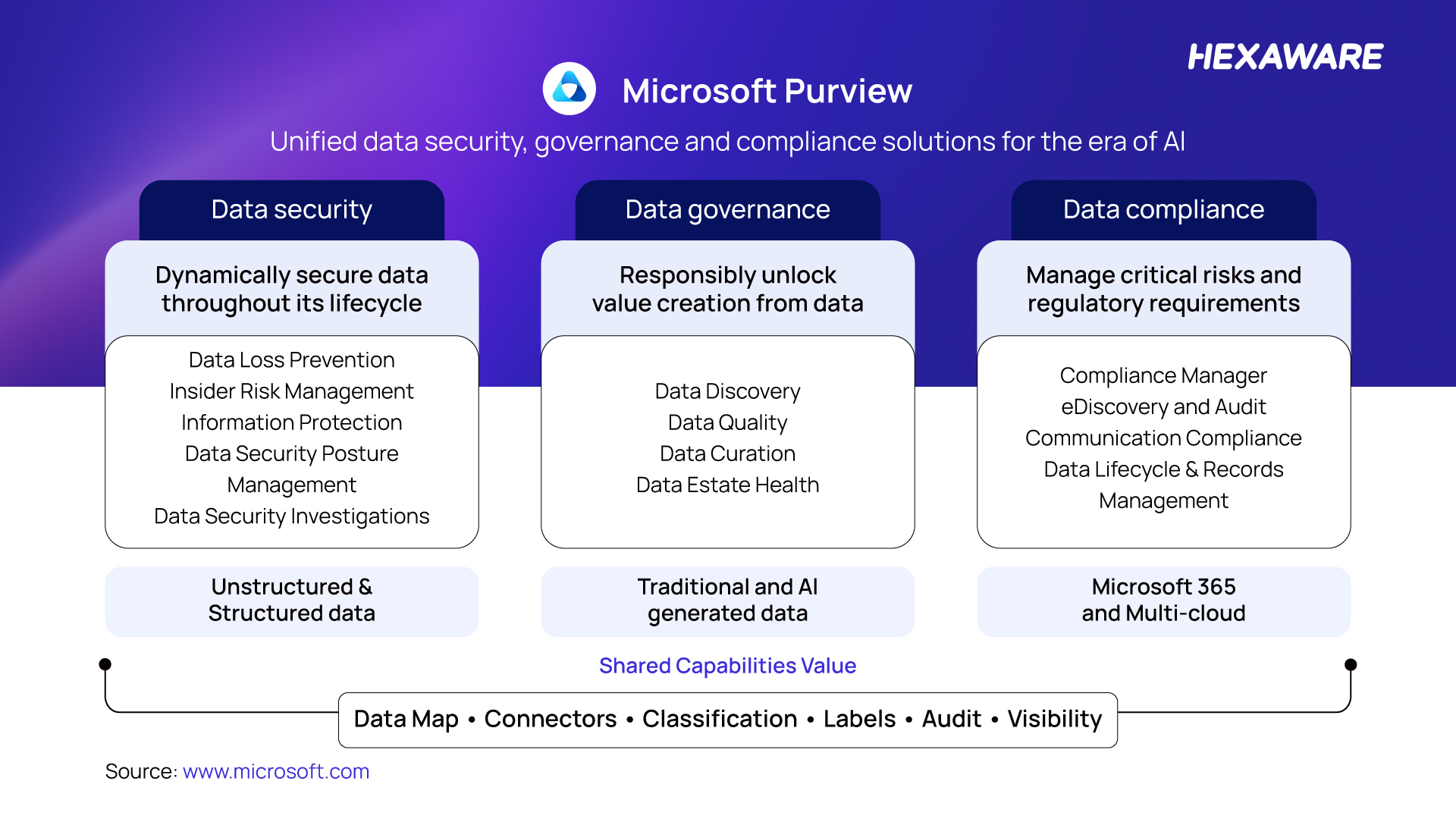
A Snapshot of Microsoft Purview Capabilities
DSPM for AI — expanded at FabCon 2026 — gives enterprises real visibility into how Copilot experiences and AI agents interact with enterprise data. It identifies sensitive data risks in AI prompts and responses, flags risky behaviors, and surfaces recommendations through Audit, eDiscovery, and retention tools.
Purview DLP for Fabric Warehouse and KQL/SQL databases is now generally available, with IRM extended to Fabric lakehouses so security teams can correlate access, movement, and labeling events in one place. The Purview Unified Catalog rounds this out with estate-wide data discovery and built-in data quality tools, ensuring the data feeding AI models is both governed and trustworthy.
Bringing Governance to AI: Agents, Copilots, and MCP
Enterprise AI is moving from passive analytics to agentic systems that reason and act. Fabric supports this shift responsibly.
Fabric Data Agents inherit the same governance, security, and compliance controls applied throughout the platform. Meanwhile, support for the Model Context Protocol (MCP) enables AI coding assistants and automation tools to securely interact with Fabric workloads across local and cloud-hosted environments.
Fabric Data Agents (General Availability)
Fabric Data Agents act as domain-specific virtual analysts operating entirely within Fabric’s governance boundaries.
Benefits include:
- Secure access to governed enterprise data
- Built-in compliance controls
- Full auditability and monitoring
- Consistent security inheritance from Fabric
- Context aware interactive interface with your data
These capabilities enable enterprises to embrace agentic AI while maintaining governance and accountability.
Further, support for Copilot in Microsoft Fabric enables users to leverage generative AI capabilities across data and analytics workflows while remaining within enterprise governance boundaries.
Enterprises can also reference Microsoft’s guidance on Privacy, Security, and responsible AI Use of Copilot in Fabric to better understand governance and compliance considerations. The result is AI that is not only more capable but also more accountable.
Responsible AI in Action Across Industries
In financial services, governed AI supports fraud detection, risk analytics, and customer insights while maintaining audit readiness.
In healthcare, lineage tracking and access controls help enterprises derive insights from sensitive patient data while supporting privacy and regulatory requirements.
In retail, AI-driven personalization can operate at enterprise scale while governance boundaries remain consistently enforced across data and AI workloads.
The common thread is trust. When governance is embedded into the platform, innovation and compliance become complementary rather than competing priorities.
Business Outcomes of Responsible AI at Scale
Enterprises implementing Microsoft Fabric as a governed AI foundation can achieve:
- Greater trust in AI-generated insights
- Improved regulatory and audit readiness
- Faster deployment of production-grade AI solutions
- Reduced operational complexity
- Enhanced data security and privacy controls
- Consistent governance across analytics and AI workloads
- Better collaboration between business, security, and data teams
While outcomes vary by enterprise, the combination of unified governance and AI capabilities enables enterprises to scale innovation more confidently.
Scale Responsible AI with Hexaware
Scaling AI responsibly is one of the most important challenges facing enterprises today. Success requires more than powerful models—it requires a governed data foundation that ensures trust, transparency, security, and accountability across the entire AI lifecycle.
Microsoft Fabric addresses this need by unifying data, analytics, governance, and AI into a single platform designed for responsible AI at scale. With innovations such as Microsoft Fabric Security, OneLake Security, Fabric Data Agents, DSPM for AI, and MCP support, enterprises can move beyond experimentation and establish trusted, production-grade AI environments.
By combining Microsoft Fabric’s platform capabilities with Hexaware’s Microsoft Fabric expertise, enterprises can accelerate AI adoption while maintaining the governance, compliance, and trust required for long-term success.