The way we approach machine learning is changing—and fast. Cloud data platforms like Snowflake are enabling machine learning to run directly where the data lives. Gone are the days of downloading datasets, moving them between platforms, and struggling with silos. With tools like Snowpark and frameworks like Keras, we can now build scalable, cloud-native machine learning workflows that are not only efficient but also production-ready. In this blog, we’ll walk you through building a deep learning model to predict housing prices using Snowflake as the data source. By the end, you’ll see how combining the power of Snowflake with deep learning simplifies workflows, drives insights, and sets the stage for modern machine learning innovation. Here’s what we’ll cover:
- A quick dive into deep learning and why it makes sense for regression problems like housing price prediction.
- How Snowflake, with Snowpark, supports machine learning
- Building and evaluating a neural network model with
- The key takeaways and lessons learned from this project.
Let’s dive in.
Why Deep Learning for Regression?
Let’s start with the basics. Regression problems are about predicting a continuous value—in this case, housing prices. Traditional approaches like linear regression work well for simple, linear datasets, but when the data gets messy, they hit their limits. Think about housing prices: they depend on a web of interrelated factors—income levels, proximity to the ocean, population density, and even the number of bedrooms in a house. These relationships aren’t always linear. Enter deep learning, which excels at capturing non-linear patterns and complex feature interactions. Deep learning models, powered by artificial neural networks (ANNs), mimic the way our brains process information. They use multiple layers of neurons to learn relationships that other models miss. And when paired with the right tools and data preprocessing, they can deliver predictions with remarkable accuracy.
Why Snowflake for Machine Learning?
In machine learning, data access and scalability are often pain points. But these challenges disappear with Snowflake, a cloud-native data platform that goes beyond traditional data warehouses. Here’s how Snowflake stands out:
- Scalability: It handles massive datasets effortlessly.
- Seamless Python Integration: With Snowpark, developers can use Python APIs to work directly with Snowflake
- In-Database Analytics: Forget about downloading data; Snowflake lets you query and process it in the cloud.
- Efficiency and Security: Data stays where it lives, eliminating movement and reducing the risk of errors.
For this project, we used Snowflake to store and access the California Housing Dataset—a rich dataset ideal for predicting housing prices.
The Dataset: California Housing Data
Let’s talk about the data. The California Housing Dataset is a classic in the machine learning world. It includes features like:
- Median Income: A key driver of housing prices.
- House Age: Older homes may have different pricing trends.
- Total Rooms and Bedrooms: Indicators of housing size.
- Population Density: A measure of living conditions.
- Ocean Proximity: A categorical feature that’s critical for coastal regions.
The target variable? Median House Value, which we aim to predict.
Building the Workflow: Step by Step
Here’s how we tackled the project.
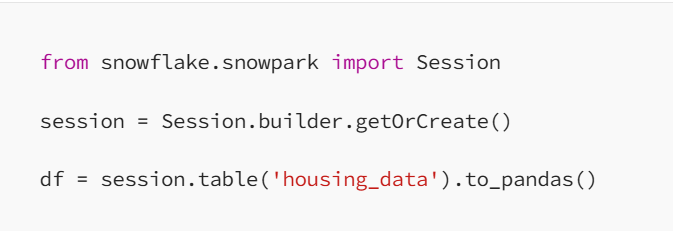
Loading Data with Snowflake
Instead of downloading the dataset manually, we accessed it directly in Snowflake using Snowpark. This approach ensured our workflow was:
- Scalable: Ready for production use without manual intervention.
- Efficient: No need for data movement.
- Cloud-native: Built for modern, distributed systems.
This seamless integration with Snowflake not only saved time but also simplified the setup process, allowing us to focus on modeling.
Exploratory Data Analysis (EDA)
No machine learning project is complete without EDA. Here’s what we did:
- Checked the dataset shape: Ensured we had all columns and rows intact.
- Identified missing values: Missing data were imputed using the median, which is robust to outliers.
- Verified data types: Ensured all features were appropriately formatted for modeling.

Feature Engineering
To make the dataset machine learning-ready, we performed a few key transformations:
- Encoding Categorical Data: The OCEAN_PROXIMITY column was converted into numerical values since neural networks only process numbers.
- Scaling Features: Neural networks are highly sensitive to scale. By standardizing the data (mean = 0, standard deviation = 1), we improved model performance.

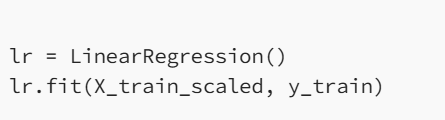
Baseline Model: Linear Regression
Before diving into deep learning, we built a baseline model using Linear Regression. Why? Because starting simple helps us understand how much value a more complex model (like a neural network) adds. The baseline model gave us a benchmark for comparison. Its simplicity also made it easy to interpret and helped us understand the dataset’s basic structure.
Building the Deep Learning Model
Now for the star of the show: the neural network. Using Keras, we built a deep learning model with the following architecture:
- Input Layer: 13 features from the dataset.
- Hidden Layers: Two layers with 16 and 8 neurons, respectively.
- Output Layer: A single neuron for predicting housing prices.
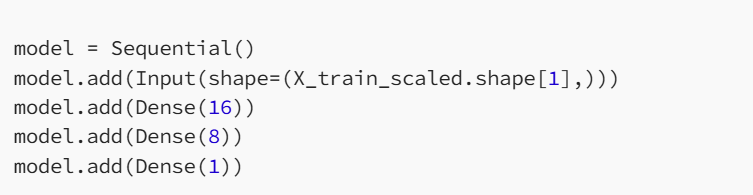
To keep it simple, we started without activation functions, which made the model equivalent to linear regression. Later, we introduced ReLU (Rectified Linear Unit) to capture non-linear patterns.
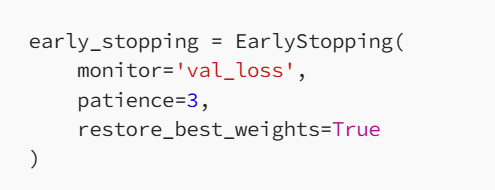
Early Stopping: Preventing Overfitting
One of the biggest risks in deep learning is overfitting, where the model performs well on training data but struggles with unseen data. To combat this, we used early stopping, which halts training when validation performance stops improving. This not only saves computation time but also ensures the model generalizes well.
Evaluating the Model
We measured model performance using two metrics:
- Mean Squared Error (MSE):A standard for regression models. Lower values indicate better predictions.
- R² Score: Measures how much variance the model explains. Higher scores (closer to 1) are better.
The deep learning model outperformed the baseline linear regression, thanks to its ability to capture complex relationships in the data.
Lessons Learned
Here are the key takeaways from this project:
- Snowflake Simplifies Data Access: With Snowpark, data integration becomes seamless, eliminating the need for manual downloads or transfers.
- Feature Scaling is Crucial: Neural networks are sensitive to input scales, and standardizing data is non-negotiable.
- Deep Learning Needs Proper Activation Functions: Without them, the model behaves like a linear regression.
- Baselines Matter: Starting with a simple model helps justify the complexity of deep learning.
Final Thoughts: The Power of Snowflake + Deep Learning
This project showcased the synergy between Snowflake’s data cloud platform and Keras-based deep learning models. By keeping data in Snowflake and leveraging tools like Snowpark, we created a scalable, efficient workflow that’s ready for production. But this is just the beginning. You can take this project further by:
- Adding advanced activation functions like ReLU or Sigmoid.
- Trying Dropout regularization to reduce overfitting.
- Experimenting with optimizers like Adam for faster convergence.
- Deploying the model using Snowflake UDFs or APIs.
The possibilities are endless when you combine cloud-native platforms with deep learning. So, what are you waiting for? Dive in, experiment, and build something remarkable.
Learn more about our Snowflake capabilities here.