The World Runs on Data. Is Telecom Making the Most of It?
Every day, telecom networks support millions of digital interactions, from payments and video calls to online shopping, streaming, and connected devices. In the process, operators generate vast amounts of customer, network, operational, and business data.
This should give telecom companies a significant advantage. Few industries have access to such a broad and continuous flow of information. Yet many operators still struggle to turn that data into meaningful business insights. Valuable information often sits across multiple systems, making it difficult to connect customer behavior, network performance, operational metrics, and financial outcomes.
This is where telecom data analytics becomes increasingly important. The ability to transform raw data into actionable insights can help operators improve customer experiences, optimize operations, strengthen network performance, and identify new growth opportunities.
In this blog, we’ll explore why many telecom operators struggle to unlock the full value of their data, how a modern telecom data ecosystem helps eliminate data silos, and how telecom data analytics enables faster decisions, operational efficiency, and better customer experiences.
Keeping Up with Today’s Hyperconnected World
The amount of data flowing through telecom networks continues to grow as businesses and consumers become more connected. Every transaction, device interaction, streaming session, and digital service generates information that moves across telecom infrastructure in real time.
Today, telecom sits at the center of a highly connected ecosystem, enabling data exchange across industries.
Data Exchange Across Industries Powered by Telecom
| Industry |
How Data Flows |
| Banking |
Secure, real-time transactions across regions and time zones |
| Manufacturing |
IoT devices and industrial systems sending continuous signals |
| E-commerce & Retail |
Real-time sync of inventory, payments, and customer data |
| Healthcare |
Connected devices, wearables, and remote patient monitoring |
| Travel & Transportation |
Live coordination across airlines, logistics, and booking systems |
| Education |
Connected learning across devices, platforms, and locations
|
Each of these interactions generates valuable data. In theory, this should make it easier for operators to understand customers, improve network performance, and make smarter business decisions.
Yet many telecom organizations continue to struggle to turn data into actionable insights. Why?
Because the challenge is no longer collecting data. It is bringing that data together to create a complete view of the business.
The Real Problem Isn’t Data Volume. It’s Data Fragmentation.
For many operators, that complete view simply doesn’t exist.
Customer information, network performance metrics, billing records, operational data, and financial information are typically stored in separate systems. Each source offers valuable insights, but on its own, it only provides part of the picture.
As a result, teams often make decisions based on a limited view of what is happening. Network teams focus on performance metrics, marketing teams focus on customer engagement, and finance teams focus on revenue trends. Connecting those insights to understand the bigger strategic picture can be difficult.
This is why harnessing intelligence from data has become a priority across the industry. Effective telecom industry data management helps operators create a more consistent and reliable view of their data, making it easier to uncover insights and support better decision-making.
Without a strong foundation of connected data streams and a single source of truth, even the most advanced telecom data analytics initiatives can struggle to deliver meaningful business value.
Building that foundation often starts with modernizing legacy data environments and eliminating disconnected data silos. Learn more in our blog, Your Guide to Data Modernization: Understanding the Most Critical Step in Data & AI Strategy, which explores how modern data architectures help organizations accelerate analytics, AI adoption, and business transformation.
Building on a Robust Data Foundation
When different functions of an enterprise begin working together, integrated by a single source of truth, the organization shifts from viewing customer complaints, network performance, service usage, and revenue trends as partial, low-context views to seeing the connected enterprise as a whole. This gives operators the perspective to understand how functional and technological themes influence one another.
A spike in customer complaints may be linked to network issues in a specific region. Changes in customer behavior can help explain shifts in revenue or service adoption. Rather than analyzing events in isolation, operators gain a broader understanding of what is happening across the business.
This is where telecommunications analytics start to deliver real value. By bringing together insights from across the organization, operators can identify trends earlier, make better decisions, and respond more effectively to changing business conditions.
But understanding what happened is only part of the equation. The real opportunity lies in using those insights to anticipate what comes next, prepare through scenario planning and ‘what-if’ analyses, and act on them more effectively.
From Data to Decisions: The Telecom Analytics Journey
Once operators start connecting data across the business, the focus shifts from gathering insights to putting those insights to work.
Different organizations are at different stages of this journey, but most follow a similar path as their analytics capabilities mature.
The Telecom Analytics Evolution Journey
| Stage |
What It Does |
Business Impact |
| Diagnostic Analytics |
Explains what happened and why |
Improves visibility and root cause analysis |
| Predictive Analytics |
Anticipates what will happen next |
Enables proactive decision-making |
| Real-time Analytics |
Acts instantly based on live data |
Drives speed, automation, and responsiveness |
Most operators begin by using analytics to understand historical performance, identify key trends and patterns, and define their standard operating procedures. This can help answer questions about customer churn, service disruptions, operational bottlenecks, or network performance trends.
As analytics capabilities evolve, organizations start using predictive analytics in telecom to identify potential risks and opportunities before they occur. This might include forecasting network demand, identifying customers likely to churn, or detecting equipment issues before they affect service.
The next stage focuses on speed and responsiveness to external market changes. Using telecom network data analytics, operators can respond to changing conditions in real time, enabling faster decisions, improved service quality, and more efficient operations.
Bringing it All Together: A Strong Telecom Data Ecosystem
By this stage, the goal is clear: turn data into insights that improve business outcomes. The challenge is doing that consistently across a complex telecom environment.
This is where a telecom data ecosystem comes in, built on strong, robust data sources, unified sources of truth, and responsive downstream analytics. When these data sources are accessed and analyzed together, operators will be better positioned to move from insight to action.
Key Sources of Telecom Data
| Data Source |
Description |
| Facilities & Infrastructure |
Towers, switches, and data centers generating performance data |
| IT Systems & Applications |
Cloud platforms, enterprise systems, service delivery data |
| Workforce Data |
Productivity, operations, workforce efficiency insights |
| Finance & Procurement |
Revenue, cost, and supplier data |
| Marketing & Sales |
Customer behavior, acquisition, and retention metrics |
A telecom data ecosystem creates a structured environment where information can flow across the organization. It leverages connected data from network operations, customer systems, finance, workforce management, and other business functions, seamlessly enabling analytics, AI, and decision-making at scale.
Data to Intelligence Flow
A typical data ecosystem comprises a seamless flow across multiple elements:
| Layer |
Components |
| Data Sources |
Facilities, IT Systems, Workforce, Finance, Marketing |
| Data Transformation |
ETL (Extract Transform, Load), integration, , staging for analytics |
| Analytics Layer |
Diagnostic and predictive analytics |
| Business Outcomes |
Customer retention, network optimization, revenue growth |
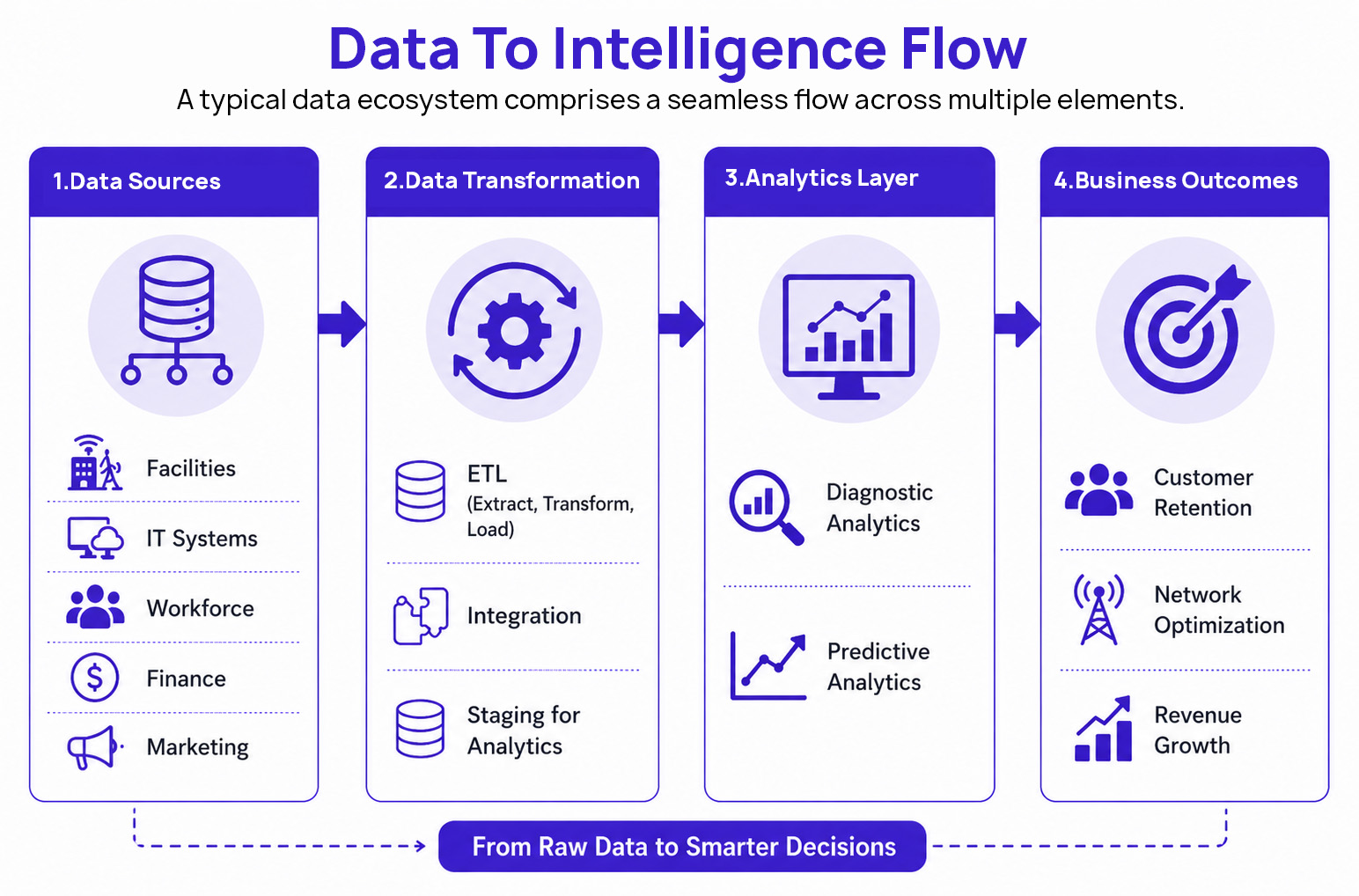
Alt text: Infographic showing a four-step data-to-intelligence flow from Data Sources (facilities, IT systems, workforce, finance, marketing) through Data Transformation (ETL, integration, staging), to Analytics (diagnostic and predictive), leading to Business Outcomes (customer retention, network optimization, revenue growth).
Generating Business Value from Telecom Data Analytics
The value of telecom data analytics is ultimately measured by business outcomes. Some of the most impactful applications include:
Customer Churn Prediction
Customer churn rarely happens without warning signs. Changes in usage patterns, declining engagement, service complaints, and billing issues can all indicate increased risk. Using data analytics in the telecom industry, operators can identify these signals early and take proactive steps to improve retention.
Network Performance Optimization
Network demand is constantly changing. Through telecom network data analytics, operators can identify congestion patterns, optimize traffic flows, and improve service quality before performance issues affect customers.
Predictive Asset Maintenance
Unexpected equipment failures can lead to service disruptions and higher operational costs. With predictive analytics in telecom, operators can detect potential issues earlier, schedule maintenance proactively, and reduce downtime.
Revenue Assurance and Fraud Detection
Revenue leakage and fraudulent activity can be difficult to identify using traditional reporting methods. Analytics helps uncover unusual patterns, detect anomalies, and strengthen financial controls. This is one area where telecom business intelligence can directly support profitability.
Personalized Customer Experiences
Customers increasingly expect relevant, tailored offers and seamless interactions. By analyzing customer behavior and preferences, operators can deliver more personalized experiences, improve engagement, and strengthen loyalty.
Telecom data analytics is no longer just a reporting capability. When supported by a strong data foundation, it becomes a strategic tool for improving operational performance, customer experience, and business growth.
What’s Holding Telecom Back?
If the benefits are clear, why are many operators still struggling to scale or maximize the ROI of their analytics initiatives?
Common challenges include:
- Legacy systems that are difficult to integrate
- Poor data quality and governance
- Organizational silos
- Skill gaps in analytics and AI
- Misalignment between business priorities and data initiatives
Addressing these barriers is a critical part of any successful telecom data transformation effort.
A Practical Roadmap to Telecom Data Transformation
Overcoming these challenges requires a structured approach.
Step-by-Step Transformation Approach
| Step |
Action |
| Assess |
Evaluate current data maturity and gaps |
| Build Foundation |
Strengthen telecom data management and integration |
| Prioritize |
Focus on high-value telecom data analytics use cases |
| Scale |
Expand analytics, AI, and automation |
| Optimize |
Continuously improve data quality and insights |
The most successful organizations focus on business outcomes first, using technology and analytics to support clearly defined goals
The Shift from Data-Rich to Insight-Driven
Telecom operators already possess one of their most valuable assets: data.
The opportunity now is to use that data more effectively. Organizations that expand telecommunications analytics capabilities and invest in telecom data transformation will be better positioned to improve customer experiences, optimize operations, and respond faster to changing market demands.
Ready to Unlock Value from Your Data?
You do not need more data. You need better outcomes from the data you already have.
Hexaware helps telecom operators accelerate telecom data transformation through data, analytics, and AI capabilities that connect information across the enterprise and turn it into actionable insights.
Ready to build a stronger data foundation and unlock greater business value? Contact Hexaware to start your telecom data analytics journey.