Insurance companies are not overspending on core systems. They are overspending on coordination.
For a typical mid-sized insurer, $15–25M of annual non-core license spend sits outside PAS, claims, actuarial, and finance platforms. It is distributed across workflow engines, RPA bots, middleware, contact center software, portals, and orchestration tools designed to manage handoffs between people and systems.
License sprawl is not a procurement issue. It is an operating model issue. As long as humans coordinate fragmented workflows, orchestration software multiplies. This is where the idea of Zero License emerges—not as reckless cost-cutting, but as the structural outcome of redesigning execution with AI.
Zero License does not mean eliminating core systems. It means systematically reducing coordination-driven, non-core software that becomes unnecessary when an AI layer executes work end-to-end.
Zero License Is Not About Eliminating Core Systems
“Zero License” does not mean removing PAS, claims platforms, actuarial engines, or finance ERP.
It means driving non-core coordination licenses toward zero wherever execution can be AI-led instead of tool-led.
Today, for non-insurance capabilities, insurers use license software to:
- Route emails
- Classify intent
- Move tasks between queues
- Patch system gaps with bots
- Orchestrate human workflows
- Monitor manual handoffs
These are not insurance capabilities. They are coordination workarounds. Zero License is the strategic ambition to remove software that exists only to manage fragmentation. When AI executes workflows end-to-end, the structural need for many of these licenses disappears.
Where License Cost Actually Lives in Insurance
For a typical mid-sized insurer, total license spend spans both core and non-core systems — and understanding both is essential to making smart reduction decisions.
Core systems — PAS, claims platforms, actuarial engines, and finance ERP — represent the non-negotiable foundation of insurance operations. Non-core spend sits around it, layered on top to manage the coordination, routing, and exception-handling that core systems were never designed to handle.
Together, total annual license spend for a mid-sized insurer is typically distributed across five operating layers.
Typical Mid-sized Insurer: Illustrative Allocation of Total License Estate
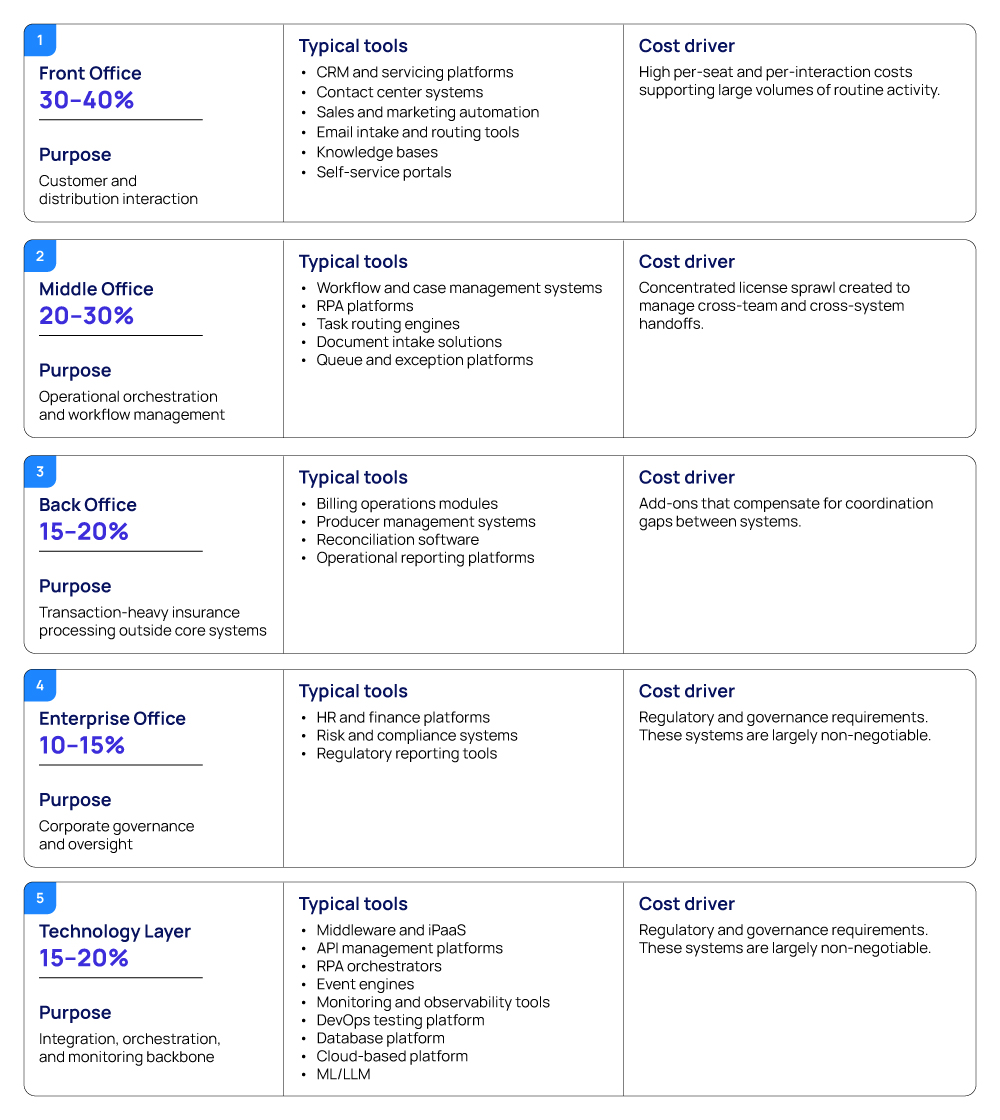
License Impact by Layer: Eliminate vs Optimize vs Retain
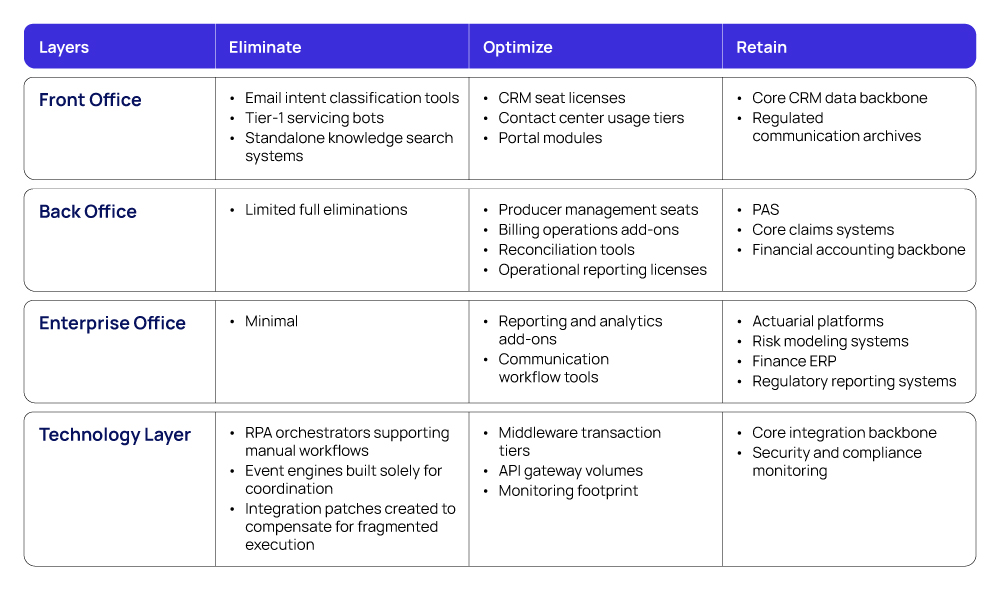
Not all license spend is reducible — and AI does not remove everything equally. Across the five layers, each tool falls into one of three categories: eliminate, optimize, or retain.
Eliminate: Structural removal. The tool becomes unnecessary when AI executes the workflow end-to-end.
Optimize: Usage and seat reduction. The tool remains but at lower volume, cost, or scope.
Retain: Non-negotiable. Core to insurance operations, compliance, or regulated data integrity.
The Pattern
Elimination concentrates in the Middle Office and Technology Layer — where coordination spend is highest and core system dependency is lowest.
Retention concentrates in the Back Office and Enterprise Office — where core platforms underpin regulated insurance operations.
The Front Office is the highest-value optimization target: large seat counts and interaction volumes that AI reduces without full elimination of the underlying platform.
Zero License by Layer
Zero License does not happen everywhere equally. It concentrates in coordination-heavy layers.
- Front Office: Zero intent-routing tools
- Middle Office: Zero swivel-chair RPA farms
- Technology Layer: Zero orchestration engines built solely to compensate for manual workflows
Back Office and Enterprise Layers will retain regulated core systems. Zero License is therefore not a binary state. It is a directional operating model shift, moving coordination from licensed tools to intelligent execution.
The Economics: Directional CBA Breakdown
Assume a representative mid-sized insurer with $20M in annual non-core license spend distributed across operating layers as shown below:
| Layer |
Current Spend |
Elimination % |
Elimination Savings ($M) |
Optimization % |
Optimization Savings ($M) |
Total Savings ($M) |
Post-Reduction Spend ($M) |
| Front Office |
$7.0M |
30% |
$2.10M |
15% |
$0.74M |
$2.84M |
$4.16M |
| Middle Office |
$5.0M |
35% |
$1.75M |
20% |
$0.65M |
$2.40M |
$2.60M |
| Back Office |
$3.5M |
5% |
$0.18M |
15% |
$0.50M |
$0.68M |
$2.82M |
| Enterprise |
$2.5M |
0% |
$0.00M |
10% |
$0.25M |
$0.25M |
$2.25M |
| Technology |
$2.0M |
25% |
$0.50M |
15% |
$0.30M |
$0.80M |
$1.20M |
| |
|
|
|
|
|
|
|
| Total |
$20M |
— |
$4.53M |
— |
$2.44M |
$6.97M |
$13.03M |
Executive Interpretation
- Structural elimination: $4.53M
- License optimization: $2.44M
- Total annual savings: $6.97M
- Year-one reduction: $20.00M → $13.03M
- 24–36-month potential: ~$12M (~40% total reduction)
This reduction is not driven by renegotiation alone. It is achieved by removing the structural dependency on coordination-heavy software across operating layers.
What Changes Operationally
Moving to an independent AI operating layer does more than reduce license costs. It fundamentally reshapes how the enterprise operates.
Reduced Vendor Dependency
Execution no longer relies on expanding modules within proprietary ecosystems. Insurers regain control over how workflows evolve.
Lower Structural Lock-In
As coordination shifts to AI agents, the enterprise becomes less dependent on vendor roadmaps and bundled feature releases.
Greater Agility
New automation capabilities, models, and orchestration logic can be deployed without waiting for platform upgrades.
Increased Architectural Flexibility
AI agents operate across systems, enabling cross-platform workflows without multiplying integration and workflow tools.
Direct Access to Emerging Technology
Insurers can adopt best-in-class models and capabilities as they mature, rather than consuming pre-packaged vendor AI.
Faster Time to Value
Agents can be deployed incrementally into production environments, accelerating go-live timelines without large platform migrations.
How Insurers Begin
Transformation does not start with enterprise-wide replacement.
It starts with:
- One high-volume workflow
- One rules-heavy process
- One coordination-intensive area
Prove elimination. Measure license displacement. Then expand layer by layer.
Where Hexaware Fits
Hexaware enables insurers to transition from license-dependent coordination layers to an independent AI operating layer, reducing structural cost and eliminating vendor lock-in.
Decouple Execution from Licensed Ecosystems
We identify coordination-heavy tools across the Front, Middle, Back, Enterprise Office, and Technology layers and redesign workflows so AI agents execute across systems without expanding proprietary platforms.
This reduces structural dependency on workflow, case management, and orchestration software.
Deliver Measurable License Reduction in 90 Days
Rather than running pilots, we target high-impact license categories and deploy AI agents directly into production.
Within a single quarter, insurers see:
- Decommissioned tools
- Reduced licensed seats
- Lower orchestration overhead
- Validated cost takeout
Speed to value is measured in license reduction, not experimentation metrics.
Eliminate Coordination-Layer Lock-In
As AI becomes the execution layer, insurers are no longer bound to vendor upgrade cycles, bundled feature releases, or inflationary pricing escalations.
Cost growth decouples from vendor roadmaps.
Accelerate Hyperscaler Value Capture
By shifting execution to an AI-native layer, insurers can leverage hyperscaler capabilities directly — without routing innovation through licensed ecosystems.
This enables faster adoption of emerging models and greater architectural flexibility.
The Result
- 0 Vendor lock-in in coordination layers
- Structural license elimination
- Protection from inflationary increases
- 90-day measurable value
Ready to simplify your license estate?
Let’s identify where licenses can be eliminated, optimized, or retained and build a roadmap to reduce non-core license spend by up to 40% without disrupting your core systems.
Start the conversation with Hexaware. Contact us today!