Legacy insurance systems are expensive to maintain, notoriously complex, and not equipped to meet modern demands. Built decades ago, these systems are deeply intertwined with outdated processes, creating substantial barriers to scalability, innovation, and customer satisfaction.
As the competition intensifies and customer expectations rise, today’s insurers face mounting pressure to evolve. Yet, despite the clear limitations of legacy insurance technology, a staggering 74% of insurers continues to rely on outdated legacy systems, hesitating to pursue modernization initiatives due to perceived risks.
A significant portion of IT budgets is consumed by maintaining legacy infrastructure, leaving little room for investment in innovation and growth. While the industry moves toward digital transformation, many insurers remain tethered to aging mainframes that increasingly represent liabilities rather than assets.
Outdated insurance technology continues to hold back digital transformation, preventing organizations from capitalizing on new opportunities.
However, in today’s fast-paced insurance environment, clinging to familiar systems is an obstacle to long-term success. This tension between tradition and transformation highlights the urgent need for modernization. Let’s explore the challenges legacy systems present—and the opportunities that lie in embracing change.
The True Cost of Inaction: Core Legacy Systems in Insurance and Their Challenges
As the industry grapples with the challenges posed by legacy insurance systems, the implications of inaction become increasingly evident. Here are a few areas where the cost implications are the highest:
The Knowledge Gap
Many legacy applications are written in archaic programming languages like COBOL, which are becoming increasingly difficult to maintain as the pool of skilled programmers dwindles. A shrinking pool of mainframe talent is creating a critical knowledge gap for insurers, putting operational continuity at risk and slowing innovation. As experienced professionals retire, organizations face growing challenges in maintaining legacy systems while also driving the upgrades and transformation needed for the future.
The Growing Cost of System Maintenance
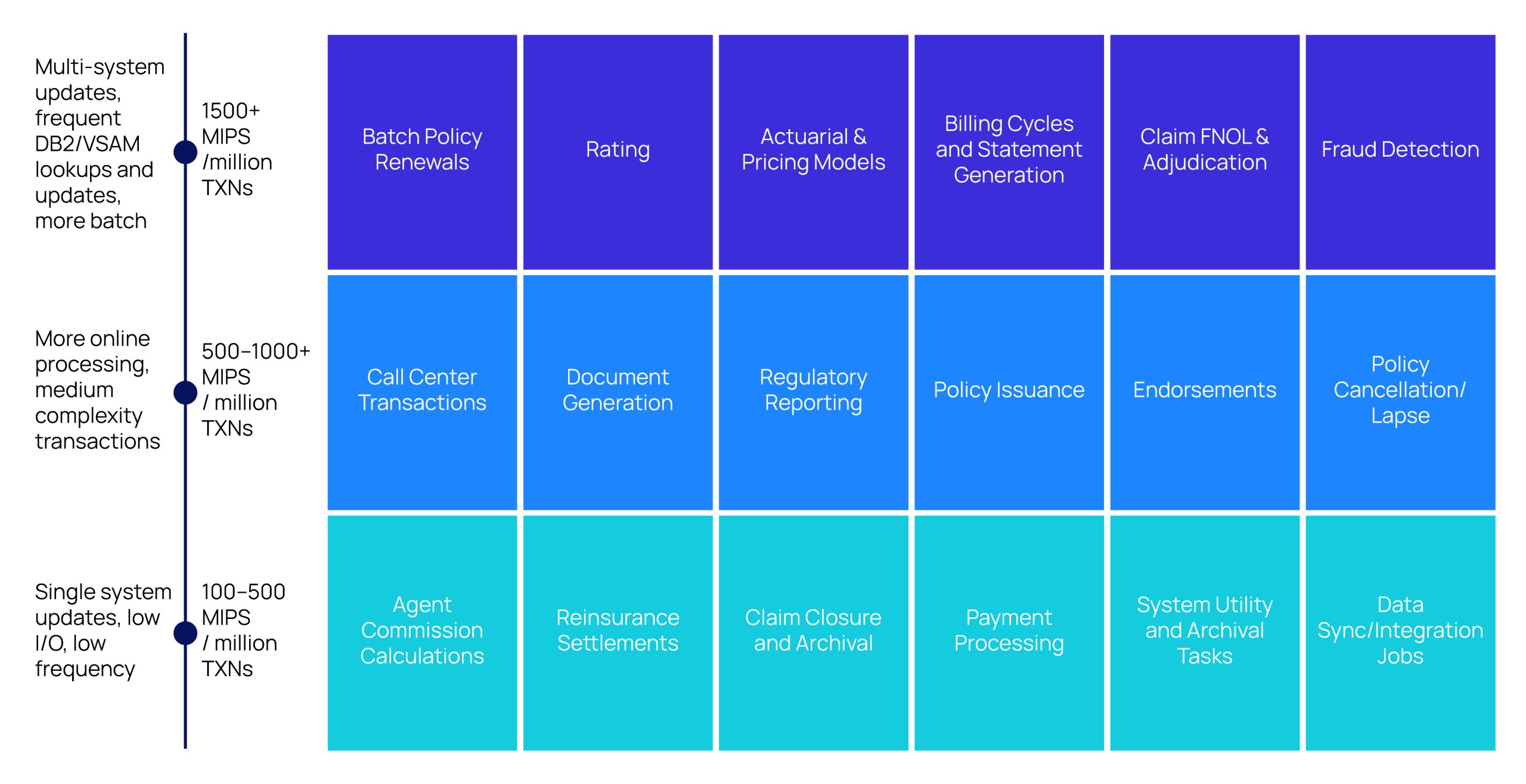
Legacy systems, particularly those built on aging mainframes, consume vast amounts of Million Instructions Per Second (MIPS), which directly correlates to inflated operational costs. As the demand for processing power rises, so do the costs associated with maintaining these systems. Moreover, the licensing fees for software tools that support these legacy systems add another layer of financial strain. Over a decade, these costs can accumulate, encompassing not just MIPS but also labor maintenance and application upkeep. This is how the insurance processes consume MIPS:
The Complexities of Mergers and Acquisitions
The insurance industry has been significantly influenced by numerous mergers and acquisitions (M&A), resulting in a complex network of systems and platforms. This fragmentation complicates integration efforts and creates technical debt, trapping insurers in a cycle of stagnation that makes modernization both urgent and challenging.
International brokers face particular difficulties during post-acquisition integration, often uncovering a tangled web of disparate systems and inconsistent data structures. Consequently, multiple instances of policy, underwriting, and claims platforms operate in silos, leading to operational inefficiencies and hindering a unified customer experience.
The Surge in the Technical Debt
1. System Rigidity and Limited Agility
Legacy systems are typically characterized by tightly coupled architectures that resist change and innovation. This inflexibility makes it challenging to respond to market demands and implement new features quickly, putting insurers at a competitive disadvantage.
2. Data Limitations and Analytics Challenges
The static reporting capabilities of legacy systems severely limit insurers’ ability to derive meaningful insights from their data. This challenge is compounded by data quality issues and limited granularity, making it difficult to implement modern analytics solutions that could drive better decision-making.
3. AI Implementation Roadblocks
The complexity of legacy systems creates significant barriers to implementing AI-based solutions. This prevents insurers from modernizing claims operations and limits their ability to capitalize on the efficiency, speed, and service improvements that AI can enable.
The Case for Change: Business Benefits of Modernizing Insurance Legacy Systems
Modernizing legacy systems in the insurance industry offers transformative benefits, addressing inefficiencies, improving customer satisfaction, and enabling insurers to stay competitive in a rapidly evolving market. Below is a cohesive overview of eight key advantages of legacy system modernization:
1. Increased Operational Efficiency
Legacy insurance systems often require significant manual intervention, slowing processes like policy issuance, claims handling, and customer service. Modern systems streamline operations by automating manual tasks and reducing inefficiencies.
For example, Allianz Direct implemented a cutting-edge platform with AI-driven loss assessment, enabling customers to complete claims in just 60 seconds by uploading photos and documents. This innovation reduced operational costs by 50% and boosted customer satisfaction by 90%. Automation and digital workflows also free employees to focus on strategic tasks, improving productivity and reducing error rates.
2. Improved Data Accessibility and Decision-Making
Legacy systems often operate in silos, limiting access to real-time, comprehensive data. Legacy modernization integrates systems, enabling seamless data flow across departments. This allows insurers to:
- Use advanced analytics to refine pricing and underwriting strategies.
- Enhance customer segmentation and risk assessment.
- Leverage real-time insights for better decision-making.
By breaking down data silos, insurers can unlock actionable insights, improving both operational efficiency and customer outcomes.
3. Enhanced Customer Experience
Modern systems empower insurers to meet rising customer expectations for fast, personalized, and seamless digital experiences. Features like self-service portals, faster claims processing, and AI-driven personalization improve customer satisfaction and loyalty.
For instance, Zurich Insurance uses AI-driven predictive analytics to enhance fraud detection, saving billions annually while improving customer trust and operational efficiency. As of 2024, insurers adopting modern systems report a 25% boost in customer satisfaction and a 40% reduction in operational costs.
4. Cost Reduction and Scalability
While modernization requires upfront investment, it delivers significant long-term cost savings. Modern systems are easier to maintain, require less manual intervention, and scale efficiently as businesses grow.
For example:
- IoT insurance technology helps insurers detect and prevent fraudulent claims, saving billions annually.
- Sensors and real-time data enable proactive risk management, reducing major claims and enhancing safety.
- Modernizing legacy systems optimizes MIPS, drastically lowering operational costs.
- Transitioning to contemporary platforms reduces licensing fees, alleviating financial strain from outdated software tools.
Modern platforms also allow insurers to expand into new markets or launch new product lines without the extensive costs associated with legacy infrastructure upgrades.
5. Stronger Security and Regulatory Compliance
Insurers are increasingly aware of the critical importance of cybersecurity, especially as many have faced significant security breaches themselves. For example, several major insurance companies have reported cyber incidents that compromised sensitive customer data, highlighting the urgent need for robust security measures. This growing awareness is reflected in the rapid expansion of the cyber insurance market, which has nearly tripled in size over the past five years, as insurers seek to protect themselves and their clients from the rising threat of cyberattacks.
Archaic systems are more vulnerable to cyberattacks and often struggle to meet evolving regulatory requirements. Modernized systems offer:
- Improved compliance with industry regulations, reducing the risk of penalties and reputational damage.
- Advanced security features, such as real-time threat monitoring and encryption.
6. Higher Gross Written Premiums and Ecosystem Expansion
Modernized systems empower insurers to accelerate innovation and significantly reduce the time-to-market for new products, ultimately driving higher gross written premiums. For example, consider the difference in timelines for product rollouts in life insurance. If rollouts through traditional methods using legacy technology take 3 to 9 months, a modern composable architecture can streamline this process, reducing the rollout time to 8 to 12 weeks. This shift not only enhances operational efficiency but also allows companies to adapt more quickly to changing market demands and customer preferences. Additionally, APIs facilitate the integration of business partners, customers, and insurtechs, allowing insurers to expand their ecosystems. This integration opens up new distribution channels and markets, enhancing overall competitiveness in the industry.
7. Improved Productivity and Lower TCO Costs
Modern systems significantly reduce the total cost of ownership (TCO) for insurers by optimizing workflows and enhancing productivity. Insurers leveraging modern technologies can achieve significantly higher productivity than those still reliant on legacy systems. This increase in efficiency translates directly into lower operational costs. Additionally, service-oriented architectures simplify system integration and maintenance, further driving down IT expenses. Insurers with modernized IT stacks can lower costs per policy, enabling them to allocate resources more effectively and invest in innovation rather than maintenance. By transitioning to modern systems, they not only streamline operations but also unlock meaningful savings that support a healthier bottom line.
8. Enhanced Risk Management
Modern systems leverage predictive analytics and advanced scoring models to improve risk selection and pricing accuracy. This reduces underwriting risks and enhances claims adjudication processes. Legacy systems, by contrast, lack these capabilities, limiting insurers’ ability to adapt to emerging risks.
Legacy Modernization Made Easy: Hexaware’s Methodology Powered by RapidX®
A unified and phased approach to becoming truly digital
What is RapidX®?
RapidX® is Hexaware’s proprietary Agentic AI platform that combines AI-driven automation with human expertise. RapidX® delivers faster, more efficient, and more reliable modernization outcomes. Whether it’s breaking down monolithic systems, migrating data, or designing future-ready architectures, RapidX® ensures that insurers can overcome the challenges of legacy systems and thrive in the digital age.
With RapidX®, Hexaware empowers insurers to reduce technical debt, enhance operational efficiency, and deliver superior customer experiences. The result? A modernized insurance ecosystem that is agile, scalable, and ready for the future.
Hexaware realizes that requirements for modernizing an insurance ecosystem need a custom insurance-specific methodology and insurance-specific knowledge. Therefore, our modernization methodology powered by RapidX® is designed around business-centric design, composable, scalable architecture, and data-driven decisions. It’s a multi-step process that leverages advanced AI capabilities and insurance-specific expertise to transform legacy systems into agile, future-ready platforms. Here are the eight key steps:
1. Strategic Pattern Selection
Modernizing legacy systems begins with selecting or creating custom patterns to break down monolithic architectures. Depending on the existing legacy platform, Hexaware recommends unique or combined patterns such as:
- Strangler Fig: Gradually replacing legacy components with modern ones.
- Domain Ring: Isolating business domains for targeted modernization.
- Façade: Creating a modern interface over legacy systems.
- Hollow the Core First: Migrating core functionalities first.
- Data First: Prioritizing data migration and integration.
- Parallel Run: Running legacy and modern systems simultaneously during the transition.
- And more
The benefit: This tailored approach ensures that modernization efforts are aligned with the insurer’s specific business needs and technical landscape.
2. Breaking Down Monoliths into Composable Architectures
Hexaware’s methodology focuses on transforming monolithic legacy systems into a five-layer composable architecture. This modular approach enhances scalability, flexibility, and integration with modern technologies. The five layers include:
- Systems of Engagement: Customer-facing interfaces and applications.
- Systems of Integration: Middleware and APIs for seamless connectivity.
- Systems of Records: Core transactional systems.
- Systems of Storage and Insights: Data warehouses and analytics platforms.
- Systems of Intelligence: AI and machine learning layers for advanced decision-making.
The benefit: This layered architecture enables insurers to modernize incrementally while maintaining operational continuity.
3. Insurance Clustering
To streamline modernization, Hexaware clusters the legacy codebase into logical groups based on geography, line of business (LOB), or business value chains.
Hexaware’s AI-powered insurance agents scan the codebase to identify these clusters, analyze usage patterns, and detect overlapping codes. A human-in-the-loop process ensures that the clusters are validated and refined, reducing exploration time for non-core modules and accelerating the modernization process.
The benefit: The business value chain clustering approach is particularly effective, as it focuses on core insurance processes such as underwriting, claims, servicing, and agency management.
4. AI Squads for Modernization
Hexaware deploys AI squads to tackle modernization at the cluster level. These specialized teams consist of:
- Process-specific AI Agents for Insurance: For example, the Underwriter Agent is trained to extract underwriting business logic and rules.
- Reverse Engineering Experts: AI agents for insurance speed up reverse engineering by extracting business rules, calculations, and workflows.
- Intelligent Virtual Assistants: These assistants provide real-time answers to questions, enabling faster decision-making.
The benefit: This squad-based approach ensures that each cluster is modernized efficiently, with minimal disruption to ongoing operations.
5. Feature Capture and Development
Hexaware’s AI agents for insurance play a pivotal role in capturing and developing features from legacy systems:
- AI agents extract business logic and translate it into English-like pseudo-code.
- Human experts validate and refine the logic to define the target state.
- Refined logic is converted into features and requirements, which are documented with visualizations for process flows.
The benefit: This process ensures that the modernized system retains the functionality of the legacy system while aligning with modern business needs.
6. AI-Assisted Design and Code Generation
Hexaware’s AI agents for insurance assist in designing and generating code for the modernized system:
- AI agents create modern technical architectures based on the defined requirements.
- Features and requirements are converted into code in modern languages like Java or Python.
- Code conversion is fully automated but flexible enough to accommodate third-party tools.
The benefit: This automation accelerates development while maintaining high-quality standards.
7. AI-Assisted Insurance Data Migration
Data migration is a critical component of legacy modernization. Hexaware’s proprietary insurance data migration tools assist in:
- Transforming data from legacy systems into modern formats.
- Migrating policy, agent, claims, and business rules data as per the cutover plan.
- Ensuring data integrity and compliance throughout the migration process.
The benefit: This improves efficiency, accuracy, and security, automating key processes like data profiling and validation, and ensuring compliance throughout the migration process.
8. AI-Enabled Testing
Hexaware’s AI-enabled testing framework ensures that the modernized system is robust and reliable:
- Functional, integration, parallel, and performance testing are automated.
- Regression suites are developed to ensure new changes do not disrupt existing functionality.
- User Acceptance Testing (UAT) is supported to validate the system against business requirements.
The benefit: This automates various testing processes, ensuring robust software reliability while minimizing manual effort and maintaining alignment with business requirements.
Conclusion
As we have explored how financial and operational burdens of outdated insurance technology can stifle innovation and hinder growth, the urgency for modernization has never been more apparent, especially with heavily dependent on these systems,
The future is innovative solutions like RapidX®, which leverages artificial intelligence to streamline the modernization process, empowering organizations to transition from maintenance mode to a future-ready state.
At Hexaware, we specialize in helping insurance companies modernize their systems seamlessly. Our experience and tailored solutions can guide your business through a successful transformation.
Are you ready to break free from the constraints of legacy systems and embrace the future of insurance? With Hexaware’s legacy modernization methodology powered by RapidX®, you can accelerate your insurance modernization journey, reduce costs, and enhance customer experiences. Explore how RapidX® for legacy insurance modernization can transform your outdated systems into agile, scalable solutions tailored for the digital age. Book a meeting now.