The Promise of the GCC Model
A global capability center does not become strategic simply because it is called a GCC. For many enterprises, the GCC model starts with a compelling boardroom promise. It offers access to specialized global talent, greater control over critical capabilities, stronger IP protection, improved cost structures, and a foundation for innovation at scale. Unlike a vendor-led model, a GCC is meant to become an extension of the parent organization. The business case for a GCC operating model is often sound, leadership support is visible, and the launch plan looks carefully designed. While the ‘GCC’ label may signal ambition, its operating reality is shaped by what happens after launch. This is where GCC drift often begins, and day-to-day execution starts reshaping the model.
Where the Drift Begins: The ODC-in-disguise Problem
Understanding the global capability center vs offshore delivery center distinction is essential because many organizations unintentionally blur the line between the two models. A true GCC is built for enterprise value. It is designed to own capabilities, integrate with the parent organization, participate in strategic priorities, and develop talent that thinks and works like part of the company. An offshore delivery center (ODC), by contrast, is usually optimized for the execution of defined tasks, delivery efficiency, cost leverage, and contractor-style output.
The issue is not that one model is inherently better than the other. The issue begins when companies expect GCC outcomes but build an operating model that behaves like an ODC. The center may still deliver work, but it does not build the strategic capability the enterprise originally envisioned.
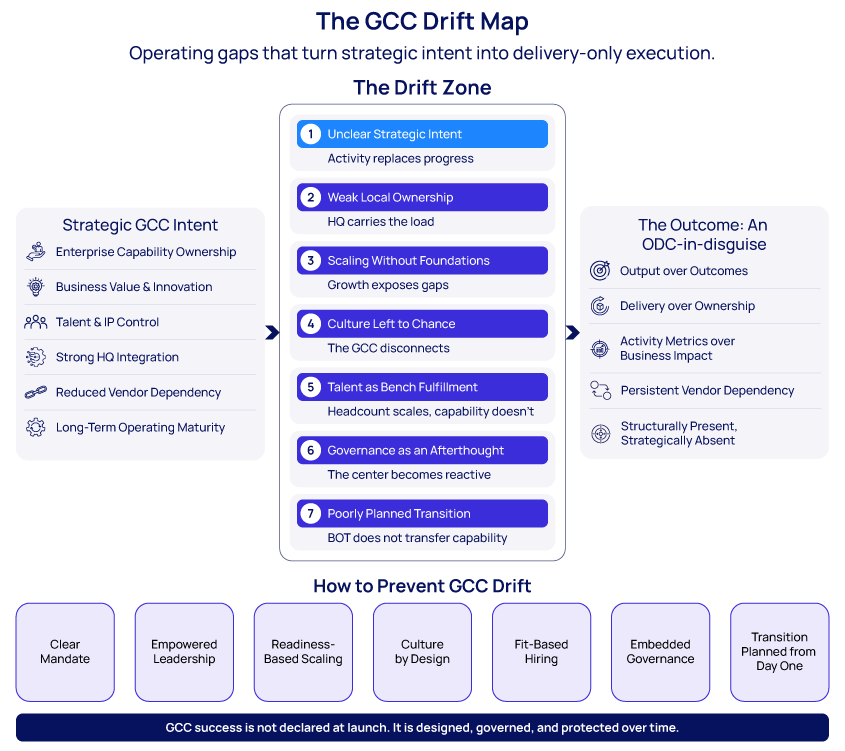
The drift is rarely dramatic at first. It usually begins with operating choices that appear reasonable in isolation: moving quickly, filling roles, centralizing decisions, etc. But together, these choices slowly reshape the center’s identity. What was meant to become an integrated enterprise capability starts behaving like a delivery mechanism. In this blog, we identify the patterns that organizations should look for to ensure their intended GCC does not end up as a mere ODC.
GCC Drift Pattern 1: Unclear Strategic Intent
When the GCC Is Busy but Directionless
A GCC can be busy and still be directionless. Hiring, onboarding, delivery milestones, and stakeholder updates can create a sense of progress even when the real definition of success is unclear. Is the center being built to reduce cost, own critical capabilities, accelerate innovation, improve product delivery, support business growth, or reduce vendor dependency? If that intent is not explicit, different leaders begin operating with different assumptions.
This is where early drift becomes difficult to detect. The GCC may look active, but activity is not the same as strategic progress. A center created mainly as a lower-cost staffing move, for example, will struggle to behave like a capability-building organization unless its mandate is deliberately redefined.
The Way Out:
Define the GCC’s North Star before a global in-house center setup begins. The mandate should specify which capabilities the GCC will own, which outcomes it is expected to influence, how success will be measured, and how the center’s role will evolve as it matures.
GCC Drift Pattern 2: Weak Local Ownership
When HQ Still Carries the Load
A GCC cannot become a strategic extension of the enterprise if every meaningful decision continues to sit with headquarters. When local leaders are not empowered, the center remains dependent on HQ for direction, approval, escalation, and problem-solving. Over time, this creates bottlenecks and weakens accountability on both sides.
The burden of the offshore capability center also shifts back to headquarters leaders, who are expected to drive GCC outcomes while carrying their existing responsibilities. The model may appear aligned on paper, but execution becomes strained because ownership has not moved close enough to the work.
The Way Out:
Design decision rights into the GCC operating model. Companies need clarity on what the GCC can decide locally, what must be escalated, what is jointly owned, and how HQ and GCC leaders work as one leadership system rather than as requestors and executors.
GCC Drift Pattern 3: Scaling Without Foundations
When Headcount Runs Ahead of Maturity
Many GCC scaling challenges emerge when growth is treated as a headcount target rather than an operating maturity journey. Without leadership bandwidth, role clarity, onboarding depth, cultural infrastructure, governance rhythms, and support systems, rapid hiring can create fragility instead of momentum.
The symptoms are familiar: a company expects to reach 100 people but remains stuck at 20, or hiring begins only for attrition to appear almost immediately. The problem is not speed itself. The problem is scaling faster than the organization’s ability to lead, integrate, and retain the people it hires.
The Way Out:
Sequence scale with readiness. Hiring waves should be tied to capability milestones, leadership maturity, cultural onboarding, governance cadence, and business absorption capacity. A GCC should scale like an operating system, not like a staffing exercise.
Also read: 5 Things to Look for in a GCC Enablement Partner (Before You Commit)
GCC Drift Pattern 4: Culture Left to Chance
When the GCC Builds Its Own Version of the Company
Culture is often treated as something that can be addressed after the center is operational. In reality, if culture is not intentionally built, it builds itself. Employees create their own ways of working, their own expectations, and their own sense of what the GCC is meant to be. Over time, this can lead to fragmented teams, inconsistent communication, unclear accountability, and a growing disconnect from the parent organization.
For a GCC, culture is not about slogans or engagement activities alone. It is how decisions are made, how teams collaborate, how leaders communicate, how accountability is reinforced, and how employees understand their connection to the enterprise’s broader mission.
The Way Out:
Treat culture as part of the GCC operating model from day one. The parent organization’s values, mission, working norms, and business context should show up in hiring, onboarding, leadership rituals, internal communication, employee experience, and day-to-day management. The goal is for GCC employees to feel they are part of the enterprise, not a remote delivery arm serving it from a distance.
GCC Drift Pattern 5: Talent Treated Like Bench Fulfillment
When Skills Fit but the Organization Doesn’t
Traditional outsourcing models often rely on bench strength and rapid role fulfillment. A GCC requires a different mindset. It is not inheriting a delivery team; it is building the DNA of a long-term organization. Early hires do more than deliver work. They influence culture, credibility, retention, leadership depth, and the center’s ability to think like the parent company.
If hiring focuses only on technical skills, the center may get capable people but still miss the larger fit. A data-focused GCC, for instance, cannot be built only by matching candidates to specific tools. The organization also needs people who understand the business context, collaborate across geographies, grow with the mandate, and align with the parent company’s way of working.
The Way Out:
Hire for fit, not just function. Technical capability matters, but so do domain relevance, cultural alignment, communication ability, growth potential, location or language fit where relevant, and the ability to operate as an employee of the enterprise rather than as a temporary capacity resource.
GCC Drift Pattern 6: Governance as an Afterthought
When the GCC Becomes Reactive
Governance is sometimes mistaken for review meetings, dashboards, or occasional oversight. In a high-performing GCC, it is much more than that. A GCC governance framework is the management system that keeps the center aligned to strategy, performance, risk, communication, change, and outcomes.
When governance is missing, the GCC becomes reactive. Leaders focus on filling seats, solving immediate delivery issues, and responding to escalations, but there is no consistent mechanism for asking where the center is going, how progress is measured, what risks are emerging, and how change is being managed. Quality, consistency, and accountability begin to erode quietly.
The Way Out:
Build a GCC governance framework into the operating playbook from the beginning. This includes leadership cadences, escalation paths, performance measures, capability tracking, communication routines, delivery quality checks, risk reviews, and change management. When done well, governance is not bureaucracy; it is the discipline that keeps the GCC aligned with its purpose.
GCC Drift Pattern 7: Poorly Planned Transition
When Build-Operate-Transfer (BOT) Does Not Actually Transfer Capability
For companies using build-operate-transfer or assisted-build models, transition is often the point where the original GCC intent is either realized or compromised. Many organizations choose the GCC route to reduce vendor dependency, regain control over talent and IP, and bring delivery closer to the business. But those outcomes depend on whether capability actually transfers.
If transition is delayed, blocked, rushed, or poorly managed, the GCC may exist structurally but not strategically. The company remains dependent on partners, the team may not move successfully, and ownership over people, knowledge, and outcomes remains incomplete. A failed transfer can leave the enterprise far from the level of control it sought when it chose the GCC model in the first place.
The Way Out:
Plan transition from day one. Companies should define milestones, stability criteria, capability assessments, leadership readiness, knowledge continuity, employee transfer strategy, retention safeguards, and ownership handover. Transition should not be an administrative event at the end; it should be built into the GCC roadmap from the start.
GCC Success Is Designed, Not Declared
Each of these drift patterns may appear manageable in isolation. A slightly unclear mandate, a delayed leadership decision, a rushed hiring wave, or a transition plan left for later may not seem serious enough to derail the model. But together, they slowly change the nature of the GCC.
A successful GCC operating model requires an execution architecture that is as intentional as the strategy. Strategic clarity, local ownership, operating maturity, culture, talent fit, governance, and transition readiness are not separate workstreams; they are the conditions that determine whether the center becomes a true enterprise capability or an ODC in disguise.
For organizations setting up or scaling a GCC, the question is not only whether the model has been launched. It is whether the center has been designed to deliver the value it promised. That is why preventing drift is not about fixing issues after they surface. It is about designing the GCC so that clarity, ownership, culture, governance, talent, and transition readiness are built into how it operates every day.
How Hexaware Can Help
Hexaware provides end-to-end GCC services to help enterprises design, build, operate, and scale global capability centers that deliver strategic business outcomes—not just delivery capacity. From operating model design and talent strategy to governance, culture, and transition planning, we help organizations build GCCs that remain aligned to their original purpose as they grow.
Before you invest in the next phase of your GCC’s growth, validate that your operating model is building enterprise capability—not just expanding delivery capacity. Contact marketing@hexaware.com to assess GCC drift risks and build a roadmap for long-term enterprise value.
Learn more about why GCCs struggle and how to avoid failure in our GCC podcast with Patricia Connolly (SVP, Global Head of GCC Services at Hexaware, and Founder of SMC Squared), and Aditya Jayaraman (Country Head, India, Hexaware Technologies).