Introduction
The rise of artificial intelligence (AI) and generative AI (GenAI) is no longer a futuristic fantasy; it’s a present-day reality transforming business operations across industries. Global capability centers (GCCs) are experiencing a profound shift as they embrace AI-powered solutions. GCCs are strategic hubs established by multinational corporations to centralize and streamline key business functions, such as IT, finance, customer service, and research and development. They offer a compelling blend of cost optimization, access to specialized talent, and operational agility. The adoption of AI in global capability centers is amplifying these advantages, unlocking unprecedented levels of productivity and innovation. This blog post explores the remarkable productivity gains that can be achieved with AI in GCCs while spotlighting the crucial human challenges that must be addressed for its success. It’s about finding the right balance of AI in business operations—to augment human capabilities and improve outcomes.
Use Cases of AI in Global Capability Centers
AI and GenAI investments are fundamentally reshaping GCC operations, moving beyond simple cost optimization to drive significant productivity enhancements.
Automation of Routine Processes: AI-driven process automation can handle repetitive tasks such as data entry, invoice processing, and routine report generation, reducing manual labor and errors. This frees up employees to focus on more strategic and creative work.
Predictive Analytics and Insights: GenAI and machine learning algorithms can be used to simulate scenarios, predict process delays, optimize resource allocation, and forecast operational needs for improved planning. This enables GCCs to proactively address potential issues and make data-driven decisions.
Intelligent Decision Support: Deploying AI-powered dashboards and analytics tools to support decision-makers in real-time, offering insights on process performance, risk, and market trends. This empowers leaders to make informed decisions quickly and confidently.
Customer Interaction Enhancements: Using natural language processing (NLP) technology to develop chatbots and virtual assistants, thereby enhancing customer support and streamlining query resolution. This improves customer satisfaction and reduces the workload on human agents.
Also read: Generative AI in Customer Service: Going Beyond Traditional Chatbots
Talent Management and Reskilling: Implementing AI-based recruitment, performance evaluation, and personalized training programs to identify skill gaps and support continuous learning. This helps GCCs build a future-ready workforce with the skills needed to thrive in the age of AI.
Quality Assurance and Compliance: Utilizing AI in global capability centers to monitor work quality, detect anomalies, and ensure adherence to compliance standards across operational processes. This reduces the risk of errors and ensures that GCCs meet regulatory requirements.
GenAI and AI in GCCs, hence, are not just buzzwords but practical solutions that can drive tangible value, such as:
- Increased Efficiency: AI algorithms can perform tasks faster and more accurately than humans, reducing errors and cycle times.
- Faster Throughput: Automated processes can handle a higher volume of work, leading to improved overall productivity.
- Reduced Costs: By streamlining GCC operations and reducing manual labor, AI can contribute to significant cost savings.
Agentic AI: The Next Frontier for GCCs
As AI continues to evolve, agentic AI is emerging as a transformative force in global capability centers. Unlike traditional AI, which responds to user prompts and delivers static outputs, agentic AI systems can act autonomously—planning, reasoning, and executing multi-step tasks without constant human intervention. This shift enables GCCs to move beyond automation and into intelligent autonomy, where agentic AI can monitor customer churn, initiate retention workflows, and experiment with outreach strategies, all while learning and adapting over time. In operations, agentic AI can orchestrate complex workflows across disparate platforms, adapt to evolving business needs, and optimize processes in real time.
According to McKinsey’s The State of AI in 2025 report, almost a quarter of its survey respondents (23%) said their organizations had started scaling at least one agentic AI system somewhere in their enterprises.
However, as GCCs embrace agentic AI, the people challenges in AI adoption become even more pronounced. The introduction of autonomous, decision-making AI agents requires a new level of trust, collaboration, and change management within organizations.
AI in GCCs: Human Challenges in Adoption
While the potential of AI in GCCs is undeniable, it’s crucial to acknowledge the often-overlooked human element in AI implementations. It’s not enough to simply deploy cutting-edge technology; organizations must also address the human challenges that can hinder successful adoption.
According to ISG Market Lens’ 2025 Global Capability Center Study, generative AI challenges are more commonly focused around human rather than technology barriers.
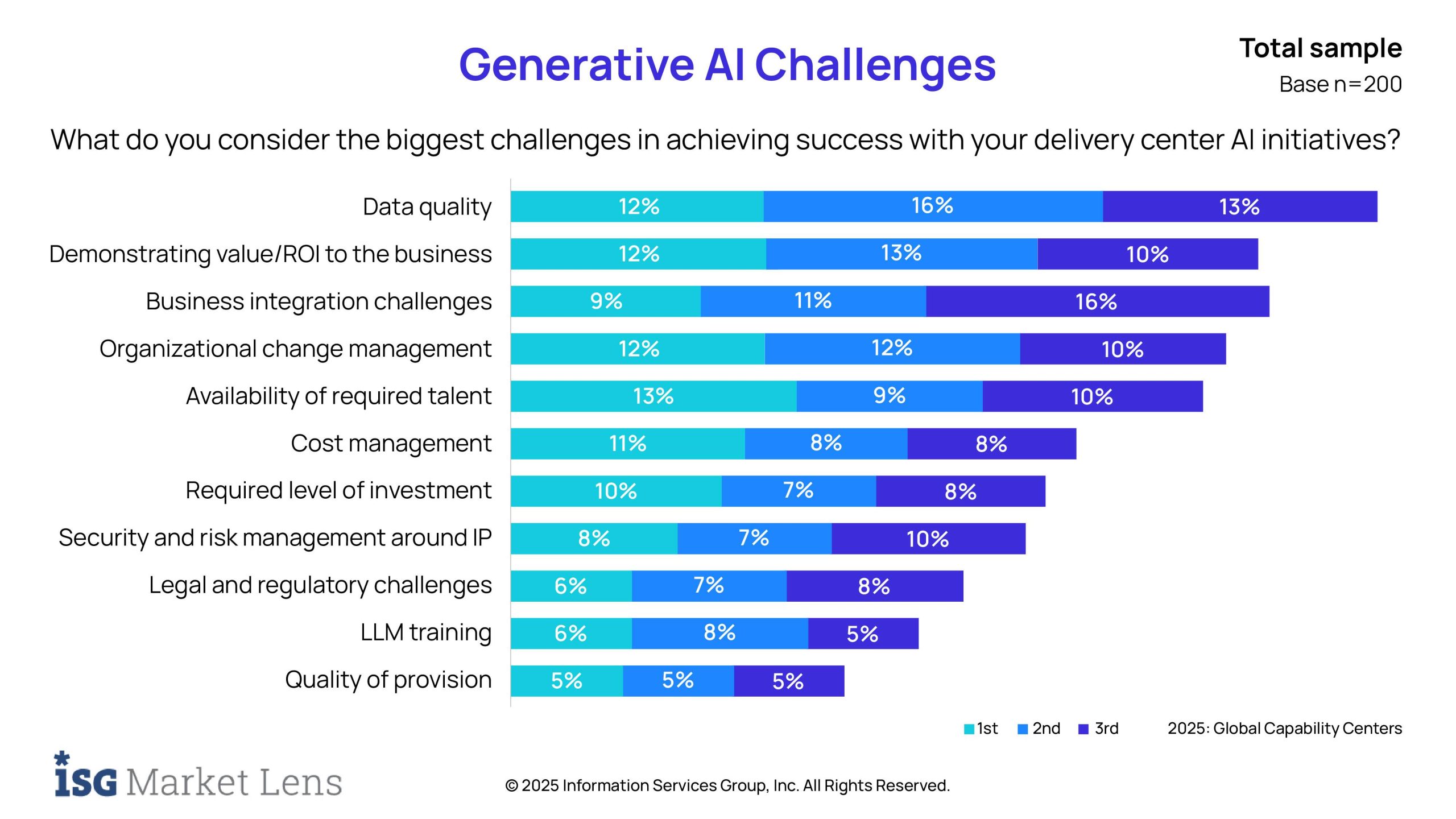
The maximum number of respondents (13%) considered the availability of required talent as the biggest challenge in achieving success with AI adoption in global capability centers. Other human barriers included organizational change management and business integration, which were cited by 12% and 9% of the respondents, respectively, as the biggest challenges in the success of AI initiatives.
Talent Availability: Integrating and maintaining AI or GenAI-based GCC solutions requires a workforce with the necessary competencies. In GCCs, this AI talent gap can manifest as:
- Difficulty recruiting qualified data scientists, AI engineers, and machine learning specialists.
- Existing employees lacking the necessary skills to effectively utilize and maintain AI-powered tools.
Change Management: Implementing a robust AI change management strategy is crucial for helping employees adapt to new roles, processes, and technologies. Resistance to change can become visible in GCCs as:
- A lack of understanding of AI’s benefits leading to skepticism and resistance to adopting new workflows.
- Difficulty in getting employees to embrace new roles and responsibilities that require collaboration with AI systems.
Business Integration: Difficulty in aligning AI projects with existing business processes can translate into:
- AI projects being developed in isolation, without a clear understanding of how they fit into the overall GCC strategy.
- Lack of seamless integration of AI systems into existing workflows and lack of communication and collaboration between IT, business operations, and other departments, leading to inefficiencies and frustration.
Failing to manage these human challenges can significantly limit AI-driven productivity gains, despite technological investments.
Strategies for Building AI-readiness in GCCs
The key to unlocking the full potential of AI in GCCs lies in ensuring that humans remain actively involved in the decision-making process, even as AI automates certain tasks. Addressing the challenges outlined above requires a multi-faceted approach. Here are some AI integration strategies for building AI-readiness in your GCC:
Strategic Alignment: Align AI initiatives with the overall GCC strategy to overcome AI integration challenges and maximize impact. This requires a clear understanding of the business objectives and how AI can help achieve them.
Upskilling and Reskilling: Provide continuous staff development and reskilling opportunities in AI technologies. This will help employees develop the skills to work effectively with AI-powered tools and systems.
Collaborative Decision-making: Foster cross-functional teams (e.g., IT, HR, business operations) to steer AI projects. This will ensure that all perspectives are considered and that AI solutions are aligned with the needs of the business.
Change Management Programs: Implement frameworks for managing organizational change to help employees adapt to new technologies. This should include clear communication, training, and support to address any concerns or anxieties.
Measuring Success: Productivity and Beyond
Measuring the success of AI in global capability centers is crucial for demonstrating their value and identifying areas for improvement. Here are some key performance indicators (KPIs) to consider:
Productivity Gains: Track metrics such as process cycle times, error rates, and output volume to measure the impact of AI on productivity.
Quality Improvements: Monitor quality metrics such as customer satisfaction, defect rates, and compliance scores to assess the impact of AI on quality.
Employee Adaptation: Measure employee satisfaction, training completion rates, and adoption of AI-powered tools to gauge employee adaptation to new technologies.
It’s also important to embrace a continuous improvement mindset, using iterative learning and feedback loops to refine AI applications and optimize their performance.
How Hexaware Can Help
At Hexaware, we believe that AI and generative AI are not just technologies, but powerful catalysts for transforming GCCs. With an AI-first approach, we help organizations unlock the full potential of these technologies to drive growth. We offer a comprehensive suite of AI solutions, including automation, analytics, and machine learning, tailored to the specific needs of GCCs.
GenAI Integration
Achieve effective GenAI integration by identifying the key contributing factors. Benefit from expertly crafted generative AI journeys, clearly defined needs, and identified potential frictions and hypotheses. Let us assess your business and IT areas for scope to select the best GenAI model. Leverage our expertise to conceptualize solutions, discover and define impactful use cases, and ensure GenAI solution alignment and prioritization for maximum strategic impact.
Workforce and Talent Solutions
Secure high-performing teams through our comprehensive workforce solutions, from employer of record (EOR) services to staff augmentation. Access top talent through data-driven sourcing, AI-powered hiring, and strategic partnerships with recruitment agencies and academia. Equip your workforce with role-based, technical, and domain-centric training using GenAI accelerators and solutions, ensuring alignment with business processes. Retain and upskill talent through continuous learning programs and career development opportunities.
Seamless Transitions
Experience smooth and agile transitions with minimal disruptions to your GCC operations. Our structured approach prioritizes risk management and operational continuity, guiding you through every step to maintain momentum and clarity as you shift to your new operating model, ensuring a seamless evolution.
Conclusion
AI and GenAI are revolutionizing GCCs, offering unprecedented opportunities to boost productivity, improve quality, and enhance customer satisfaction. However, the human side of AI is equally important. By addressing the challenges of change management, talent availability, and business integration, GCCs can ensure that AI initiatives are successful and sustainable. The key is to strike the right balance—leveraging the power of AI to augment human capabilities, investing in training, fostering collaboration, and embracing a continuous improvement mindset.
Ready to unlock the power of AI in your global capability centers? Contact us today at maketingmarketing@hexaware.com for a consultation and learn how we can help you develop a strategic roadmap, implement AI solutions, and build a future-ready workforce to achieve your business objectives.