For decades, global capability centers (GCCs) have been defined by their ability to help enterprises access talent at scale. The conversation typically revolved around familiar questions: How quickly can we hire? How do we attract specialized skills? How do we retain top performers? How do we optimize costs while growing capability? But as enterprises begin adopting AI agents, autonomous workflows, and intelligent systems, a more fundamental question is emerging: What happens when work is no longer performed exclusively by people—when it becomes a combination of people and AI agents in the workforce?
This is not simply a technology question. It is an organizational one. This shift marks the transition from talent acquisition to talent architecture for GCCs.
Why Talent Acquisition Is No Longer Enough
Traditional workforce strategies are built around a relatively straightforward premise: business outcomes are produced by people:
People analyze data.
People make decisions.
People execute processes.
People coordinate activities.
People produce outcomes.
Consequently, workforce planning is largely an exercise in matching talent supply to business demand.
Today, however, GCCs are increasingly experimenting with AI agents that can analyze information, execute routine workflows, coordinate activities across systems, and support decision-making. They are also beginning to ask a new question: what kind of GCC talent strategy will be required to operate in that future environment? When the participants in work change, the GCC workforce strategy must change as well.
The Shift from Talent Acquisition to Talent Architecture
The emergence of agentic operating models is forcing organizations to rethink GCC workforce strategy from the ground up.
Talent acquisition focuses on filling positions.
Talent architecture focuses on designing a workforce.
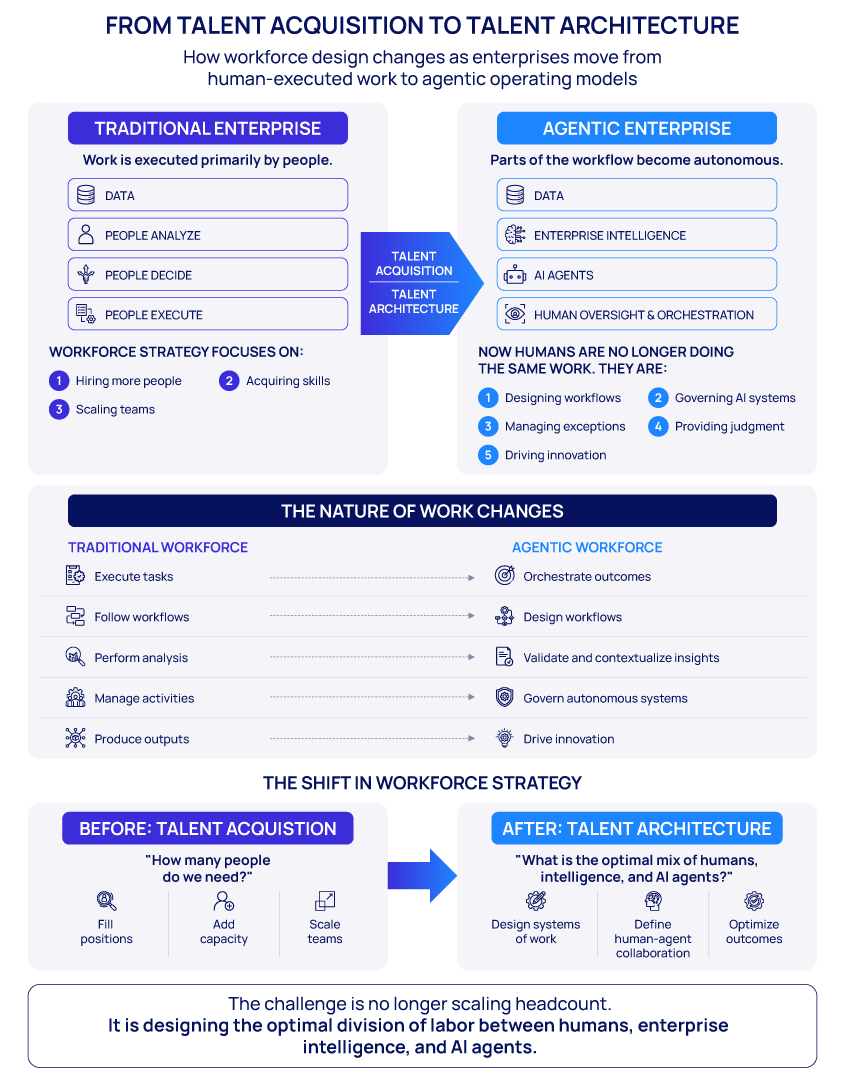
Once organizations accept that, in the modern agentic enterprise, work will be distributed across humans, enterprise intelligence, and AI agents, workforce design becomes fundamentally different.
In traditional workforce planning, leaders focus on questions such as:
- How many people do we need?
- What skills do they require?
- How quickly can we hire them?
In an agentic enterprise, the more important questions revolve around workforce planning for AI adoption:
- How should work be divided between humans and agents?
- What activities require judgment versus execution?
- How should accountability be structured?
- What capabilities will create long-term value?
- How should leaders manage systems of work rather than teams of workers?
Answering these questions requires a different approach to workforce design. The following five shifts can help organizations build a workforce that is ready for an agentic future.
Workforce Design Principle #1: Design Around Outcomes, Not Roles
Most organizations still structure work around roles.
A role is created, responsibilities are assigned, and a person is hired to perform them.
Agentic enterprises require a different mindset.
Instead of beginning with roles, organizations must begin with outcomes.
Consider a customer onboarding process.
In a traditional model, multiple individuals may collect information, validate documents, update systems, generate reports, and communicate status updates.
In an agentic model, some of those activities may be handled by AI agents, some by intelligent systems, and some by people. The objective is no longer to assign tasks to individuals. It is to determine the most effective way to achieve the desired outcome.
The question shifts from:
Who should do this work?
to
What is the optimal way to get this work done?
This may seem like a small distinction, but it fundamentally changes workforce design.
Organizations that continue to design work around fixed roles may struggle to fully realize the value of agentic AI in GCCs. Organizations that design around outcomes will have greater flexibility in determining how work should be distributed across people and intelligent systems.
Workforce Design Principle #2: Separate Judgment Work from Execution Work
One of the most important principles of talent architecture is recognizing that not all work creates value in the same way.
Historically, employees often performed both judgment work and execution work.
For example:
- A financial analyst gathers data, analyzes it, creates reports, and makes recommendations.
- A customer service representative retrieves information, updates systems, resolves issues, and communicates with customers.
- A project manager tracks progress, updates documentation, coordinates stakeholders, and makes decisions.
Many of these activities involve a combination of execution and judgment.
As agentic capabilities mature, organizations have an opportunity to separate the two.
Execution-oriented activities—gathering information, generating reports, monitoring workflows, updating systems, and coordinating routine processes—can increasingly be handled by intelligent systems and AI agents.
Human value, meanwhile, shifts toward judgment-oriented activities:
- Solving complex problems
- Navigating ambiguity
- Managing exceptions
- Exercising business judgment
- Driving innovation
- Building relationships
- Making strategic decisions
This does not reduce the importance of people.
It elevates it.
The most successful GCC transformations will occur when enterprises intentionally shift their workforce toward higher-value contributions while enabling intelligent systems to handle more routine execution.
Workforce Design Principle #3: Build Human-Agent Teams, Not Human-Only Teams
Perhaps the biggest mistake organizations can make is viewing AI as a replacement for people.
A more productive perspective is to view AI agents as new participants in the workforce.
Just as organizations design teams with different human capabilities, they will increasingly need to design teams that combine human expertise with agentic capabilities.
In the future, a high-performing team may include:
- Domain experts
- Process owners
- Data specialists
- AI agents
- Workflow orchestration platforms
Success will depend on how effectively these participants work together.
This requires leaders to think differently about organizational design.
Instead of asking:
How many analysts do we need?
They may ask:
What combination of analysts and agents produces the best outcomes?
Instead of asking:
How many support representatives should we hire?
They may ask:
Which interactions require human empathy and judgment, and which can be handled by AI-native contact centers?
The most effective organizations will not be those with the largest workforce. They will be those with the most effective human-agent operating models.
Workforce Design Principle #4: Optimize for Adaptability, Not Static Skills
Traditional workforce planning often focuses on specific skills.
The problem is that technologies evolve faster than skills frameworks.
The tools that are in demand today may be very different from those that matter five years from now.
Talent architecture for GCCs, therefore, requires a greater emphasis on enduring capabilities.
As agentic enterprises emerge, organizations will increasingly need people who can:
- Think across systems rather than functions
- Design and improve workflows
- Collaborate effectively with intelligent systems
- Apply business judgment in complex situations
- Govern AI-enabled processes
- Adapt to rapidly changing technologies
These capabilities are less about technical proficiency and more about organizational effectiveness.
The future workforce will be defined not by mastery of a particular tool, but by the ability to work effectively in environments where humans and intelligent systems operate together.
Workforce Design Principle #5: Create New Leadership Models
Talent architecture also changes leadership itself.
Historically, leaders managed teams of people.
Increasingly, leaders will oversee systems of work that include people, AI agents, automation platforms, and enterprise intelligence capabilities.
This requires a broader management perspective.
Leaders will need to understand:
- How work flows across the organization
- Where automation creates value
- Where human oversight is essential
- How accountability is maintained
- How performance should be measured
The role of leadership shifts from managing individual contributors to orchestrating entire ecosystems of work.
This may ultimately be one of the most profound changes associated with the rise of the agentic enterprise.
Five Capabilities GCCs Must Build for the Agentic Enterprise
Process experts: People who understand how work flows across functions.
Human-AI orchestrators: People who coordinate humans and agents.
Enterprise intelligence builders: People who transform data into decision-making assets.
Domain experts: People who provide judgment and context.
Governance leaders: People who ensure trust, accountability, and compliance.
Why GCCs Will Lead the Transformation Towards Agentic Enterprises
GCCs are uniquely positioned to pioneer this new approach to workforce design.
Many leading GCCs have already evolved beyond their original role as cost-efficient delivery centers. Increasingly, they are viewed as innovation hubs that drive transformation across the enterprise. At the same time, forward-looking GCC leaders are actively thinking about the workforce requirements of a future shaped by autonomous workflows and agentic technologies.
This combination of talent, technology, innovation, and enterprise responsibility makes GCCs ideal environments for experimenting with new workforce models.
The organizations that succeed will not simply use GCCs to scale talent.
They will use GCCs to redefine how work gets done.
The Future Workforce Will Be Designed, Not Hired
For years, competitive advantage came from access to talent.
Tomorrow, competitive advantage will increasingly come from the ability to architect work.
Organizations will still need exceptional people. They will still invest in recruitment, development, and retention. But those activities will no longer be sufficient on their own.
The defining challenge of the next decade will be in designing an effective GCC workforce strategy that balances people, intelligent systems, and AI agents.
That is why talent acquisition alone is no longer enough.
The future belongs to organizations that master talent architecture—those that can deliberately design the workforce, operating model, and human-agent collaboration strategies required to thrive in an agentic enterprise.
And for GCC leaders, that future is already beginning to take shape.
The future workforce won’t build itself. Get in touch with us at marketing@hexaware.com to start architecting yours. Hexaware’s global capability center solutions help organizations design workforce models that combine human expertise, enterprise intelligence, and AI agents.
Learn more about real-world insights shaping the future of global capability centers in our GCC podcast with Patricia Connolly (SVP, Global Head of GCC Services at Hexaware, and Founder of SMC Squared), and Aditya Jayaraman (Country Head, India, Hexaware Technologies).