Client
American Financial Services Enterprise
Our client is a large American financial services enterprise operating at scale, serving millions of customers across banking, payments, lending, and wealth management applications. Built on trusted expertise and secure, resilient technology, their platform enables seamless financial experiences with data to lead its decisions.
Challenge
Maintaining Control as Data Volume and Risk Increase
Our client was balancing increasing regulatory pressure, rapid data growth, and rising operational costs—simultaneously. The need was clear: enforce precise data retention and purge controls for its information lifecycle without disrupting complex banking systems or increasing risk.
Key challenges included:
- Complex purge dependencies – Intricate parent–child data relationships meant records could not be deleted out of sequence without impacting downstream integrity and reporting.
- Application-specific retention codes – Different banking products followed distinct policy codes (e.g., BNK110, ACC340), requiring accurate, regulation-aligned enforcement.
- Legal hold exceptions – Standard purge logic had to pause immediately when legal holds were triggered, adding operational complexity and risk.
At the same time, inactive data remained in high-cost storage tiers, driving unnecessary infrastructure spend. Limited visibility into archival and purge events increased audit pressure and business friction—exposing the enterprises to compliance risk and weakening enterprise data compliance posture, penalties, and reputational impact if left unaddressed.
Solution
Cloud-Native Information Lifecycle Management (ILM) Framework
Hexaware designed and deployed a cloud-native information lifecycle management framework aligned to the institution’s regulatory and operational landscape.
The solution unified archival, retention enforcement, legal hold management, purge sequencing, and stakeholder notifications—within a unified data archival framework and governed architecture.
Built with Snowflake: Cloud-Native ILM on AWS Architecture
The foundation included:
- Snowflake as the enterprise data platform
- Amazon Web Services (AWS US East 2) for scalable infrastructure
- Informatica IDMC/CDGC for ingestion, metadata management, and orchestration
How We Built the ILM Framework
We translated regulatory requirements and product-specific policies into a structured, technology-led framework—designed to scale across applications without compromising control.
Metadata-Driven Retention Framework
Hexaware created centralized metadata tables in Snowflake to capture:
- Retention codes
- Purge schedules
- Parent-child sequencing logic
- Exception rules
This ensured retention enforcement was policy-driven, not manually executed.
Automated Ingestion and Relationship Detection
Data was ingested from Oracle, SQL Server, mainframes, and flat files via Informatica IDMC. AI/ML-assisted column matching identified parent-child relationships and auto-populated purge orchestration metadata—improving sequencing precision.
Policy-Based Purge and Exception Engine
Stored procedures and scheduled Snowflake tasks automated:
- Retention validation
- Purge orchestration
- Legal hold exception handling
This removed manual intervention while ensuring compliance guardrails.
Proactive Pre-Purge Notifications
An integrated alert mechanism notified stakeholders ahead of archival or purge actions, reducing surprises and improving transparency.
Security, Governance, and Audit
- RBAC and dynamic masking policies ensured role-based access
- Audit logs captured via Snowflake ACCESS_HISTORY
- Monitoring integrated with AWS Systems Manager, CloudTrail, and Security Hub
Cost-Optimized Data Tiering
Active “hot” data remained in Snowflake, while archival/cold data transitioned to S3 storage tiers—optimizing cost without compromising access or compliance.
The ILM framework became a living lifecycle engine—more than just an archival solution.
Hexaware’s AWS Solution Architecture
The secure, automated data lifecycle architecture built on AWS to meet financial regulatory and compliance demands.
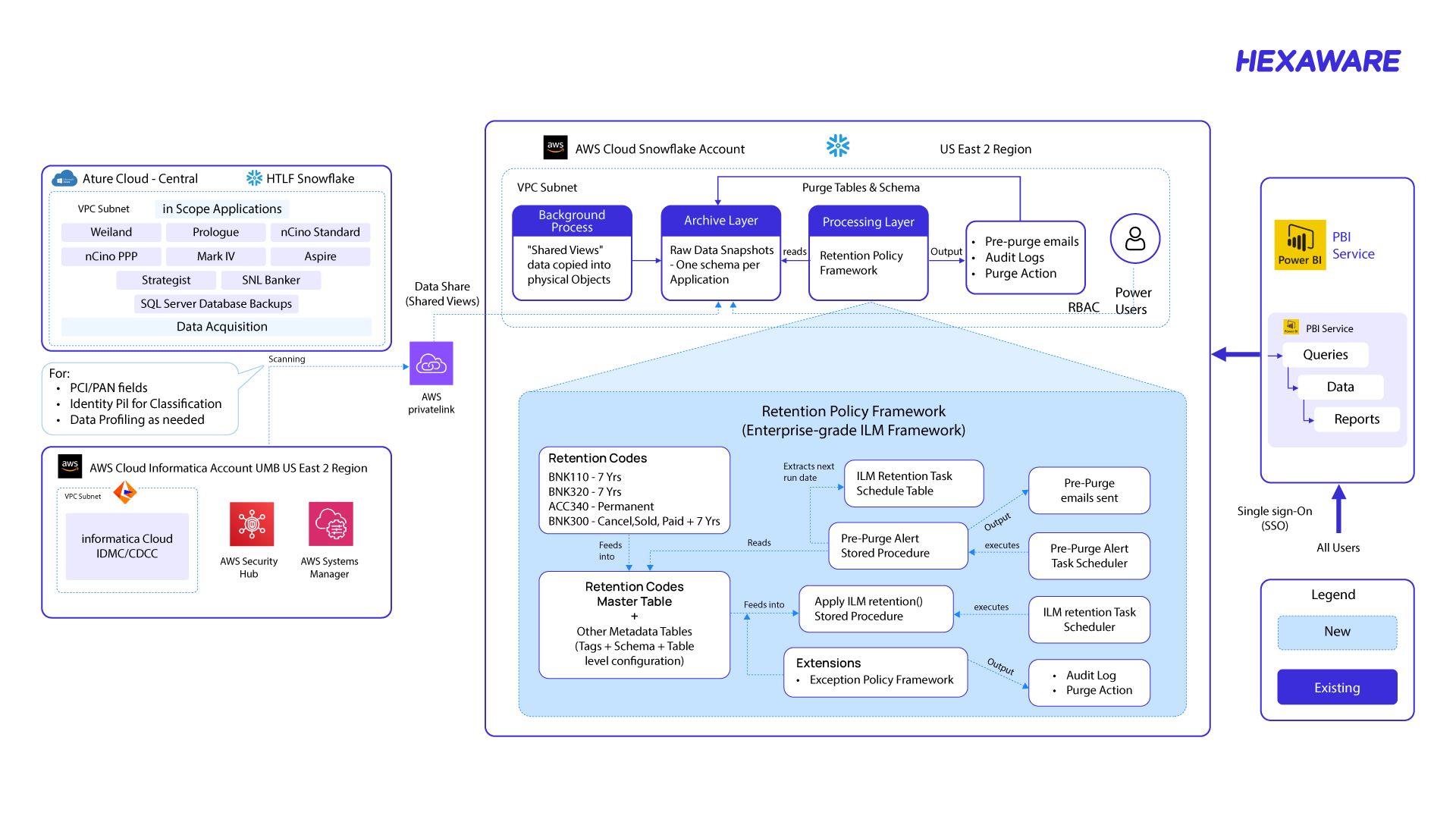
The solution leverages AWS Cloud in the US East 2 region as the secure and scalable foundation for deploying Snowflake accounts, ensuring high availability and regional compliance tailored to financial regulatory requirements. This cloud infrastructure provides the necessary elasticity to handle enterprise-scale data volumes and complex workloads efficiently.
AWS Systems Manager plays a crucial role in managing audit logs and automating exception handling within the data retention and purge workflows. It enables proactive operational monitoring and streamlined management, reducing manual intervention and enhancing compliance adherence through automated remediation processes.
For governance and security, AWS CloudTrail offers detailed logging of all API and user activity across the AWS environment. This ensures robust traceability and transparency, providing immutable records that support audit requirements and help maintain strict compliance with financial industry regulations.
Complementing this, AWS Security Hub consolidates security alerts and compliance findings from across AWS services, delivering continuous monitoring of the security posture. It centralizes risk management and compliance tracking, enabling rapid identification and resolution of potential vulnerabilities to safeguard sensitive financial data.
These AWS services, integrated seamlessly with Snowflake and Informatica, strengthen the solution’s security, compliance, and operational efficiency, creating a resilient and automated data lifecycle management system fit for the complexities of the financial services sector.
Benefits
Enterprise-Grade Compliance with Leaner Operations
Automated, policy-driven lifecycle controls strengthened compliance while reducing manual risk and audit overhead. Coordinated archival and purge processes lowered storage costs and streamlined operations—without compromising data integrity.
Up to 80% Improvement in Purge Sequencing Accuracy
AI-driven parent-child detection significantly improved purge precision, reducing the risk of data corruption and compliance breaches.
Up to 90% Reduction in Manual Retention Effort
Automated workflows replaced manual lifecycle orchestration, freeing teams to focus on governance and analytics rather than operational cleanup.
40% Reduction in Storage and Backup Costs
Timely purging of inactive and closed customer data reduced Snowflake storage and archive costs substantially.
100% Policy-Driven Compliance Enforcement
Metadata tagging, audit trails, and automated exception handling strengthened regulatory posture and audit readiness.
Zero Surprise Lifecycle Events
Pre-purge notifications ensured stakeholders were informed ahead of archival or deletion actions—improving trust and operational alignment.
Secure, Role-Based Data Access
RBAC and masking policies ensured only authorized users accessed archived or active datasets, enhancing data privacy compliance.
Summary
A Modern, Governed Data Lifecycle in Action
Today, our client operates with a fully automated, cloud-native ILM framework that:
- Enforces product-specific retention policies accurately and consistently
- Manages complex purge dependencies without disrupting data integrity
- Applies legal holds smoothly, without breaking lifecycle processes
- Lowers storage costs while staying fully compliant
- Improves audit readiness with clear visibility and timely stakeholder alerts
The enterprise has moved from reactive data cleanup to intelligent lifecycle governance—where compliance, cost optimization, and operational efficiency coexist within a scalable Snowflake-on-AWS ecosystem.
The framework now serves as a strategic backbone for sustainable data growth in a high-compliance financial landscape.
Learn how Hexaware’s partnership with AWS enables simpler compliance and more cost-efficient data management.