Let me tell you about a person I will call Raj.
Raj has been at his firm for nineteen years. He started as a junior developer on a tax calculation engine and never left. Over nearly two decades, he has touched every part of that system. He knows why the exception was added in 2017. He remembers the meeting where a partner insisted on a workaround that was supposed to be temporary but has quietly kept a business process alive for six years.
Raj can tell you, without looking anything up, which database table should never be modified without checking three downstream systems first. He knows the name of the batch job that fails every third Tuesday and exactly which log file to check when it does.
When something breaks, everyone knows who to call.
Raj is fifty-seven years old. He has been talking about retiring to be closer to his grandchildren for the last two years.
The Problem Nobody Puts on a Risk Register
Here is what keeps technology leaders at professional services firms awake at night: the people who understand the applications are leaving faster than the knowledge can be captured.
A tax platform that has been running for fifteen years contains thousands of business rules governing calculations, thresholds, exclusions, and reporting. A legal matter management system has absorbed years of client-specific workflows, compliance requirements, and integration decisions. An advisory firm’s data platform has accumulated layers of business logic that no single person fully understands anymore.
The technology itself is often an easier problem to solve. The harder problem is that the knowledge needed to change, maintain, or modernize these systems lives in the heads of a handful of people who are approaching retirement, changing roles, or being pulled in too many directions to document what they know.
This is not a small problem. It is arguably the single largest hidden risk in enterprise technology today.
What Application Intelligence Actually Means
Application intelligence is the ability to build a structured, application-specific understanding of your code, business logic, architecture, and dependencies, and then apply that understanding across the entire application lifecycle.
Imagine you could ask your most critical application a question. Something like: “What happens if we change this calculation?” or “Why does this workflow behave this way?” or “What would it take to move this to a modern architecture?”
Application intelligence is what makes those questions answerable without tracking down the one person who remembers.
The progression typically looks like this:
Application discovery: Analyze the application estate across diverse technology landscapes and build a knowledge base of code, architecture, and dependencies. This answers: what exists?
Application knowledge: Extract and continuously enrich the technical and business knowledge embedded in the estate, including business rules, workflows, and cross-system relationships. This answers: how does it work, and why?
Impact and change intelligence: Map relationships across application components and assess the potential impact of a proposed change before it happens. This answers: what could be affected?
Transformation: Use that understanding to guide modernization, business logic transformation, technology upgrades, and ongoing maintenance with greater confidence.
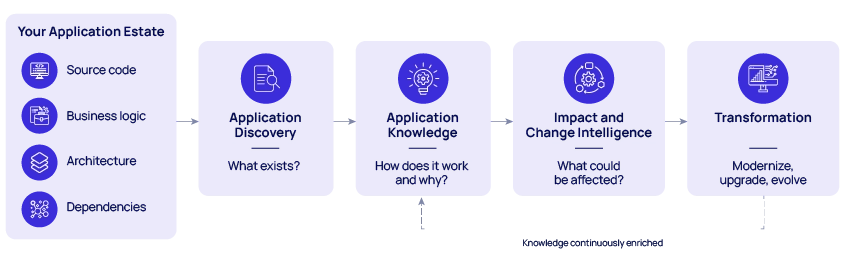
The critical distinction here is between documentation and living knowledge. Traditional documentation becomes outdated almost the moment it is written. Application knowledge, by contrast, must remain connected to the code, dependencies, and business logic that teams are actually working with.
How This Plays Out Across Professional Services
The specific technology challenges differ across professional services, but the underlying pattern is remarkably consistent: critical business processes depend on applications whose complexity has accumulated over the years.
Tax, Audit, and Accounting
Tax and audit platforms operate in environments where accuracy, compliance, and traceability are fundamental. An audit application that has evolved over many years may contain thousands of business rules governing calculations, thresholds, exclusions, and reporting.
Application intelligence helps teams identify where critical business rules are implemented, which components support a particular process, and which downstream systems could be affected by a proposed change. This creates a much stronger foundation for application impact analysis before any modification is made, which matters considerably when regulatory scrutiny is involved.
Legal, Risk, and Compliance
Legal and compliance platforms work with contracts, case information, regulatory content, and large volumes of unstructured data. As these firms introduce automation and generative AI, application context becomes essential.
Instead of asking only whether AI can perform a particular task, teams can examine how that capability fits into the existing application environment. Where does the relevant data originate? Which workflows depend on it? Which business rules must remain intact?
People, Talent, and Advisory Platforms
Talent management firms depend on application ecosystems spanning recruitment, candidate experience, background verification, HCM, learning, performance, and employee engagement. Advisory firms rely increasingly on data-driven platforms, analytics, collaboration systems, and client-facing applications.
These systems rarely operate in isolation. A background verification workflow may touch a recruitment platform, a compliance database, and a client-facing portal simultaneously. Application intelligence helps teams map these relationships before changing an individual application.
Advertising and Marketing
Advertising and marketing organizations rely on interconnected platforms for campaigns, content, customer data, analytics, and digital experiences. A change in any one system can affect several others. Application intelligence helps teams see those dependencies before making changes.
AI Can Write Code. Can It Understand Your Application?
Generative AI has changed software engineering remarkably quickly. It can explain unfamiliar code, generate documentation, write tests, translate legacy languages, and suggest refactoring improvements.
But there is an important distinction between generic AI capability and application-grounded intelligence.
Generic AI has general programming knowledge. Application-grounded AI has context about your specific application’s architecture, code, business logic, and dependencies. Generic AI offers a broad technical understanding. Application-grounded AI works from the verified structure of your actual estate. Generic AI makes general recommendations. Application-grounded AI makes recommendations supported by application evidence, with traceable sources.
For professional services firms, this distinction carries real weight. A tax application, a legal platform, or an advisory data system may support processes where accuracy, confidentiality, traceability, and continuity are fundamental to client trust.
AI becomes genuinely useful in these environments when teams can understand not only what the AI recommends but also the application knowledge that supports that recommendation.
This is precisely the gap that application intelligence platforms like Zerovity™ are designed to close.
The Zero Friction Enterprise™ Connection
Hexaware’s Zero Friction Enterprise™ framework is designed to remove the friction that slows enterprise change across modernization, engineering, operations, quality, security, and business workflows.
Application intelligence contributes to that goal in a specific and often overlooked way: it removes the knowledge friction that accumulates in complex application estates.
When teams understand their applications deeply, modernization moves faster. Changes carry less risk. Dependency on a handful of SMEs decreases rather than grows over time. The friction caused by “we don’t know what will break if we touch this” disappears.
This is what turns application knowledge management from a one-time project deliverable into a continuous organizational capability.
Connecting Application Intelligence to Your Application Modernization Strategy
There is no single application modernization strategy that works for every application. The right approach depends on what the application contains and how it supports the business.
A stable application on outdated infrastructure may be a candidate for rehosting or replatforming. Valuable functionality trapped in a tightly coupled architecture may call for refactoring or rearchitecting. Critical business logic with limited documentation requires application discovery and business logic transformation before anything else can proceed. Redundant or low-value applications may simply need to be replaced or retired.
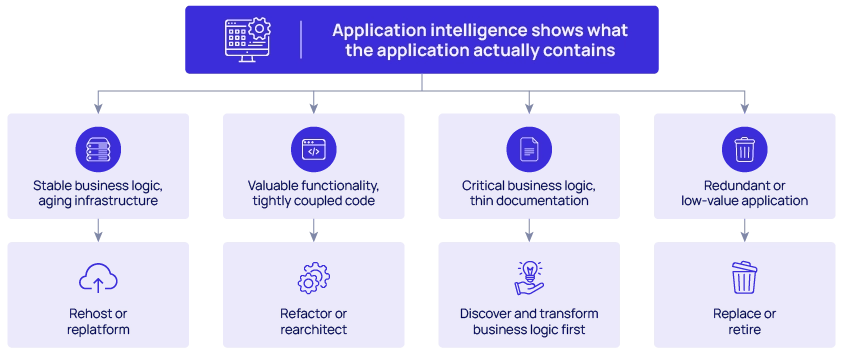
Application intelligence changes these decisions from intuition-based guesses into evidence-based choices. When you can see the actual business logic, dependencies, and technical debt in an application, the appropriate modernization path becomes considerably clearer.
Business logic transformation deserves particular attention here. The real objective is to identify the business logic that still creates value and determine how that logic should be carried forward into a modern environment.
This shifts the central modernization question from “How do we move this code?” to “What business capability does this code represent, and how should that capability work in the future?”
That reframing matters because it changes who can participate in the decision. When the conversation is grounded in extractable, documented business logic rather than the recollections of a few veterans, business stakeholders and technology leaders can make modernization decisions together.
The Realistic Goal: An Application Estate You Can Evolve
You can modernize an application today, migrate it to the cloud, and refactor its architecture. But the business will keep changing. Technology will keep changing. The people maintaining the application will keep changing. Eventually, another modernization decision will arrive.
This is why an effective application intelligence approach extends beyond any single modernization project. The same understanding that guides a migration can also support day-to-day maintenance, code optimization, refactoring, technology upgrades, and the next transformation initiative.
Back to Raj.
He is still at his firm. He still knows everything about that tax calculation engine. But now, when he talks about retiring to be closer to his grandchildren, his technology leader does not break into a cold sweat.
Because the knowledge Raj carries is no longer trapped in his head. It has been extracted, structured, and made available to every engineer who needs it. The application estate can evolve because it is now something the organization understands.
Your application knowledge should outlive any individual project team, SME, or vendor relationship.
The firms that get the most value from AI in the coming years will be the ones that first make their applications understandable to it.
Find Out What Your Applications Know
Every application estate tells a story. The question is whether anyone in your organization can still read it.
If you are facing a modernization decision, a shrinking pool of subject matter experts, or a platform that nobody fully understands anymore, what that moment calls for is application intelligence: a structured, living understanding of the business logic, dependencies, and architecture that keep your firm running.
Two places to start:
Explore Zerovity™, Hexaware’s application intelligence and transformation platform. It builds a code-grounded, repository-cited understanding of your applications, so expertise survives turnover and modernization decisions rest on evidence rather than memory.
See how we work with Professional Services firms across tax, audit, accounting, legal, advisory, marketing, and talent management, where trust, compliance, and continuity are non-negotiable.
Your best application expert is leaving. That part was always inevitable.
What happens to everything they know?
That part is still up to you.