This blog was first published on hfsresearch.com on November 13, 2026.
The HFS Point of View on zero tickets is for CIOs, heads of infrastructure, and IT operations leaders rethinking managed services contracts to eliminate IT demand rather than resolve tickets faster.
IT operations continue to face the same challenges they have for the past decade. As we’ve seen across multiple engagements over years of research, traditional automation clears the easy 30%–40% of tickets and then flatlines, because scripts cannot reason and the context needed to resolve the rest sits trapped across disconnected systems. Agentic AI that can hold context and reason finally offers a way through. CIOs and heads of infrastructure need a better definition of success, which is to eliminate the need for tickets altogether rather than resolve them faster.
The Automation Ceiling for Ticket Handling Is Real, and Rule-Based Scripts are the Reason
For years, every major outsourcing service provider has hit the same ceiling: automating 30%–40% of tickets before the curve begins to go flat. The reason is structural rather than a product or capability gap at any one vendor. Rule-based scripts resolve predictable requests like a password reset or a new instance, but they stall the moment an incident needs context or judgment. That context, i.e., what the system is, what it depends on, or what broke last time, is scattered across a configuration management database (CMDB) here, a wiki there, and an engineer’s memory, and none of it reaches the resolution engine. So every non-trivial incident gets its fix reinvented from scratch, and effort scales in lockstep with volume.
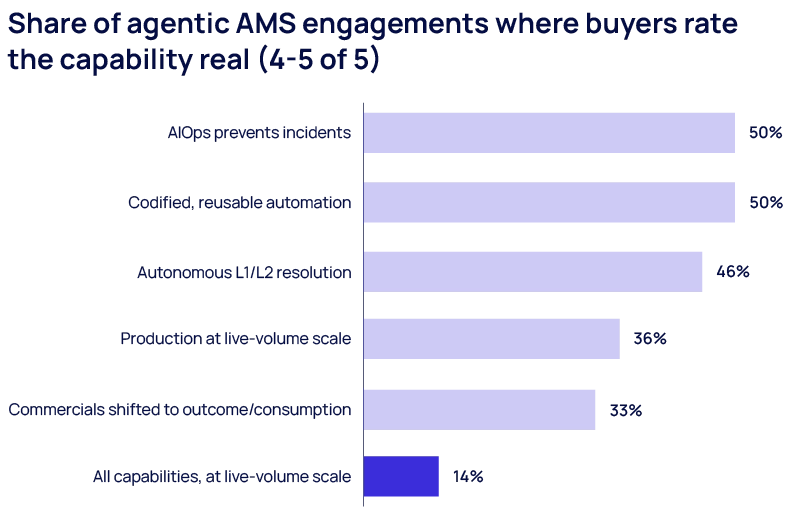
The capability to break through now exists, but it is nowhere near as widespread as the marketing implies. According to the 2026 Agentic AMS SaS Stars buyer-sourced study, 50% of engagements credit AIOps with preventing incidents and 46% report autonomous resolution at L1 and L2, yet only 14% (roughly one engagement in seven) run those capabilities together at live production volume (see Exhibit 1). Most of the gains that landed sit under 25%. While the technology is real, firms haven’t learned to scale it yet.
Exhibit 1: The agentic capability is real, but running it at scale on outcome terms is not
Sample size: n=407
Source: HFS Research, Agentic Application Management Services, 2026
Reasoning Changes Ticket Resolution KPIs from Faster to Fewer
The useful shift hiding underneath the AI hype is a change in what you measure. Traditional operations and the contracts that fund them reward speed, whether it’s mean time to resolve (MTTR), tickets closed, or SLAs met. None of those ask the question that matters to the business, which is why the ticket exists at all. Reasoning-led operations invert the goal. Rather than resolve an incident faster, the aim is to understand why there’s a ticket in the first place, what it takes to stop it from recurring, and how to engineer or reverse engineer the underlying cause at the source. The progression runs from unified observability, to reasoning that correlates and runs diagnostics based on evidence, to automated action under human supervision, and then to prevention, where the event simply stops happening. Success stops being based on resolution speed and starts being counted in demand deleted against a baseline.
This is a much better metric for both technology and business teams that value speed, and it’s worth noting that at least one provider is willing to name it plainly. Hexaware has built an operations model around demand deletion rather than faster closure, which is the right forward-looking posture. Engineering the effort down structurally can help providers reprice engineering support away from headcount while increasing throughput, which is the promise of AI in managed services. This will not completely end the cycle of incidents and tickets but can help catch issues before they become larger problems.
The Real Blocker Is the Contract, Not the Code
The main place where most programs quietly stall has nothing to do with AI. The dominant commercial model in IT operations still revolves around headcount, tickets resolved, and incidents handled. On that model, a provider that attempts to delete demand will end up sacrificing its own revenue. The shift to Services-as-Software™ puts the math plainly. If automation removes 30% of the staff a contract requires, it removes roughly 30% of the provider’s revenue on that contract. Because of that contradiction, a supplier paid by the ticket has every reason to resolve tickets efficiently and none to make them disappear.
Outcome and consumption pricing reverses the incentive, so every unit of demand deleted lifts the provider’s margin instead of eroding it. That is the reframe that makes this approach viable, and it is exactly where the market lags. In our agentic AMS research, we found that only a third of engagements have moved commercials to consumption or outcome units, and across the industry, revenue per employee is growing barely 1% a year, which tells you how few providers have genuinely broken the link between growth and headcount.
Providers will have to cannibalize part of their own book to deliver this, but that cannibalization can be cushioned. As ticket revenue shrinks, providers can backfill it with new AI-native services, so individual deals may shrink while total account revenue holds or even grows. That is a shrewd trade rather than a sacrifice. Any provider unwilling to move off per-person or per-ticket pricing tells you it has no intention of getting you to a point where ‘zero tickets’ is a reality.
The Bottom Line: Before you sign, establish a demand baseline and make the contract pay for demand deleted against it, not for tickets resolved faster or FTEs deployed. Demand deletion is a direction, not a decision.
Insist on governance over the agents doing the resolving, because unwatched automation only trades a ticket backlog for a trust problem. The technology to break the automation ceiling is finally here, and your contract choices will decide whether your provider uses it to delete your demand or simply to bill you more efficiently.