Modernizing enterprise analytics with SAP integration on Microsoft Fabric enables enterprises to unify SAP and non-SAP data, support real-time analytics, accelerate AI-driven decision-making, and reduce the complexity and cost of fragmented analytics platforms.
As enterprise data volumes grow and AI becomes central to business operations, legacy SAP BI/BW environments are no longer sufficient for delivering scalable, enterprise-wide analytics. With mainstream maintenance for SAP BW systems ending around 2027, enterprises are re-evaluating their data strategies and looking beyond traditional modernization paths.
Microsoft Fabric provides a modern, scalable, and cost-efficient analytics platform that combines data engineering, data warehousing, real-time analytics, and business intelligence on a unified data foundation.
This blog explores SAP integration with Microsoft Fabric, covering integration approaches, key limitations, cost considerations, and best practices for accelerating the transition to a unified, AI-ready analytics ecosystem.
Key Takeaways
- Microsoft Fabric provides a modern, scalable, and cost-efficient platform for integrating SAP data and enabling unified enterprise analytics.
- SAP integration is more than migration—success depends on selecting the right connectivity approach while maintaining performance, governance, and cost efficiency.
- Native connectors, third-party tools, and accelerators such as DAB Nexus each play a distinct role based on SAP landscape complexity and business requirements.
- A unified data platform enables organizations to combine SAP and non-SAP data, unlock real-time analytics, and build AI-ready data foundations.
- Fabric’s capacity-based pricing and integrated analytics capabilities help reduce licensing complexity, consolidate tools, and lower the total cost of ownership.
Learn how Hexaware accelerates SAP-to-Fabric modernization through proven frameworks, AI-led accelerators, reusable assets, and deep implementation expertise, helping organizations achieve faster time-to-value.
Why SAP Integration with Modern Platforms
Data strategies increasingly require enterprises to integrate SAP data with broader enterprise data ecosystems to support real-time analytics, AI, and business-wide decision-making. However, traditional SAP architectures were designed for transactional processing and structured reporting, making it difficult to deliver the flexibility, scalability, and interoperability that modern analytics demand.
As enterprises seek to unify SAP and non-SAP data while controlling costs and simplifying data operations, modern platforms like Microsoft Fabric provide a more connected and scalable approach to enterprise analytics.
Traditional SAP data architectures are often:
- Siloed and tightly coupled within SAP ecosystems
- Dependent on batch-based extraction processes
- Limited in supporting real-time analytics and AI use cases
As a result, enterprises face challenges in:
- Combining SAP data with non-SAP sources
- Enabling enterprise-wide analytics
- Scaling efficiently with growing data volumes
- A rise in Licensing costs
Microsoft Fabric addresses these gaps by providing a unified analytics platform built on OneLake, enabling enterprises to centralize SAP and non-SAP data for advanced analytics and AI workloads.
Why Microsoft Fabric for SAP Integration
Microsoft Fabric redefines SAP data integration brings data engineering, analytics, and business intelligence together on a single, unified platform.
Instead of relying on disconnected tools and complex integration pipelines, enterprises can centralize SAP and non-SAP data, enable real-time analytics, and build AI-ready data foundations within a governed ecosystem.
With native SAP connectivity, flexible integration options, and a capacity-based pricing model, Microsoft Fabric simplifies modernization while reducing operational complexity and accelerating time-to-value.
Unified Analytics Platform
- Combines data engineering, warehousing, and BI in a single SaaS platform
- Eliminates fragmented tool chains
Real-Time Insights
- Supports Change Data Capture (CDC) from SAP
- Enables near real-time analytics
Open Ecosystem
- Integrates SAP with other enterprise systems (CRM, IoT, external data)
- Avoids SAP-only data silos
Cost Efficiency
- Capacity-based pricing reduces overall licensing complexity
- Minimizes dependency on multiple third-party tools
Tool Compatibility
- Supports a wide range of integration options including native connectors, APIs, and third-party tools
- Leverages existing Microsoft ecosystem skills and tools, reducing rework and onboarding effort
The Solution Architecture: SAP Integration with Microsoft Fabric
This simplified architecture shows how data flows cleanly from the SAP Ecosystem into Microsoft Fabric for unified analytics. Data from SAP ERP, Data Warehouses, and Cloud Apps are securely transferred through a flexible integration layer using Native Connectors, 3rd Party Tools, or specialized solutions like DAB Nexus.
Once inside Microsoft Fabric, the data is consolidated into a single, governed Unified Data Lake where it is processed and instantly made available for Power BI Reporting, data science, and external business applications.
While the SAP Datasphere remains a valid option, many enterprises evaluate Fabric for greater flexibility, faster innovation, and better cost control.
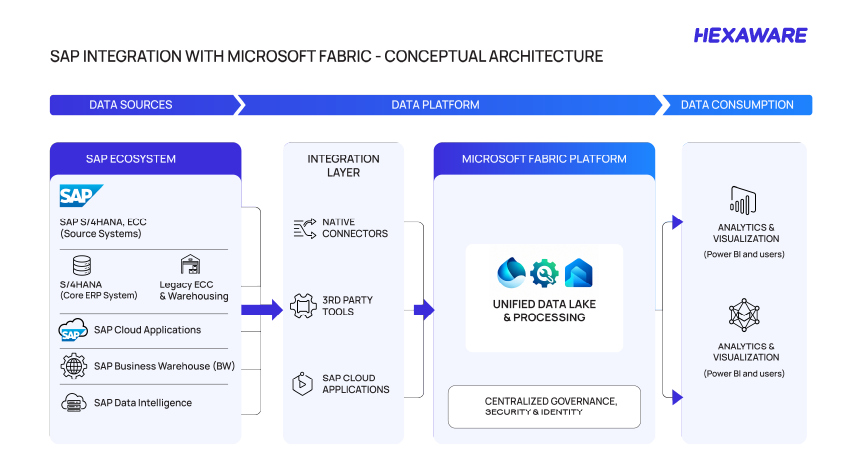
Solution architecture for SAP integration with Microsoft Fabric
Key Challenge: SAP Connectivity Complexity
SAP integration is not plug-and-play. It comes with several constraints:
- Complex authorization and access setup – RFC (Remote Function Call), ODP (Operational Data Provisioning), APIs (Application Programming Interface(s))
- Dependency on SAP-supported extraction frameworks
- Proprietary data structures and embedded business logic stored in ABAP objects
- Limited ease of direct connectivity
Because of this: SAP systems connectivity is the primary limitation when integrating with Microsoft Fabric
To overcome this, enterprises require:
- Proper connector selection
- Secure access configuration
- Wide range of third-party tool options (if required)
Integration Approaches for SAP to Microsoft Fabric
Choosing the right SAP integration approach depends on your existing SAP landscape, data complexity, migration objectives, and budget. Microsoft Fabric supports multiple integration methods, allowing enterprises to balance performance, flexibility, and cost while preserving business logic and minimizing migration effort.
Hexaware’s SAP integration strategy for Microsoft Fabric includes the following options:
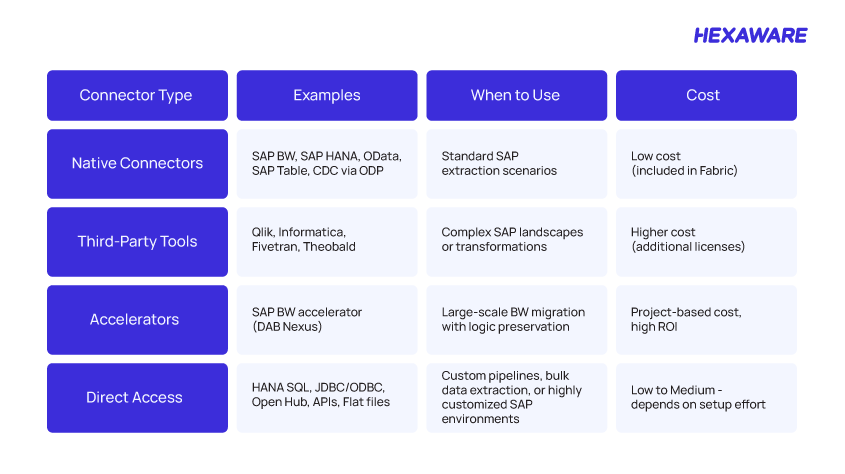
SAP integration methods support varying migration, performance, and cost requirements
Key Takeaway
- Use native connectors wherever possible for cost optimization
- Use third-party tools for complex scenarios only
- Use DAB Nexus specifically for SAP BI/BW transformation use cases
Role of DAB Nexus in SAP Integration
DAB Nexus plays a critical role in SAP BI/BW modernization, especially when migrating analytical workloads.
It helps:
- Translate SAP BW objects (InfoProviders, queries, hierarchies)
- Preserve business logic embedded in ABAP objects during migration
- Accelerate large-scale transformations
DAB Nexus is not a generic Fabric connector—it is a specialized accelerator for SAP BW scenarios, complementing the overall integration strategy.
Key Considerations for Successful Integration
Beyond selecting the right integration approach, enterprises should address key architectural and operational considerations to ensure secure, high-performance, and cost-efficient SAP analytics on Microsoft Fabric.
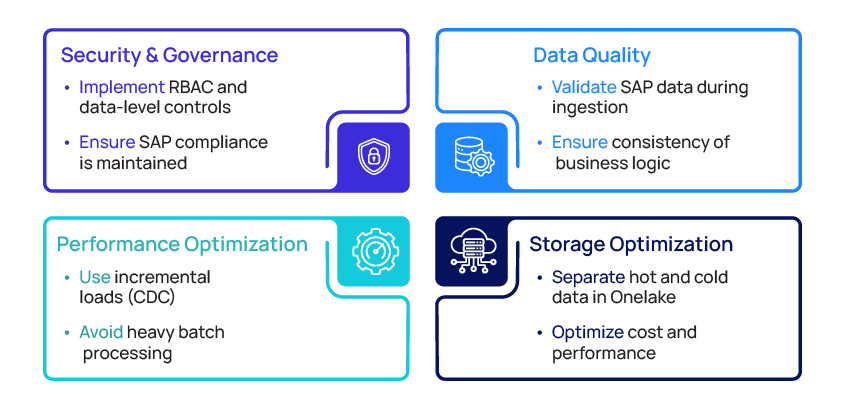
Key considerations for enterprise analytics optimization across security, data quality, performance, and storage
Cost & Licensing Considerations
From a cost perspective, SAP integration with Fabric offers:
- Lower total cost of ownership (TCO) compared to multi-tool ecosystems
- Reduced dependency on expensive third-party tools
- Simplified licensing through Fabric capacity model
Compared to SAP-native expansion paths like Datasphere:
- Fabric provides better cost predictability
- Improved productivity (25%+) for data teams, leading to indirect cost savings
- Enables tool consolidation (Data Factory, BI, analytics in one platform)
Understanding the Business Impact of Integrating SAP with Microsoft Fabric
Integrating SAP with Microsoft Fabric enables enterprises to unlock greater business value from their enterprise data by combining SAP and non-SAP information on a unified analytics platform.
The integration supports real-time decision-making, AI-driven insights, and cross-functional analytics while reducing data silos and improving operational efficiency.
Manufacturing
- Combine SAP ERP data with IoT streams
- Enable predictive maintenance
Retail
- Integrate SAP inventory with sales data
- Improve demand forecasting
Finance
- Centralize SAP reporting
- Enable real-time financial insights
Human Resources (HR)
- Integrate SAP Success
- Factors data with enterprise systems
- Workforce analytics, attrition prediction, and talent planning
Supply Chain & Logistics
- Combine SAP logistics data with external partner systems
- Improve supply chain visibility and optimize delivery performance
Healthcare / Life Sciences
- Integrate SAP data with clinical and operational systems
- Enable data-driven patient care insights and operational efficiency
How Hexaware Integrates SAP with Microsoft Fabric
At Hexaware, we bring hands-on experience in enabling SAP-to-Microsoft Fabric integration through a combination of innovation, accelerators, and strong ecosystem partnerships.
What Hexaware delivers
- Delivered multiple Proof of Concepts (POC) and Point of View (POV) to validate SAP-to-Fabric integration scenarios, evaluate market-available tools, and identify the right-fit approach for you.
- Built end-to-end demos and reusable assets showcasing SAP CDC, native connectors, and Fabric analytics capabilities.
- Capitalize Hexaware’s in-built Agentic AI solutions and agents to automate assessment, accelerate migration planning, improve productivity, and reduce dependency on manual analysis.
- End-to-end delivery approach covering discovery, architecture, integration, migration, validation, and rollout.
- Provided advisory and implementation support across SAP connectivity, data extraction, and Fabric architecture.
- Partnered and aligned with Microsoft ecosystem teams to adopt best practices and latest integration patterns
- Enabled custom integration strategies combining native connectors and third-party tools based on client needs
What’s Hexaware’s Approach
- Fast-track SAP modernization and Fabric adoption through proven frameworks
- Reduce risk with validated POCs and demo-driven implementations
- Ensure seamless transition with minimal disruption to existing SAP landscapes
- Accelerate time-to-value with scalable, AI-ready data platforms