Hexaware Positioned as a Visionary in the 2026 Gartner® Magic Quadrant™ for Custom Software Development Services
Gartner, Magic Quadrant for Custom Software Development Services, By Jaideep Thyagarajan, Ryan McKinney, Nathan Davie, 7 October 2026. Gartner and Magic Quadrant are trademarks of Gartner, Inc. and/or its affiliates. Gartner does not endorse any company, vendor, product or service depicted in its publications, and does not advise technology users to select only those vendors with the highest ratings or other designation. Gartner publications consist of the opinions of Gartner’s business and technology insights organization and should not be construed as statements of fact. Gartner disclaims all warranties, expressed or implied, with respect to this publication, including any warranties of merchantability or fitness for a particular purpose. This graphic was published by Gartner, Inc. as part of a larger research document and should be evaluated in the context of the entire document. The Gartner document is available upon request from Hexaware.
Blog
Share on
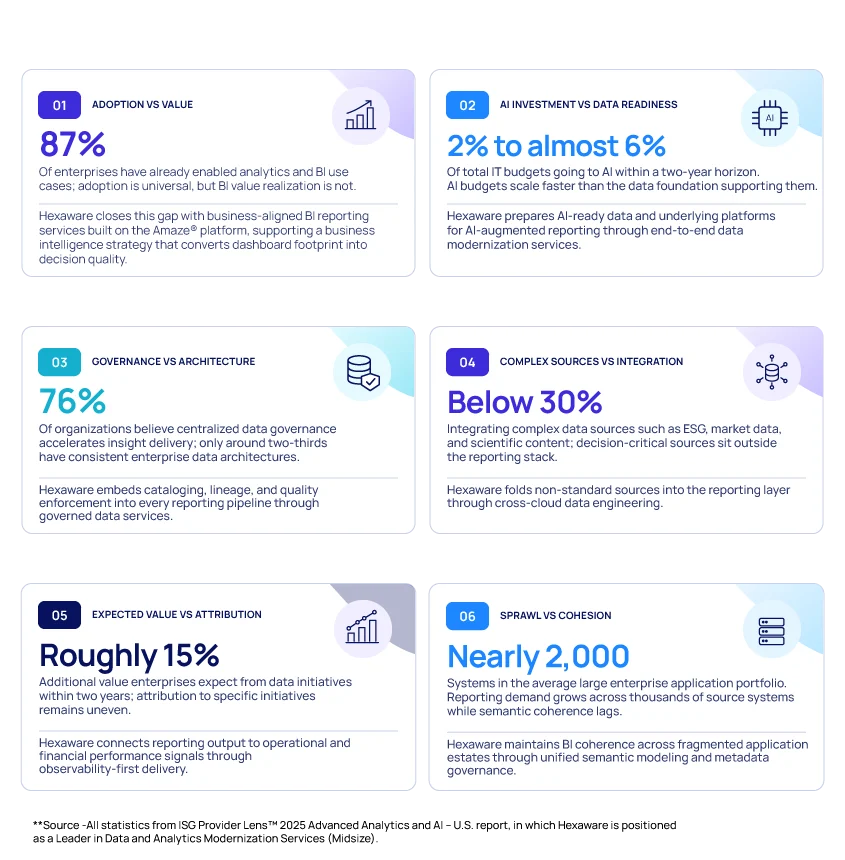
Business intelligence and reporting services are entering a new phase. As enterprises invest more in AI and analytics, competitive advantage is increasingly determined by the strength of the underlying data ecosystem rather than analytics adoption alone. Drawing on the ISG Provider Lens® Advanced Analytics and AI Services – Large and Midsize 2025 U.S. Quadrant Report, we examine six areas where enterprise business intelligence and reporting services continue to face the greatest disconnects between investment and value.

For more on Hexaware’s BI and reporting services, explore our Data & Analytics services.
Business intelligence and reporting focus on monitoring performance through dashboards, reports, and operational insights, while business analytics uses historical and predictive data to identify trends and forecast outcomes. Hexaware helps organizations strengthen enterprise business intelligence with AI-ready data and modern reporting foundations.
Enterprises can balance self-service BI with centralized data governance by giving business users access to trusted, governed data while maintaining consistent standards for data quality, security, and definitions. A strong business intelligence strategy supports BI value realization by combining self-service capabilities with centralized governance, helping teams access insights faster while maintaining consistency and control.
A semantic layer provides a consistent business view of data across multiple systems, ensuring users access the same definitions, metrics, and KPIs regardless of the underlying data source. Semantic modeling improves reporting consistency, reduces ambiguity, and supports trusted enterprise business intelligence and reporting.
Metadata management provides information about data assets, including their definitions, origins, relationships, and usage. Combined with a strong enterprise data architecture, it improves data discovery, governance, and consistency across business intelligence and reporting initiatives.
Data lineage tracks how data moves and changes from its source through transformation to reporting. This visibility improves trust, simplifies auditing, and helps identify data quality issues before they affect business decisions.
Generative AI is transforming business intelligence and reporting through natural language queries, automated insights, and AI-augmented reporting. To realize these benefits, organizations need AI-ready data, modern platforms, and strong governance.