Reimagined ITOps is a weekly series about what IT operations becomes when AI stops assisting and starts operating. This is article 11 of Season 1. Stay with it.
Every survey I read this year gives IT leaders the same explanation for why their agents are not in production. The data is not ready.
One published in August found 57% of organizations piloting or running AI agents, and 8% saying the data feeding those systems is trustworthy enough for production use. Data quality and trust ranked as the number one barrier, with 76% of respondents putting it in their top three.
I believed a version of that too. Then we measured it, and the measurement disagreed with me.
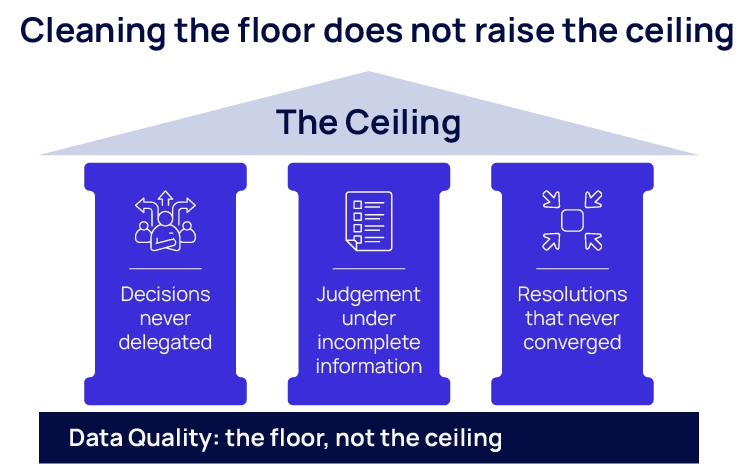
My claim: the ceiling on how much IT operations work can run without a human is structural, not a data problem. Cleaner records raise the floor. They do not move the ceiling, because what sits under the ceiling is not missing information. It is missing permission.
What We Expected the Clean Estate to Do
When we stopped estimating automation potential and started measuring it against real ticket estates, we expected data quality to be the dominant variable. Every assessment carried the same caveat: the numbers would improve once the records improved.
Then we assessed an estate with genuinely clean data. Good taxonomy. Populated work notes. A maintained configuration database. The conditions everybody says they are waiting for.
The measured ceiling did not move.
Same method, same classifier, same version stamp as the other estates. The floor was better: more classes were reachable, more resolutions were traceable, less of the work was guesswork. The top of the range stayed where it was.
I am not going to publish our portfolio figure here. A measured number from a small set of assessed estates is a fact about those estates, not a prediction about yours, and the rule in this series is that measured numbers travel with their conditions, or they do not travel.
What the Residual Is Actually Made Of
Look at what remains once the convergent, well-documented work has been carried, and almost none of it is a data defect.
The first and largest part is decisions the enterprise has never delegated. Spend. Risk acceptance. An exception to a policy. A change to someone’s entitlements. A step inside a regulated boundary. Perfect records do not create authority, and no amount of context tells a machine it is allowed to decide something nobody has decided it may decide.
The second part is judgment under incomplete information. The novel fault, the unfamiliar interaction between two changes, the symptom that matches nothing in the history. Reasoning helps here, materially, and it is still an exception path rather than autonomy.
The third part is demand whose resolutions never converged. 50 tickets of one type and resolved 50 different ways. Cleaning those 50 records does not create a convergent answer. It documents the absence of one more precisely. Volume tells you where the effort is. Convergence tells you where the automation is.
Clean Is Not the Same as Contextual
Here is the concession, and it is a real one. Data quality is necessary. A messy estate caps lower, and some classes of demand stay unreachable until the records improve. Anyone reading this as “data does not matter” has read it backward.
But cleanliness is a property of records, and what an agent needs is relationships. A populated resolution-notes field is not a resolution. An owner field with a name in it is not an owner. A knowledge article existing for a fault is not an article that resolves it. Presence is not the property it stands for, which is how an estate audits as clean and stays context-poor.
The same August survey found 61% of respondents calling a reliable context layer critical or very important for agents, and 16% saying their organization deliberately designs and engineers one. That gap is the work. It is engineering, not hygiene, and it does not appear anywhere on a data-quality plan.
What It Costs to Get This Backwards
Budget consequence first. If you fund a multi-year data remediation program on the promise that autonomous coverage rises at the end of it, you have bought a necessary condition and no ceiling movement. In 12 months, somebody will ask why coverage is flat after the records were fixed, and the honest answer will be that the records were never the binding constraint.
The ceiling moves when someone writes down, for each class of demand, what an agent is allowed to decide without a human, and signs their name next to it. That work needs service owners, risk and legal in one room. It costs far less than the data program, and it is much harder to schedule, which is exactly why programs reach for the data program instead.
The Second Concession
One clean estate is one clean estate. The finding is consistent with everything else we have measured, and it contradicted our own prediction, which is the kind of evidence I weight most heavily. It is still a pattern rather than a law. If your estate cleaned its records and the ceiling moved, I would like to see it, because that is the result that would change my position.
Our ceiling is also measured with our own method at a point in time, and it moves as the system learns. The claim is not that the number is permanent. The claim is that cleaning data was not what moved it.
What This Changes
Run the delegation inventory before the data program. Take your 10 largest classes of demand. For each one, write the decision its resolution requires and the name of the person allowed to make that decision today. The blanks are your ceiling, and you can collect them in a week.
Test convergence before you fund anything on volume. A large category whose resolutions scatter is not an automation candidate. It is usually a taxonomy defect or a genuinely varied fault, and both of those need people.
Stop accepting either half of the data excuse. “Our estate is too messy for this” is partly true and mostly an alibi. “Clean it and we will be fine” is not a plan.
The Question for IT Leaders
Pick the largest class of ticket in your estate. Ask what decision its resolution requires, and whether anyone in your organization has ever written down that a machine may make that decision.
So, my question: if your data were perfect tomorrow morning, which classes of work would you actually let an agent close without a human in the path?
Next week: autonomy is a governance architecture, not a model capability, and what that architecture has to contain before anyone lets an agent write to a production system.
Sanjesh Rao leads product strategy and innovation for Hexaware’s Agentic ITOps platform.