Reimagined ITOps is a weekly series about what IT operations becomes when AI stops assisting and starts operating. This is article 12 of Season 1. Stay with it.
Two numbers published this year sit badly together.
In one survey of senior AI executives, 85% of those whose organization uses agentic AI said at least a handful of those systems already execute actions without a human involved in real time. In another, covering 3,235 business and IT leaders across 24 countries, 21% said their organization has a mature governance model for agentic AI.
Nothing in that gap is about model quality. Both groups are buying the same models.
My claim: autonomy in IT operations is a property of the architecture around the model, not a property of the model. What decides whether an agent may write to a production system is a set of structures you can draw on one page, and most programs have not drawn them.
The Model Is Not What Is Stopping You
When we scoped the first write actions in a live estate, every blocking question was architectural. Who approves this class of change. What does the system check before it acts, and what does it check afterward. What happens when it is wrong at 2am. Who can reconstruct the decision six weeks later in front of an auditor.
A better model answers none of those. It produces a more plausible recommendation, which is a different thing and occasionally a worse one.
Here is the concession, and it is real. Model capability sets the floor of what can be attempted. Weak reasoning under good governance fails safely and often, which is annoying and survivable. Strong reasoning with no governance fails rarely and expensively. Only one of those is a risk you can price, and better models do raise the floor.
What the Architecture Has to Contain
Five structures, and the specific failure each one prevents.
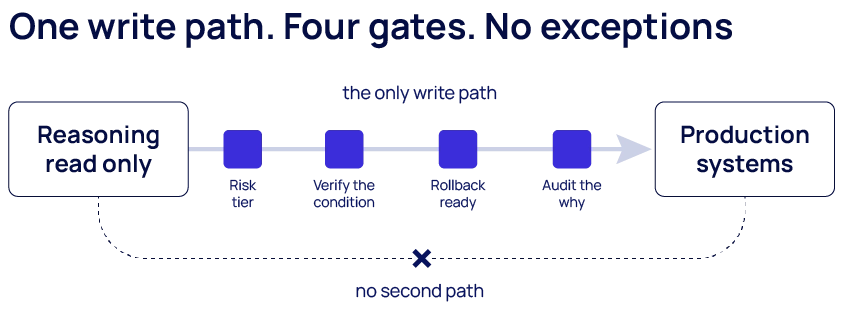
A read and write boundary that is absolute. The layer that reasons never changes anything. Every state-changing action leaves through one governed execution path, and there is no second path. Without it you have a reasoning system holding production credentials, which is the finding a security review will open.
Risk tiers the business signs, not the vendor. Low risk executes, medium risk executes inside guardrails, high risk waits for a named approver. The tiering is a business decision taken per class of demand. A vendor default is a configuration, not a policy, and nobody is accountable for a configuration.
Verification of the condition, not the command. Most of what gets called verification checks that the command returned successfully. That confirms something ran. It does not confirm the disk is clear, the service is healthy, or the user can log in, which was the point.
Rollback as a designed path. If the recovery plan for a failed action is a person on a bridge call, there is no rollback. There is an incident procedure with better branding.
An audit record that answers why. Not only what ran and when, but what evidence the agent held, which policy applied, what it rejected, and who or what approved it. An action you cannot explain is an action you will eventually have to defend.
The Unit of Governance Is the Agent, Not the Model
Most of the governance conversation in the market is about models. The things that actually need governing sit one level up: which sources an agent may see, which roles may invoke it, which tools it may call, and whether that configuration has ever been reviewed and published rather than left in draft.
Draft versus published is the control that stops a demonstration reaching production. It looks like a configuration state. It is the governance boundary.
An estate with one approved model and 40 unreviewed agent configurations is not governed. It is governed in the place where nothing happens.
What This Costs
This architecture adds latency, adds cost, and makes the first deployment slower than a pilot that skips it. Guardrails do not demonstrate well. That is most of the reason the market builds them last.
It also does not raise coverage. Governance does not make more work automatable. It decides how much of the already automatable work you are willing to let run, which is why the two conversations keep getting confused in business cases.
And human oversight has to be a guardrail rather than a dependency. If a human approves every action, the result is the previous human process with added latency and a license fee. Early in a deployment, more is gated than the design requires, because trust is earned one class of demand at a time rather than one release at a time. That is a deliberate cost, not a capability gap, and it should be written down as such before anyone is disappointed by it.
The Second Concession
Nothing here makes an agent safe on its own. These five structures make failure bounded, attributable and recoverable. They do not make it rare. An organization that builds all five and skips the work of deciding what an agent is allowed to decide has built a very well audited way of doing nothing.
Architecture and delegated authority are two different problems, and both have to be solved. Last week’s article was about the second one. This one is about the first.
What This Changes
Put the write path in the security review before the model evaluation. The model question is answerable in a week. The write path question will take a quarter and decides whether anything reaches production.
Ask any agent vendor, including us, for those five structures on one page, with the failure each prevents named. A supplier who answers with model benchmarks has told you where their engineering went.
Then stop buying autonomy as a capability. It arrives as a set of constraints you can audit, or it does not arrive.
The Question for IT Leaders
Pick one system in your estate that an agent could usefully change tonight.
Without opening a document, can you name the approver, the verification, the rollback path, and the place the record of that decision would live? If any of the four is blank, that is the gap between your pilot and your production estate.
Next week: the four jobs left for the operations engineer when execution moves to the agents.
Sanjesh Rao leads product strategy and innovation for Hexaware’s Agentic ITOps platform.