Reimagined ITOps is a weekly series about what IT operations becomes when AI stops assisting and starts operating. Article 13 of Season 1. Stay with it.
Open an L2 queue in the morning and watch where the first hour goes.
Very little of it goes to fixing anything. It goes to working out which tickets are what they claim to be, which ones belong in this queue, and which ones need something nobody has yet.
Now picture the same queue after the system has read every ticket in it overnight. Each arrives carrying its evidence, its analysis, a recommended action, and a declared position on whether it has seen this before.
The first hour does not vanish. It changes shape.
My claim: when execution moves to agents, the operations engineer’s job neither disappears nor stays the same. It re-forms into four kinds of work, and the mix between them moves.
Four kinds of work, not four tasks. This is not a countdown to zero.
1. Validation: Judging What the System Proposes
This is the dominant job today, and the reason is exact. In our platform every write action runs with human approval. The agent assembles the case and proposes the change. A person decides whether it is the right change and approves it.
That is not the skill of making the change. It is the skill of reading evidence fast and catching the recommendation that is confidently wrong.
Validation is per action: one ticket, one decision, one approval.
The work gets harder before it gets smaller, and this is what harder looks like at L2. The engineer no longer types the command. The engineer carries the judgment for every command the system wants to run.
2. Exception: Resolving What the System Says it Cannot Carry
The second job exists because of a sentence the system is built to say: I have no precedent for this.
Three different things arrive wearing that label. Genuine no-precedent work, where nothing in the estate’s history resolves the case. Work where the decision was never delegated to anyone. And work where the access required was never granted.
Only the first is a knowledge problem. The other two are organizational, and cleaner data does not move them.
That is the argument of article 11, and it is why this job is permanent. The ceiling is structural, so exception work has a floor.
3. Governance: Owning What the Agents May Do At All
The third job is the one most operations teams have nobody doing.
Validation asks whether this action is right. Governance asks whether anyone should have to be asked at all, and who signs that.
It means owning the risk tier each class of action sits in, the declarations the system makes about its own coverage, and the record that answers why an action was permitted six weeks after it ran.
I wrote last week that autonomy is a governance architecture rather than a model capability. This is the human side of it. Those structures are what we are building toward, and I will not describe them as finished. But the role has to exist before they do, because somebody has to write down what an agent may decide. That artifact does not emerge from the technology.
Governance is per policy: one decision covers a class of work for a year.
4. Design: Deciding What Demand Should Exist
The fourth job is where the series has been walking.
In article 10 I argued that lean problem work gets a product: demand that did not arrive. The design job owns it, finding the recurring classes where resolutions converge, authoring the knowledge nobody wrote down, and removing the causes of predictable failures rather than resolving them faster.
Part of this is work we do today. Reading a full ticket population to find where resolutions converge is an analysis we run now, and so is finding the knowledge that exists only in closed tickets and drafting it for the people who own it.
The preventive half, where the system acts on the predictable before it becomes demand, is a destination and I will keep calling it one.
The Mix Moves, and That is the Actual Claim
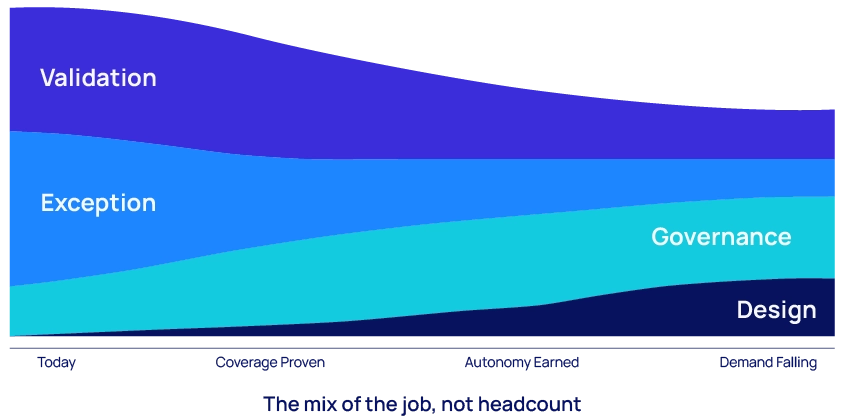
Early on, almost all of it is validation and exception. Validation is heavy because approval is required everywhere, exception because coverage is thin.
As coverage is proven queue by queue, the per-action validation load falls. It was never meant to be permanent. Governance grows, because more classes of action need somebody to have decided about them. Design grows last and slowest, because it only becomes possible once the first three stop eating the day.
Exception never reaches zero.
One sentence for planning: the job moves from carrying every decision to deciding which decisions should exist at all.
What I Am Not Going to Tell You
These four jobs are harder than the one they replace. Validation under time pressure costs more than execution. Governance requires authority most engineers do not hold. Design requires analysis the operations floor was never hired for.
They also need fewer people. I am not going to dress that up the way this industry does, because the usual phrasing has done enough damage. The headcount curve decouples from ticket volume, and that is the point of the economics. Not everyone moves across, and the organizations that handle it well say so early rather than discovering it late.
What This Changes
The market’s answer is a new job title about managing agents, and there is real work in running an agent estate.
But three of these four jobs are not about agents at all. Exception work is about decisions your organization never delegated. Governance is about who holds authority. Design is about demand. The agent is the occasion for each, not the subject.
If you lead a desk, the retraining question is not which tool to certify people on. It is which of the four you are short of, and in my experience that is governance and design, because nobody was ever hired into them.
So my question: which of the four does your operation have nobody accountable for, and what is that costing you in work that keeps arriving?
Next week: the four numbers I would put on an operations board pack, and the three I would take off it.
Sanjesh Rao leads product strategy and innovation for Hexaware’s Agentic ITOps platform.
Stay with it.