Imagine looking at a professional services firm’s org chart a few years from now.
Alongside partners, managers, analysts, associates, and specialists, you see roles such as Research Agent, Quality Agent, Proposal Agent, Client Follow-Up Agent, and Compliance Agent.
These are AI agents assigned to specific types of work.
One researches a client issue. Another prepares a first draft. A third checks the output against defined rules. Another coordinates follow-ups across systems.
The professional still owns the relationship, interpretation, judgment, and final decision. But a growing share of the work surrounding those decisions could be performed by AI.
That creates a bigger question than whether firms should adopt agentic AI for professional services.
If AI becomes part of the workforce, who does what?
The answer could reshape operating models, career paths, management, governance, productivity, and how firms develop expertise.
The shift is already underway. Thomson Reuters’ 2026 research found that 15% of surveyed professional services organizations were using agentic AI, while another 53% were planning or considering it. By 2030, 77% expect agentic AI to be central to their workflow.
For firms, the opportunity is significant. So is the organizational rethink that comes with it.
The Professional Services Pyramid Is Changing
Professional services firms have traditionally relied on a leverage model.
Experienced professionals provide judgment and client leadership. Managers coordinate work and review outputs. Junior professionals handle research, preparation, analysis, documentation, and other activities that help them build expertise.
AI changes where some of that work happens.
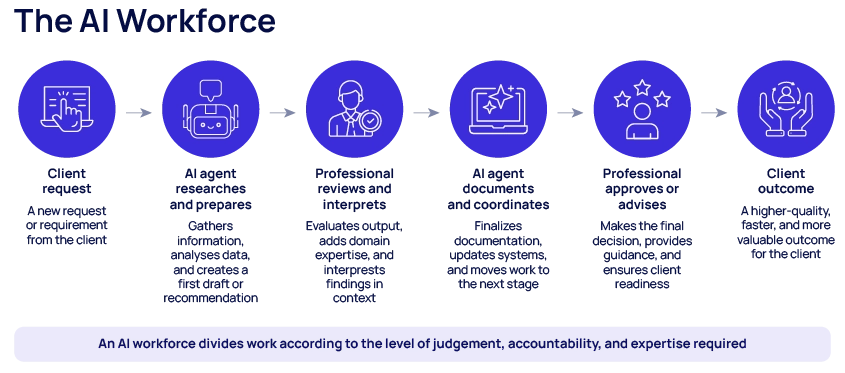
Consider a tax engagement. An AI agent could gather relevant documents, identify missing information, prepare an initial analysis, flag inconsistencies, and organize supporting evidence. A professional could then focus on interpreting the situation, challenging the analysis, discussing implications with the client, and making the final recommendation.
A similar division of work could emerge across legal, audit, consulting, marketing, risk, and talent services.
Hexaware’s Professional Services practice covers tax, audit and accounting, legal, risk and compliance, people and talent, advisory and consulting, and advertising and marketing. Its capabilities include process automation and AI for predictive and prescriptive analytics.
The important change is the allocation of work.
Instead of asking where AI can be inserted into an existing process, firms need to ask how work should be divided between people and AI in the first place.
For firms adopting agentic AI for professional services, the question is therefore not simply which agents to deploy. It is how those agents should fit into the firm’s operating model.
That is a much bigger operating-model decision.
An AI Agent Needs a Job Description
Calling something an “AI agent” does not explain what it should actually do.
A useful agent needs a defined responsibility, access to the right information, boundaries around its actions, and a clear point at which a human takes over.
For example:
| AI role |
Possible responsibility |
Human responsibility |
| Research Agent |
Gather and organize relevant information |
Assess relevance and implications |
| Preparation Agent |
Create a first-pass analysis or document |
Review and refine |
| Quality Agent |
Check defined requirements and inconsistencies |
Resolve material issues |
| Coordination Agent |
Route work and track dependencies |
Manage exceptions |
| Follow-Up Agent |
Prepare reminders and status updates |
Handle sensitive client interactions |
| Exception Agent |
Identify cases outside defined rules |
Investigate and decide |
The right division will vary by firm, service line, workflow, and risk level.
A low-risk, repetitive activity may be suitable for a high level of automation. A client recommendation, regulatory interpretation, or material financial decision may require substantially more professional involvement.
This is where human in the loop AI becomes an operating-model decision rather than simply a technical feature.
The Real Management Question: Who Is Accountable?
The most important question about an AI agent may be what it is allowed to decide.
There is a major difference between an agent that prepares information and one that takes action in an enterprise system.
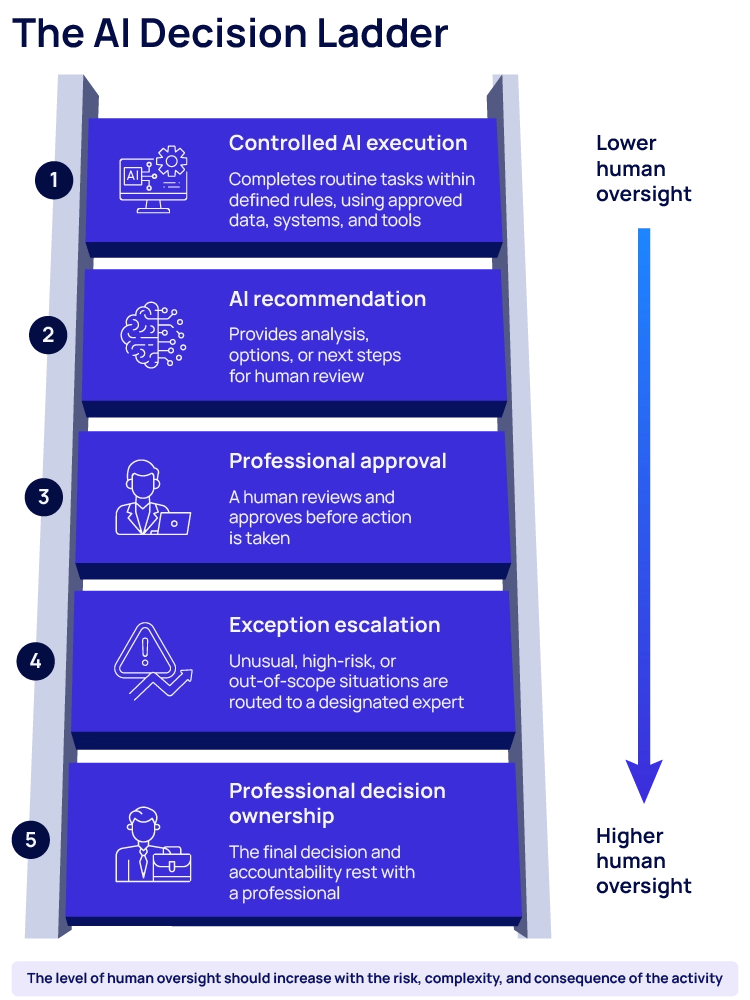
A practical model is a decision ladder:
- AI can execute within clearly defined rules.
- AI can recommend an action for review.
- Professional approval is required before execution.
- Exceptions must escalate to a designated expert.
- The professional owns the decision where judgment, risk, or accountability is material.
This creates a practical framework for AI-Driven Process Automation.
The level of autonomy should match the nature of the work. IBM’s guidance on agentic AI governance similarly emphasizes ownership, authority, boundaries, responsibilities, monitoring, and controls designed into the system.
Then Comes the Junior Work Problem
There is another issue that deserves attention.
Some of the work AI agents are well suited to perform is also the work through which junior professionals traditionally develop their skills.
Research. Drafting. Checking. Information gathering. Basic analysis.
If AI takes over too much of this work, firms could gain efficiency while creating a longer-term talent challenge.
Junior professionals still need opportunities to learn how to investigate an issue, identify unreliable information, challenge an answer, communicate with clients, and make decisions under uncertainty.
Thomson Reuters Institute research on building a tech-agile workforce emphasizes that organizations must help employees develop the skills needed to work effectively alongside AI and emerging technologies, highlighting workforce readiness, continuous learning, and technology adoption as key priorities.
As AI takes on more routine and repetitive tasks, the traditional career ladder may need to evolve. Junior professionals may spend less time creating first drafts and more time learning how to evaluate, refine, and validate AI-assisted outputs. Managers may shift from checking routine details to overseeing exceptions and quality. Senior professionals may devote more attention to complex judgment, strategic decision-making, and client relationships. In this environment, organizations need to rethink not only how work is done, but also how people learn the skills required to do that work effectively.
Rework Tells You Where the Model Is Breaking
One of the easiest mistakes in professional services automation is to measure only the amount of work an AI agent completes.
Completion does not necessarily mean quality.
Suppose an AI agent prepares 1,000 documents. If professionals need to substantially correct 300 of them, the automation may have simply moved the work downstream.
That makes rework an important operating signal.
Rework can come from many places:
- Poor source data
- Incomplete requirements
- Weak instructions
- Workflow design
- Agent limitations
- Application constraints
- Human review errors
- Changing client requirements
The point is to treat rework as evidence that the operating model needs adjustment, rather than assuming the AI itself is always the problem.
Useful measures could include:
- First-pass acceptance rate
- Correction rate
- Escalation rate
- Exception volume
- Professional review time
- Turnaround time
- Repeat work
- Client response time
These measures can show whether reducing rework with AI is actually happening.
Stop Measuring Only Hours Saved
Hours saved will remain useful.
But for professional services firms, the bigger question is what happens to the expert capacity that has been released.
Can specialists take on more complex work?
Can teams respond to clients faster?
Can senior professionals spend more time on advisory work?
Can the firm handle more engagements without adding the same amount of administrative workload?
Can employees spend more time developing expertise?
This suggests a broader productivity measure: expert capacity.
The value of AI may ultimately be reflected less in how many hours disappear and more in how much higher-value work becomes possible.
That is where enterprise AI transformation becomes an operating-model discussion. Technology creates the opportunity, but the value depends on how the organization redesigns work around it.
Where Could AI Agents Actually Work?
The possibilities vary by service line.
- Tax, audit and accounting
Agents could support document collection, reconciliation, research, preparation, exception identification, and quality checks.
- Legal, risk and compliance
Agents could help organize large volumes of information, identify relevant requirements, prepare summaries, and route exceptions for professional review.
Agents could support research, market analysis, data preparation, meeting preparation, proposal development, and recurring reporting.
- Advertising and marketing
Agents could assist with campaign research, content preparation, performance analysis, audience insights, and workflow coordination.
Agents could support information gathering, process coordination, employee communications, and administrative workflows.
These are potential use cases rather than a universal blueprint. The right application depends on the firm’s data, systems, controls, risk profile, and service model.
AI Workflow Orchestration Needs More Than Agents
An AI agent does not operate in isolation.
To perform useful work, it may need access to enterprise applications, documents, business rules, data, workflows, and approval processes.
That makes AI workflow orchestration an important part of the architecture.
It also makes application intelligence relevant.
Zerovity™ is Hexaware’s application intelligence and transformation platform. It builds a code-grounded understanding of application architecture, dependencies, and business logic, then applies that understanding across application maintenance, modernization, and transformation. Its capabilities include Business Logic Transformation and Agentic Engineering Automation.
For an AI workforce, that context matters.
An agent working inside an enterprise environment needs more than a task description. It needs to operate within the applications, workflows, business rules, and controls that shape the work.
That makes the foundation supporting an AI workforce broader than a collection of individual agents.
It includes:
Professional services expertise
↓
AI and agentic AI
↓
Intelligent process automation
↓
Enterprise data and applications
↓
Zerovity™ as an application intelligence and AI delivery layer
↓
Zero Friction Enterprise™ as the broader enterprise vision
The Technology Has to Match the New Operating Model
A new workforce needs supporting infrastructure.
For professional services firms, that can include:
- Reliable, AI-ready data
- Integration with enterprise applications
- Workflow orchestration
- Identity and access controls
- Human approval mechanisms
- Auditability
- Monitoring and observability
- Security and privacy controls
- AI evaluation and quality measurement
- Clear escalation paths
Hexaware’s AI services include enterprise AI transformation, agentic AI and autonomous systems, AI-enabled intelligent process automation, data foundation models, and data and AI engineering.
Its Intelligent Process Automation services also support professional services automation with workflow integration, automation platforms, and human intervention built into the approach.
The technology therefore needs to support the operating model the firm wants to build.
What Does a Zero Friction Enterprise Look Like?
The Zero Friction Enterprise™ provides a broader way to think about this evolution.
Hexaware describes the Zero Friction Enterprise as an approach to driving friction toward zero across systems, processes, and teams, with agentic AI extending that approach and Zerovity™ serving as an AI delivery layer. The foundation includes data readiness, security, governance, and observability.
For professional services firms, that could mean fewer unnecessary handoffs between people and systems.
A client request can move through research, preparation, review, approval, and follow-up with less manual coordination.
Professionals can see where work stands.
AI agents can handle defined tasks within their authority.
Exceptions can reach the right expert faster.
And the firm’s technology estate can support the way work actually needs to happen.
That is a more useful way to think about friction than simply counting applications or automation projects.
The AI Workforce Needs a Different Kind of Org Chart
The professional services org chart may not disappear.
It may become more distributed.
Professionals remain responsible for judgment, interpretation, relationships, complex decisions, and accountability.
AI agents take responsibility for defined categories of work.
Managers oversee people and AI-supported workflows.
Junior professionals learn to evaluate, challenge, supervise, and improve AI-generated work while developing the professional judgment they will need as their careers progress.
That creates a hybrid workforce.
The advantage may come from how well a firm designs the relationship between its human and digital workers.
The firms moving in this direction will need to answer practical questions:
- Which work should AI perform?
- Which work requires professional judgment?
- Where should a human approve the outcome?
- What happens when an agent is wrong?
- How will junior professionals build expertise?
- What will the firm measure to prove the model is working?
These questions are more important than simply asking how many AI agents a firm has deployed.
Ready to Design Your AI Workforce?
Start with the work itself.
Look at a workflow and identify where hidden costs of workflow friction are consuming professional capacity through repeated data entry, manual coordination, rework, unnecessary handoffs, or time spent searching for information.
Then determine which activities can be automated, which require AI assistance, which need professional review, and which should remain fully human-led.
From there, the technology can follow.
Hexaware combines professional services domain expertise with AI, agentic AI, intelligent process automation, data, digital engineering, cloud, and application intelligence capabilities. Its Professional Services practice spans tax, audit and accounting, legal, risk and compliance, people and talent, advisory and consulting, and advertising and marketing.
The question for 2027 is therefore bigger than whether your firm is ready for AI.
Is your organization ready to manage a workforce that includes both people and AI?
Start Mapping Your AI Workforce →