Introduction
Cybersecurity is no longer just a challenge for public sector institutions. It has become a non-negotiable strategic imperative. As governments accelerate digital transformation, they must protect growing volumes of Personally Identifiable Information (PII), critical infrastructure, and essential public services against increasingly sophisticated cyber threats.
Today’s cybercriminals, ransomware groups, and nation-state adversaries are continuously evolving their tactics, using automation and AI to launch persistent, targeted attacks. Unlike public sector institutions, these antagonistic actors are rarely constrained by traditional limitations such as time, workforce capacity, or operational budgets, allowing them to adapt and innovate at a rapid pace.
Public sector institutions, however, operate within very different realities. They must defend expanding digital environments while working within constrained budgets, limited cybersecurity talent, finite operational resources, complex governance structures, and increasing public accountability. As the volume and sophistication of cyber threats continue to grow, relying primarily on manual monitoring and response is no longer sustainable.
At the same time, rising labor costs and ongoing cybersecurity skills shortages are driving a fundamental shift in how institutions approach security operations. Organizations are increasingly adopting AI-driven cybersecurity capabilities, governed by human expertise, to automate routine tasks, improve threat detection and response, and enable security teams to focus on higher-value decision-making. This transition not only strengthens security and cyber resilience but also helps optimize long-term technology investments by shifting resources from labor-intensive operational activities toward scalable cybersecurity capabilities.
This guide explores the evolving public sector cybersecurity landscape, the key threats facing government institutions, and the strategies required to build resilient security programs that strengthen critical infrastructure and maintain public trust.
What Is Public Sector IT Security?
Public sector IT security refers to the policies, technologies, governance frameworks, and operational practices used to protect government systems, applications, networks, cloud environments, Operational Technology (OT), and sensitive data from cyber threats. Its objective is to safeguard critical services, protect Personally Identifiable Information (PII), and ensure governments can continue serving citizens securely and without disruption.
Public sector institutions manage high-value assets such as citizen records, healthcare data, financial information, defense systems, and critical infrastructure, making them attractive targets for cybercriminals and nation-state adversaries.
Unlike private organizations, however, they operate under unique constraints. They must balance cybersecurity with public accountability, regulatory compliance, multiple layers of governance and oversight, political priorities, budget limitations, legacy infrastructure, and the need to deliver uninterrupted public services. These institutional complexities make cybersecurity transformation more challenging and reinforce the need for resilient, risk-based security strategies.
Modern government IT environments extend well beyond traditional infrastructure. Today’s digital ecosystem includes hybrid cloud environments, citizen-facing platforms, IoT devices, digital twins, third-party suppliers, and interconnected public services. As governments accelerate digital transformation, this expanding digital footprint increases the cyber attack surface, requiring organizations to proactively identify, manage, and mitigate evolving cyber risks.
Many public sector institutions continue to rely on legacy technologies, but legacy does not always mean insecure. Platforms such as mainframes continue to support mission-critical workloads because of their mature architecture, hardware-enforced isolation, strong access controls, and proven reliability. However, risk often emerges when these systems are integrated with cloud platforms, third-party applications, or unsupported software, creating new attack surfaces. Rather than replacing legacy systems outright, organizations should adopt a phased, risk-based modernization approach that strengthens security while maintaining operational continuity.
An effective strategy focuses on three priorities:
- Protect sensitive data: Safeguard citizen information through strong identity controls, encryption, and public sector data protection practices.
- Ensure service continuity: Build public sector cyber resilience so critical services remain available during cyber incidents.
- Preserve public trust: Adopt proactive cyber risk management public sector strategies that strengthen security while enabling reliable public services.
Decoding the Public Sector Threat Landscape (2025-2026)
The threat landscape facing public sector institutions is becoming increasingly sophisticated. Cybercriminals, nation-state adversaries, and organized threat groups are targeting governments to disrupt critical services, steal sensitive information, and compromise national security. As digital transformation accelerates, protecting government IT security requires addressing threats across interconnected IT, OT, cloud, IoT, and third-party environments.
Nation-State Threats
Nation-state adversaries often target government institutions to conduct espionage, disrupt essential services, or gain strategic advantage. These attacks typically involve advanced persistent threats (APTs), long-term infiltration, credential theft, and supply chain compromise, allowing attackers to remain undetected for extended periods.
Ransomware
Ransomware continues to be one of the most disruptive threats to the public sector. Attackers increasingly combine data encryption with data theft, using the threat of public disclosure to increase pressure on organizations managing sensitive citizen information.
Supply Chain Attacks
Government organizations rely on extensive networks of software vendors, cloud providers, and service partners. within a trusted supplier can expose multiple public institutions, making third-party governance a critical component of cyber risk management public sector strategies.
Critical Infrastructure Risks
Increasing connectivity across transportation, healthcare, energy, water, and emergency services has expanded the attack surface for critical infrastructure security. The growing adoption of IoT devices and digital twins further increases operational complexity and requires stronger security controls across both IT and OT environments.
AI-Enabled Threats
Threat actors are increasingly using AI to automate reconnaissance, generate convincing phishing campaigns, develop malware variants, and evade traditional security controls. At the same time, security teams are adopting AI-powered detection, threat intelligence, and response automation to identify and contain attacks more quickly.
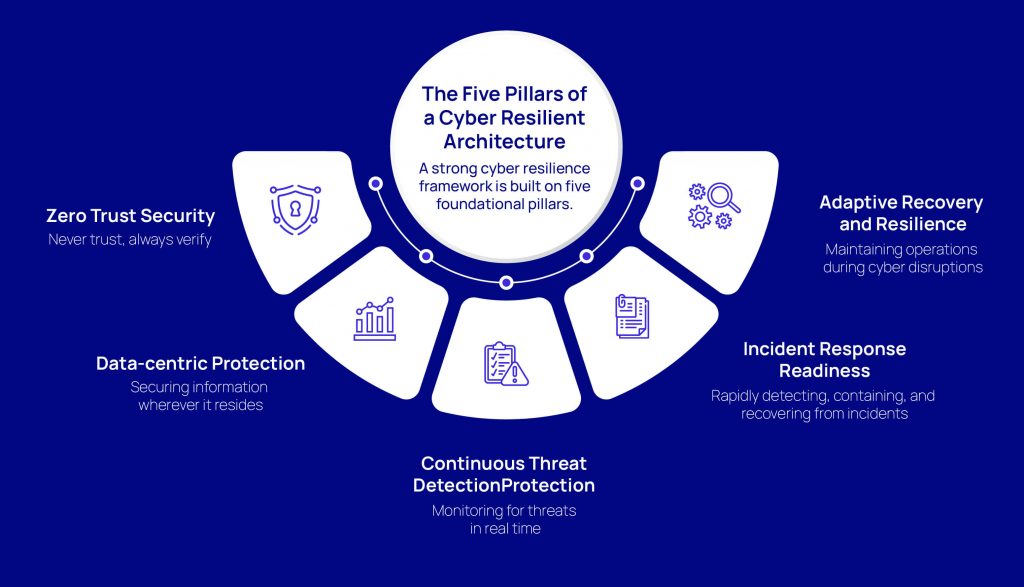
The Five Pillars of a Cyber Resilient Architecture
Building public sector cyber resilience requires more than preventing cyberattacks. A resilient security strategy enables public sector institutions to anticipate threats, minimize disruption, recover quickly, and maintain the continuity of essential public services.
1. Zero Trust Security
Zero Trust Security follows the principle of “never trust, always verify.” Every user, device, application, and workload must be continuously validated before accessing government resources. A robust Identity and Access Management (IAM) strategy should include strong authentication to verify identities, granular authorization to enforce least-privilege access, and continuous access management that adapts permissions based on user behavior, device health, and risk. Combined with micro segmentation and continuous monitoring, these controls help prevent unauthorized access and limit lateral movement across government environments.
2. Data-Centric Protection
As public sector institutions manage vast amounts of Personally Identifiable Information (PII) and other sensitive data, security must extend beyond the network perimeter. A strong government data protection strategy includes data classification, encryption, secure sharing, backup and recovery, and data loss prevention across on-premises, cloud, and hybrid environments.
3. Continuous Threat Detection and Response
Cyber threats evolve rapidly, making continuous visibility essential. Modern security operations combine Security Information and Event Management (SIEM), Extended Detection and Response (XDR), Security Operations Centres (SOC), threat intelligence, and AI-assisted analytics to identify suspicious activity, prioritize risks, and accelerate incident response across IT, OT, cloud, and IoT environments.
4. Incident Response Readiness
Even the strongest security controls cannot eliminate every risk. A well-defined incident response plan enables organizations to detect, contain, eradicate, and recover from cyber incidents while minimizing operational disruption. Regular tabletop exercises, simulations, and post-incident reviews help strengthen preparedness and improve future response.
5. Adaptive Recovery and Business Continuity
Cyber resilience extends beyond incident response to ensuring essential services remain operational during and after an attack. A cyber-resilient architecture combines business continuity planning, disaster recovery, immutable backups, system redundancy, and regular recovery testing to restore operations quickly and minimize the impact on citizens and public services.
Strategic Best Practices for Public Sector IT Security
Building a resilient security posture requires more than deploying technology. Successful public sector IT security programmes align people, processes, governance, and technology around a common mission: protecting citizens, essential services, and critical assets.
Modernize Legacy Systems Strategically
Many public sector institutions continue to rely on legacy infrastructure to support mission-critical operations. While ageing applications and unsupported software can increase cyber risk, legacy systems are not inherently insecure. Technologies such as mainframes continue to underpin critical government and financial workloads because of their mature architecture, hardware-enforced isolation, robust access controls, and proven reliability.
Risk often arises when these platforms are integrated with modern applications, cloud environments, or unsupported technologies, creating new attack surfaces. Rather than replacing legacy systems outright, organizations should adopt a phased, risk-based modernization strategy that strengthens security while maintaining operational continuity.
Cybersecurity modernization initiatives should prioritize:
- High-risk systems handling sensitive data
- Citizen-facing applications
- Critical infrastructure platforms
- Unsupported software and hardware
- Systems with significant compliance exposure
Implement Identity-First Security
Compromised credentials remain one of the most common attack vectors in government cybersecurity incidents. An identity-first approach ensures users have the right level of access at the right time while reducing the risk of unauthorized activity.
Key capabilities include:
- Multi-factor authentication (MFA)
- Privileged Access Management (PAM)
- Identity Governance and Administration (IGA)
- Continuous authentication
- Risk-based access controls
As public sector institutions embrace hybrid work and cloud environments, and access management has become the new security perimeter.
Strengthen Third-Party Risk Management
Public sector institutions depend on an extensive ecosystem of vendors, contractors, managed service providers, and software suppliers. A single compromised partner can expose critical systems and sensitive data.
To reduce supply chain risk, organizations should:
- Conduct vendor security assessments
- Continuously monitor third-party risks
- Enforce cybersecurity requirements in contracts
- Validate regulatory compliance regularly
- Assess software supply chain integrity
Third-party governance should become a core component of cyber risk management for the public sector, rather than a periodic compliance exercise.
Adopt Security by Design
Security should be embedded throughout the technology lifecycle rather than introduced after deployment. Integrating security from the outset reduces vulnerabilities, accelerates remediation, and strengthens long-term resilience.
Security-by-design practices include:
- Secure software development
- Automated vulnerability testing
- Infrastructure-as-code security controls
- Secure cloud architecture reviews
- Continuous compliance validation
Enhance Workforce Cyber Awareness
Technology alone cannot prevent cyber incidents. Employees remain both a potential source of risk and one of the strongest lines of defense.
Public sector institutions should invest in:
- Security awareness training
- Phishing simulations
- Executive cyber exercises
- Role-based security education
- Insider threat awareness programmes
Measure Resilience, Not Just Security
Traditional metrics, such as blocked attacks or vulnerability counts, provide only a partial view of an organization’s security posture. Measuring resilience helps leaders understand how effectively their institution can respond to and recover from cyber incidents.
Key metrics include:
- Mean Time to Detect (MTTD)
- Mean Time to Respond (MTTR)
- Recovery Time Objectives (RTOs)
- Recovery Point Objectives (RPOs)
- Incident recovery success rates
Together, these metrics provide a more meaningful assessment of public sector cyber resilience and support continuous improvement.
Leadership’s Role: Cybersecurity as Governance
One of the biggest shifts in modern cybersecurity is the recognition that security is no longer solely an IT responsibility. It is a governance, risk, and business continuity issue.
Public-sector leaders play a critical role in shaping organizational resilience.
Elevating Cybersecurity to the Boardroom
Cyber incidents can disrupt essential public services, impact citizen trust, and create national security concerns.
As a result, cybersecurity discussions should involve:
- Institutional Leadership
- Department heads
- Risk management leaders
- Legal and compliance teams
- Operational stakeholders
Security decisions should align objectives and public service priorities.
Establishing Clear Accountability
Successful security programs define responsibilities across the organization.
Leadership teams should establish:
- Governance frameworks
- Security ownership models
- Risk escalation processes
- Incident reporting structures
- Decision-making authorities
Clear accountability accelerates response efforts during cyber incidents and reduces operational confusion.
Aligning Security Investments with Risk
Budget constraints remain a reality across many government organizations. Beyond cost-benefit analyses, leaders must factor security and risk considerations into investment decisions to ensure resources are directed where they can deliver the greatest value. Key considerations include:
- Threat exposure
- Mission criticality
- Data sensitivity
- Regulatory requirements
- Service delivery impact
A risk-based approach helps organizations prioritize investments that strengthen security, improve resilience, and safeguard the delivery of essential public services.
Building a Culture of Resilience
Resilient organizations recognize that cybersecurity is everyone’s responsibility.
Leadership can strengthen resilience by:
- Promoting security awareness
- Supporting continuous learning
- Encouraging transparent reporting
- Rewarding proactive risk management
- Conducting regular resilience exercises
Culture often determines how effectively organizations respond when incidents occur.
Future-Proofing: Emerging Tech & Sovereign Security
The next generation of public-sector cybersecurity will be shaped by evolving technologies, geopolitical realities, and increasing digital interconnectivity.
Agencies must prepare for challenges that extend beyond today’s threat landscape.
AI-Powered Security Operations
Artificial intelligence is becoming a force multiplier for security teams.
AI-driven capabilities can help agencies:
- Detect threats faster
- Analyze large security datasets
- Prioritize alerts
- Automate investigations
- Improve incident response
As AI becomes central to both cyberattacks and cyber defense, organizations should also understand how AI-driven security operations align with industry best practices such as the NIST Cybersecurity Framework (CSF) 2.0. Read our blog, Hexaware’s AI-Driven Cybersecurity Solutions Align with NIST CSF 2.0 Using Microsoft Security Services, to learn more.
Quantum Computing Readiness
While large-scale quantum threats remain several years away, governments are already planning for a post-quantum future.
Future-focused agencies should begin:
- Inventorying cryptographic assets
- Evaluating quantum-resistant encryption
- Updating long-term security roadmaps
- Monitoring evolving standards
Preparation today can reduce future migration challenges.
Cloud-Native Security
Cloud adoption continues to accelerate across the public sector.
However, cloud migration alone does not improve security.
Agencies need:
- Cloud security posture management
- Continuous compliance monitoring
- Secure workload protection
- Cloud-native threat detection
- Strong identity governance
Cloud environments should be designed with resilience as a foundational principle.
Data Sovereignty and Trusted Digital Infrastructure
As governments accelerate digital transformation, data sovereignty is becoming an increasingly important consideration alongside cybersecurity. Public sector institutions must ensure that sensitive data is stored, processed, and governed in accordance with national regulations while maintaining visibility and control over critical digital assets.
Key priorities include:
- Meeting data residency requirements
- Adopting sovereign or regulator-approved cloud environments where appropriate
- Strengthening trusted technology and supply chain ecosystems
- Protecting critical digital infrastructure
- Ensuring compliance with evolving national cybersecurity regulations
As geopolitical risks and regulatory requirements continue to evolve, data sovereignty will play an increasingly important role in shaping government data protection strategies and long-term cyber resilience.
Resilience-Driven Security Models
The future of public sector IT security will focus on building proactive resilience alongside strong defensive perimeters. While preventing cyberattacks remains essential, organizations must also be prepared to anticipate, withstand, recover from, and adapt to evolving cyber threats.
Organizations that embed resilience into their security strategy will be better positioned to maintain critical services, minimize disruption, and continue serving citizens regardless of the challenges they face.
How Hexaware Can Help
Building public sector cyber resilience requires more than technology. It requires a strategic partner that understands the complexity of modern government environments and the evolving cyber threat landscape.
Hexaware combines consulting, engineering, and managed cybersecurity services to help public sector institutions strengthen security, modernize operations, and build resilience. With the addition of CyberSolve, Hexaware has further expanded its cybersecurity capabilities, bringing together deep expertise in Identity and Access Management (IAM), Zero Trust, governance, risk, and compliance to help organizations secure complex hybrid environments.
Our cybersecurity capabilities include:
- Governance, Risk, and Compliance (GRC)
- Identity and Access Management (IAM)
- Zero Trust implementation
- Hybrid cloud security
- DevSecOps and application security
- Security operations and cyber resilience
- Risk assessment and compliance management
By embedding cybersecurity across cloud, infrastructure, applications, and digital operations, Hexaware is well-positioned to help public sector organizations reduce cyber risk, improve resilience, and deliver secure digital services with confidence.
Ready to Build Cyber Resilience with Confidence?
Protect critical services, strengthen security operations, and prepare for evolving threats with a resilience-first cybersecurity strategy.
Click here to learn more about our cybersecurity services, and here to learn how we can help public sector enterprises modernize systems, secure operations, and deliver better citizen outcomes.