Summary
Modern business process services (BPS) require a retained operating model that aligns providers, internal teams, automation, and AI-enabled BPS services to deliver outcomes—not just activity. A BPS control tower orchestrates outsourced delivery for measurable enterprise outcomes.
Key takeaways
- A BPS control tower is a client-owned operating capability, not just a vendor dashboard.
- It clarifies ownership where execution spans providers, automation, AI, and internal teams.
- It prioritizes coordinated decisions over isolated optimizations.
Introduction
Business process outsourcing (BPO) began as a straightforward way to hand off tasks to service providers, primarily to reduce costs and improve efficiency. Over time, it evolved, blending service partners, retained teams, platforms, automation, analytics, and AI-enabled BPS services. Providers are increasingly expected to contribute to transformation and outcomes, not just execution. Yet many organizations are still trying to run this new reality with business process services (BPS) operating models designed for a simpler past.
This mismatch has created a growing gap between what business process services are expected to deliver and how it is actually run. That gap is where the idea of a control tower starts to matter — not as a piece of technology, but as a way of rethinking how modern outsourcing programs are governed, steered, and owned.
What Is a ‘Control Tower’ and What Does It Mean in BPS?
The idea of a control tower didn’t originate in the BPO industry. It comes from environments like supply chains, where execution is distributed across multiple parties, systems, and locations — but decisions still need to be made quickly and in a coordinated way.
In supply chains, a control tower typically refers to a centralized platform that aggregates real‑time data, applies analytics, and supports faster, better‑informed decisions across the network.
In BPS, however, the meaning is different — and broader.
In the context of modern BPS, a control tower is not a tool, platform, or dashboard. It is the retained organization’s operating model—combining governance, decision rights, analytics, and accountability to orchestrate outsourced delivery and ensure outcomes.
That distinction is important. A BPS control tower operating model isn’t about adding more oversight or tightening controls. It’s about deciding where ownership sits when execution spans providers, automation, AI platforms, and internal teams.
Why Outsourcing Alone No Longer Works in Modern BPS
Traditional outsourcing models were designed for a more predictable world — one where volumes were stable, processes changed infrequently, and roles were clearly separated.
Modern BPS looks nothing like that. Today, organizations are dealing with:
- Hybrid BPO delivery models that blend people, automation, and AI
- Bundled contracts that combine operations, analytics, and technology
- Continuous transformation rather than one-time change programs
- Shorter contract cycles that compress time to value
In this environment, outsourcing without reconsidering who owns what can cause friction. Decisions stall. Dependencies are overlooked. Transformation efforts end up clashing with everyday business priorities. While providers focus on optimizing their specific areas, there’s no one taking responsibility for the entire system.
The bottom line: Execution can be outsourced; system-level ownership cannot.
This is not a failure of providers. It is a structural limitation of an outsourcing‑only model applied to a far more complex reality.
If your current model still treats outsourcing as a handoff, schedule a short assessment. Simply write to marketing@hexaware.com.
The Retained Team as the Control Tower
If a control tower is an operating model, the next question is obvious: where does it live?
In practice, it lives within the retained organization in outsourcing.
High‑performing outsourcing programs intentionally retain roles that anchor ownership and decision‑making, including:
- Process owners and governance leads
- Transformation and change owners
- Value managers and prioritization leads
These roles aren’t about micromanaging delivery. They exist to handle the decisions that sit above individual processes or providers. It allows organizations to:
- Anchor ownership for system‑wide trade‑offs
- Make prioritized trade-offs across cost, risk, and experience
- Align transformation initiatives with steady‑state operations
Maintaining a retained orchestration layer is a response to complexity—not inefficiency—to ensure that execution across providers, automation, and internal teams aligns with enterprise outcomes. As BPO becomes more integrated, AI‑driven, and outcome‑oriented, the cost of not retaining orchestration capability quickly outweighs the cost of maintaining it.
Industry data reflects this shift. ISG® Market Lens’ 2026 Business Process Outsourcing Study shows that modern BPO programs consistently operate with substantial retained teams alongside partner FTEs.
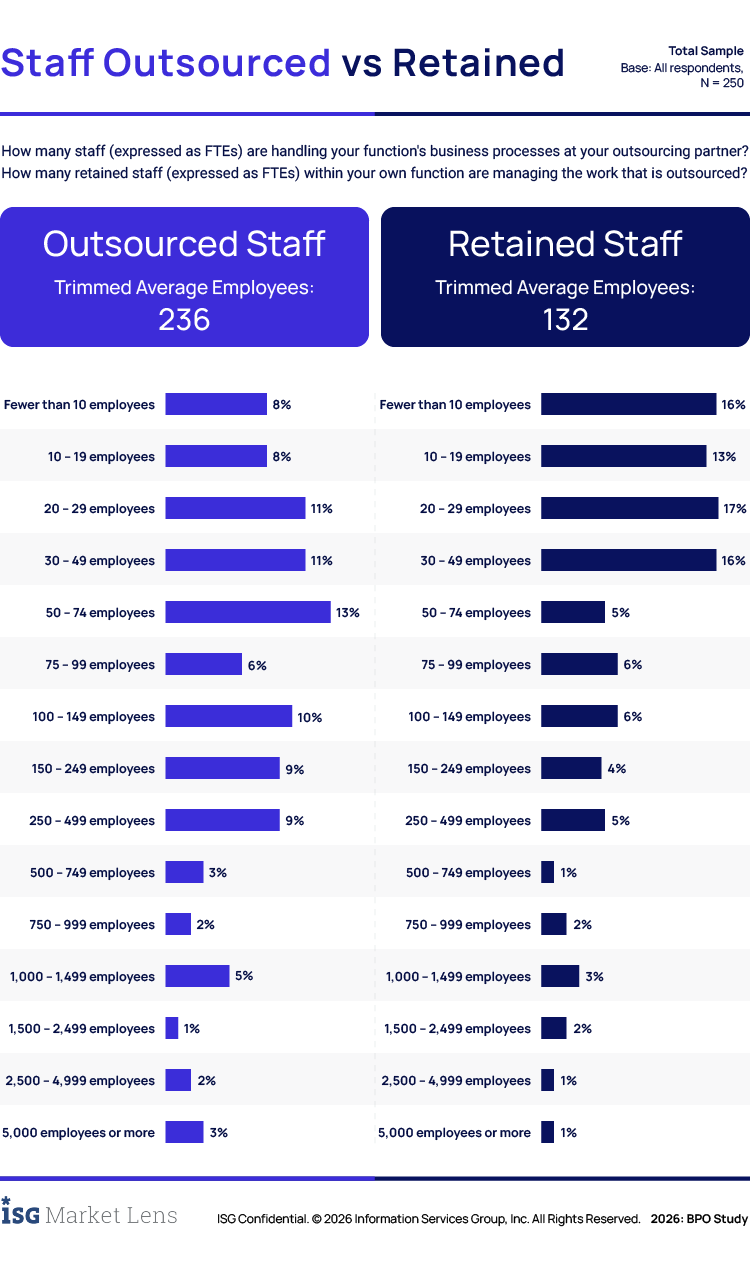
Source: ISG Market Lens 2026 BPO Study, n=250
“Enterprises are doubling down on hybrid BPO. Partly outsourced models dominate customer operations and change‑heavy domains—CX process management, finance and procurement transformation, procurement technology, industry‑specific processing, and routine customer transactions. The mix signals a preference for flexible capacity and specialist skills without relinquishing full control of end‑to‑end processes.
“Core control towers stay in‑house: supply and production planning (74%), FP&A (72%) and treasury (64%) lead, with supplier management and tactical purchasing also anchored internally. Full outsourcing concentrates in scalable, transactional areas—talent acquisition (42%) and customer technical support (40%)—with material footprints in payroll, logistics, and learning. The split underscores governance over strategy versus outsourcing execution,” the report noted.
What a BPS Control Tower Actually Does
To understand the value of a BPS control tower, it helps to move beyond generic ideas of governance and look at how decisions are made day to day.
At its core, a control tower enables three capabilities that traditional outsourcing models often struggle with.
Decision coherence
In intricate outsourcing setups, every decision is linked. A modification to one process may have repercussions for expenses, risks, compliance, or even the general experience in other domains. A control tower assists in establishing clear decision rights and escalation pathways to ensure that trade-offs are made deliberately rather than by accident or as a result of delays.
Dynamic steering
Most outsourcing models still rely on periodic reviews to spot issues. By the time problems show up there, they’ve often already taken root. A control tower enables ongoing steering instead — bringing performance signals, risk indicators, and transformation progress into the same conversation, while there’s still time to act.
Run‑and‑change integration
One of the most common points of failure in BPO is the collision between transformation programs and day‑to‑day operations. A control tower provides a single point of orchestration that keeps operations stable while change moves forward — instead of forcing leaders to choose between running the business and fixing it.
Viewed structurally, a BPS control tower can be understood as a simple operating pyramid.
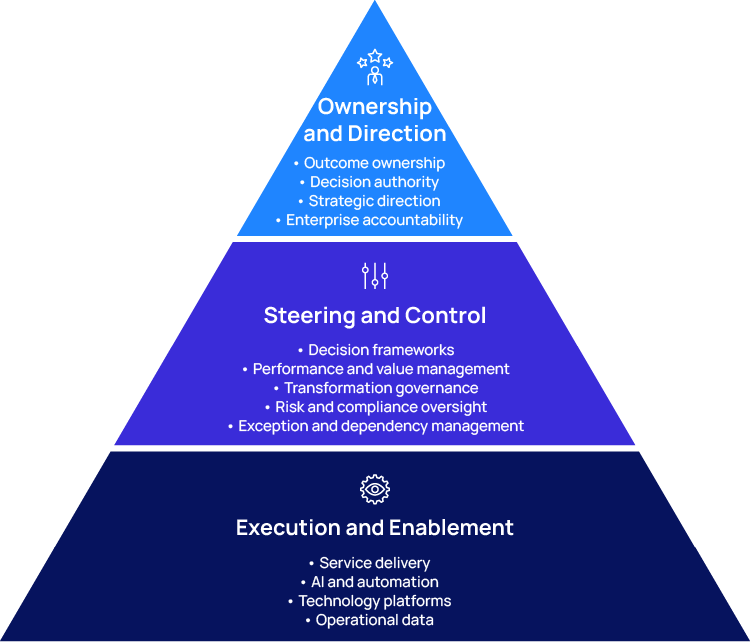
Orchestration is the principle that governs how all layers work together. Seen this way, the control tower is less about control and more about coordination at speed.
Why Control Towers Matter More Now, in the Age of AI
The argument for a control-tower approach isn’t just a concept anymore; it’s becoming essential, given how BPO contracts are being written and how risk is absorbed in practice. With shorter contract cycles, there’s little room for slow or postponed decisions. As BPO agreements start to bundle more services and technologies, having alignment shifts from being a luxury to a necessity for smooth operations.
Automation and AI increase opportunities but they also raise the stakes in the event that something goes wrong. AI in BPO doesn’t just make execution faster; it multiplies decisions: when to intervene, what to prioritize, and how much risk to accept. Models act continuously, and a single AI-driven decision can instantly reshape cost, compliance, or customer experience elsewhere.
This is where many AI-enabled BPS services strain. Not because the technology underperforms, but because ownership becomes blurred. Who is accountable when efficiency improves but experience degrades? Who arbitrates when models from different providers optimize for conflicting outcomes?
A control tower resolves this by putting AI in context rather than replacing it. Signals and recommendations flow into a retained operating layer that weighs them against enterprise priorities — decision rights are clear, escalation paths exist in advance, and AI is coordinated across providers instead of siloed.
How AI Strengthens the Control Tower
Paradoxically, AI also makes the control tower viable at scale. Applied with a clear purpose, it can:
- Detect anomalies in real time — surfacing deviations across providers before they escalate
- Enable predictive decision support — driving earlier, lower-cost interventions
- Synthesize cross-provider performance — delivering a single, coherent view of outcomes
- Automate escalation routing — directing the right exceptions to the right owners instantly
Without that orchestration layer, AI amplifies fragmentation. With it, AI becomes a force multiplier — accelerating execution while keeping outcomes aligned. As BPS becomes more advanced, the margin for error shrinks. Control towers are how organizations manage that complexity without slowing down.
What Changes When BPS Is Run Through a Control Tower
When BPS adopts a control-tower model, it leads to some significant changes:
- Vendor management transitions from merely enforcing contracts to truly owning the outcomes.
- Governance shifts from retrospective reporting to directing future developments.
- SLAs are still important but they are no longer the only metric that matters.
- Accountability becomes more acute — not because it is enforced more tightly, but because ownership is no longer assumed.
Over time, complexity stops acting as a constraint. Instead of scaling back ambition to keep outsourcing manageable, organizations gain confidence in vendor management and governance to expand automation, AI, and transformation — because there is a clear way to coordinate it all.
That is what allows stronger BPS programs to keep evolving.
Implications for Enterprise Leaders
Control-tower-led BPS requires enterprise leaders to have a different perspective on retained capacity. The focus moves from tracking work to owning value, from monitoring activity to orchestrating results, and from supervising delivery to owning decisions.
It also entails having a clear understanding of decision-making rights before adding new platforms or tools. A strong operating model can be reinforced by technology but a lack of ownership cannot be fixed.
The client-provider dynamic also changes. Although they remain crucial execution partners, providers now operate within a client-owned framework. Clients can set priorities, make trade-offs, and take ownership of the results with this model.
The future of BPS isn’t about outsourcing more. It’s about orchestrating better.
How Hexaware Helps Enable Control‑tower‑led BPS
As BPS operating models continue to evolve, it becomes more important than ever for companies to team up with partners who grasp both orchestration and execution.
Apart from providing automation, managed services, AI transformation, and technology platform implementation, Hexaware supports enterprises in designing and operationalizing control‑tower‑led BPS models — strengthening retained governance, clarifying decision frameworks, and enabling coordination across services and technology. Rather than replacing the enterprise control tower, Hexaware works alongside clients to help them build and mature it.
By blending deep process expertise with AI-enabled and AI-native services and a wealth of experience in hybrid environments, Hexaware supports organizations throughout the outsourcing spectrum — from steady‑state delivery to large-scale transformations.