Key Takeaways
- Knowledge transfer is shifting from one-time handovers to continuous knowledge access.
- Modern KT builds operational capability, not just documentation or training attendance.
- AI-enabled knowledge management reduces SME dependency by surfacing contextual guidance in the flow of work.
- Successful AI-powered knowledge transfer depends on current, governed, and SME-validated knowledge.
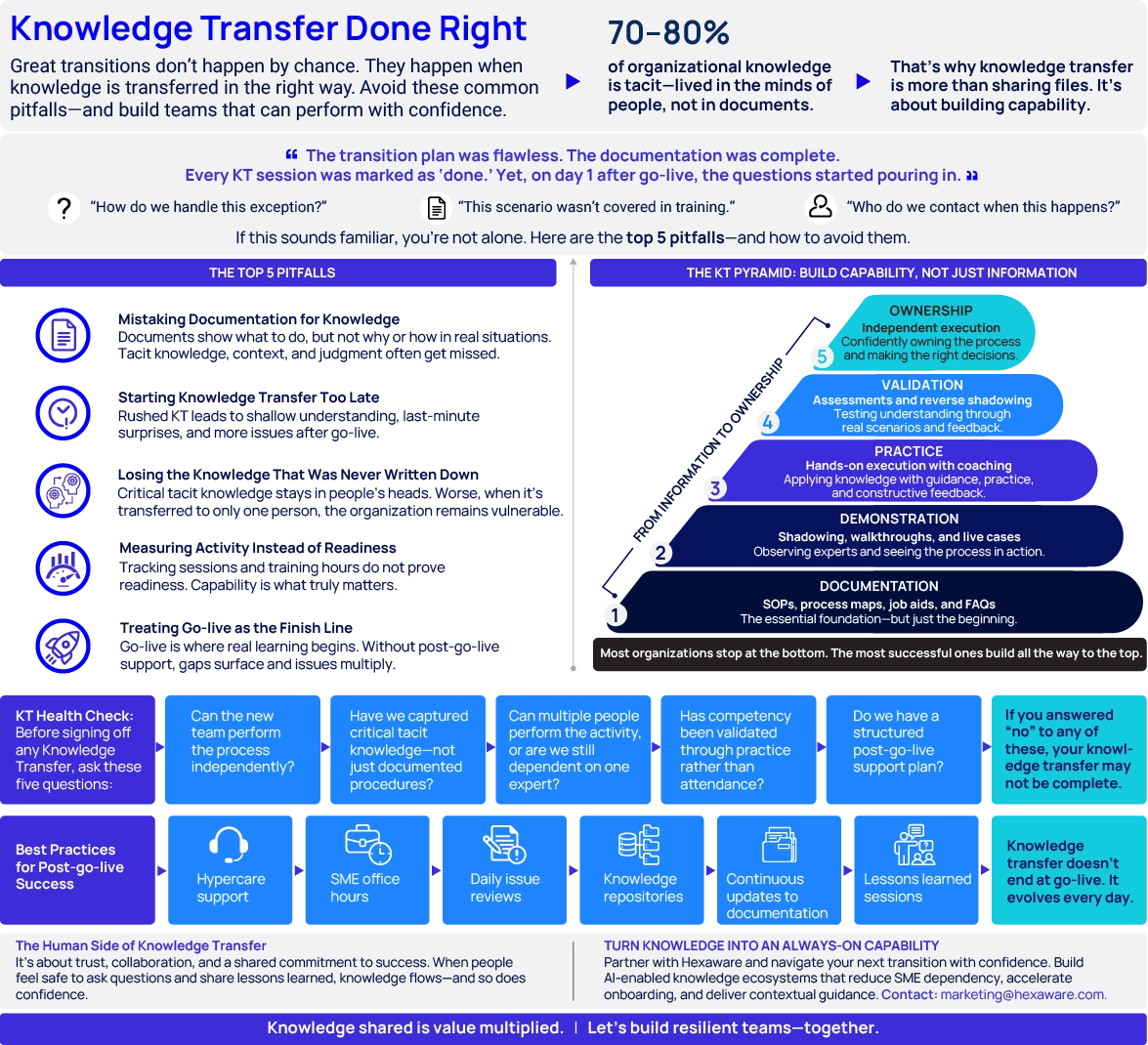
Imagine the following scenario: An organization’s transition plan is on track, every standard operating procedure (SOP) has been approved, and every knowledge transfer (KT) session has been completed. Yet within days of go-live, productivity drops, exceptions pile up, and the new team starts reaching back out to the incumbent team to keep operations moving. Why? This often happens because knowledge is documented but not transferred. For decades, organizations have invested heavily in knowledge transfer processes during outsourcing, shared services migrations, ERP implementations, operating model redesigns, and M&A integrations. While these practices remain important, a fundamental shift is underway—mere knowledge transfer during transition is no longer sufficient. The need of the hour is to make knowledge continuously available. This is where AI in knowledge management is transforming the traditional KT model into a knowledge-on-demand capability.
What Knowledge Transfer Really Means
Knowledge transfer is not about sharing information. Knowledge transfer best practices involve enabling teams to understand business context, execute independently, handle exceptions confidently, make informed decisions, and continuously improve operations.
Successful KT builds capability, not awareness.
The true measure of success is whether the receiving team can operate independently after go-live.
Top 5 Knowledge Transfer Pitfalls
| Pitfall |
Business Impact |
Best Practice |
| Documentation replaces learning |
Teams struggle with exceptions and judgment calls |
Combine documentation with simulations and hands-on learning |
| Training only for standard scenarios |
Increased escalations and delays |
Train on real-world scenarios and exceptions |
| Measuring attendance instead of capability |
Teams cannot work independently |
Validate readiness through assessments and simulations |
| Losing tribal knowledge |
Loss of institutional knowledge |
Capture SME expertise systematically |
| Treating go-live as the finish line |
Prolonged stabilization periods |
Extend support through hyper care and coaching |
Many of these challenges can be addressed through AI-enabled knowledge transfer processes, which make institutional knowledge easier to discover, access, and apply.
The New Era of Knowledge Transfer
| Traditional KT |
Modern KT |
| Documentation-focused |
Capability-focused |
| Attendance tracking |
Readiness validation |
| Knowledge transferred periodically |
Knowledge available on demand |
| Learning is concentrated during the transition |
Learning is embedded in daily work |
| SME-dependent |
AI-assisted knowledge discovery |
| Knowledge stored in static repositories and documents |
Knowledge connected across systems |
| KT is viewed as a project activity that ends at go-live |
KT is viewed as a continuous learning ecosystem |
Knowledge transfer is shifting from a transition activity to a continuous enterprise capability. The goal is no longer just to document and transfer knowledge periodically, but to leverage AI-powered knowledge transfer to make expertise available in context, on demand, and at the moment of need.
Ensuring a successful ‘knowledge-on-demand’ implementation depends on four crucial pillars:
| Pillar |
Focus |
| People |
SME ownership and capability assessments |
| Process |
Structured KT and readiness validation |
| Technology |
Knowledge repositories and enterprise search |
| Governance |
Metrics, ownership, and hyper care |
Technologies Redefining the Knowledge Transfer Process
| Technology |
What It Enables |
Business Value |
| Enterprise AI search |
Instant access to knowledge across systems |
Faster onboarding and reduced SME dependency |
| Expert discovery |
Quick identification of SMEs and process owners |
Faster issue resolution |
| Automated knowledge capture |
Conversion of meetings and KT sessions into searchable assets |
Reduced tribal knowledge loss |
| Digital adoption platforms |
Learning embedded within applications |
Faster capability development |
| Agentic AI |
Real-time guidance and workflow support |
Improved productivity and decision-making |
Leading AI Tools Supporting KT
The following tools are helping organizations operationalize AI-enabled knowledge transfer at scale:
| Tool |
Typical KT Use Cases |
| Microsoft 365 Copilot |
Onboarding, policy retrieval, and process support |
| Glean |
Enterprise search and SME discovery |
| Guru |
SOPs, FAQs, and operational guidance |
| Atlassian Rovo |
Project and IT knowledge discovery |
| WalkMe |
In-application guidance and training |
| Copilot Studio |
Custom KT assistants and learning co-pilots |
Before You Deploy AI
Many organizations rush to deploy AI before establishing the foundations required for successful AI-powered knowledge transfer. A better sequence would be to:
- Standardize processes
- Capture SME knowledge
- Build governed repositories
- Establish ownership
- Deploy AI search and copilots
AI will not fix broken knowledge management. It will simply expose it faster. Before deploying AI, ensure knowledge is documented, current, governed, owned, and enriched with critical SME expertise.
Where AI-enabled Knowledge Management Falls Short
| Limitation |
KT Implication |
| AI provides answers, not judgment |
Human accountability remains essential |
| AI is only as good as its data |
Strong governance is critical |
| AI struggles with tacit knowledge |
Mentoring and coaching remain important |
| AI can be wrong |
Validation is required |
| AI cannot replace hands-on learning |
Simulations and practical experience remain necessary |
Bottom Line: AI accelerates access to knowledge. It does not replace capability development.
Trust AI. Verify AI.
The biggest risk in AI-enabled knowledge transfer is overreliance.
| Validation Area |
Key Question |
| Source validation |
Does the answer reference an approved source? |
| Data currency |
Is the information current? |
| Risk assessment |
What happens if the answer is wrong? |
| SME oversight |
Has critical content been validated? |
Golden Rule: AI can recommend. Humans must decide.
Also read: AI-powered Knowledge Bases: A Smarter Way to Access Information
The KT Maturity Journey
Think of it as a progression from documentation-centric KT to AI-enabled knowledge on demand.
| Level |
Outcome |
What It Means |
| Level 1 |
Knowledge is Stored |
Knowledge exists in SOPs, process maps, SharePoint folders, Confluence pages, or repositories. Finding and using it still depends heavily on individuals. |
| Level 2 |
Knowledge is Shared |
Structured KT sessions, workshops, training programs, and documentation handovers are conducted. Knowledge is shared but not necessarily retained or applied effectively. |
| Level 3 |
Knowledge is Applied |
Teams can perform activities independently after KT. Knowledge has been translated into capability and operational readiness. |
| Level 4 |
Knowledge is Made Accessible |
Employees can quickly find the information they need through enterprise search tools and AI assistants rather than searching through multiple repositories or contacting SMEs. |
| Level 5 |
Knowledge is Embedded |
Knowledge is integrated directly into workflows and applications. Employees receive contextual guidance while performing tasks rather than having to search for information. |
| Level 6 |
Knowledge is Continuously Delivered |
AI, automation, and intelligent agents proactively deliver relevant knowledge, recommendations, and guidance based on the user’s context, role, and activity. |
The shift can be summarized as:
| Old Mindset |
New Mindset |
| How do we transfer knowledge? |
How do we make knowledge available? |
| Train employees once |
Support employees continuously |
| People search for answers |
People receive contextual guidance |
| Knowledge is stored in documents |
Knowledge is embedded in workflows |
Leading organizations are rapidly moving toward Levels 5 and 6, where knowledge is captured automatically, guidance is embedded into workflows, and expertise scales beyond individuals.
Also read: Overcoming Resistance to Agentic AI Adoption in BPS
Final Thoughts
The future of knowledge transfer is not about transferring knowledge faster. It’s about eliminating the need to search for knowledge.
For decades, KT was viewed as a transition activity. Today, leading organizations are transforming it into a continuously available capability powered by AI, enterprise search, digital adoption platforms, and intelligent agents.
The winners will not be the organizations with the most documentation. They will be the ones that make expertise instantly accessible, continuously updated, and impossible to lose.