Ask any rail operations executive where critical rail supply chain risk hides, and material management rarely tops the initial agenda. It stays in the background right up until a maintenance depot runs completely out of a safety-critical traction motor component, or an internal audit uncovers a central warehouse holding tens of millions of dollars in obsolete inventory. As rail networks become more complex, AI demand forecasting for railways is emerging as a critical capability for aligning inventory levels with actual operational requirements.
The traditional approach of setting static replenishment rules inside enterprise resource planning (ERP) platforms and reviewing them once every few years is quietly eroding operational margins across modern rail networks.
While scheduling platforms, fleet telematics, and maintenance diagnostics have advanced rapidly across passenger and freight operations, the underlying material replenishment logic inside core ERP environments remains frozen in time.
Closing the gap between actual network demand and material availability requires moving away from static parameters toward closed-loop AI enterprise intelligence to deliver true ERP inventory optimization.
The Illusion of Control in Legacy ERP Platforms
Most railway enterprises rely on heavy enterprise platforms to support railway material management and manage inventory across central distribution hubs, regional warehouses, and line-of-route depots.
On paper, these platforms appear to function seamlessly. Minimum and maximum stock thresholds are configured, reorder points trigger automated purchase requisitions, and economic order quantities balance procurement unit costs.
In practice, this operational design creates a false sense of security.
Static ERP parameters operate under a fundamental assumption that network conditions, supplier lead times, and maintenance schedules remain predictable over long horizons. But rail operations are inherently dynamic. Component wear rates fluctuate with changing seasonal temperatures, track geometry variations, and shifted fleet utilization. Supplier lead times stretch unexpectedly due to global logistics bottlenecks and manufacturing delays.
When material requirements planning engines run on outdated baseline numbers, two costly outcomes occur simultaneously across the network:
- Capital Lockup in High-Value Safety Stock: Supply chain planners compensate for systemic uncertainty by manually inflating safety buffers. Capital becomes locked up in slow-moving or obsolete components sitting idle in central distribution facilities.
- Unplanned Downtime at the Maintenance Depot: Despite massive aggregate inventory levels across the enterprise, line-of-route maintenance teams routinely encounter stockouts of specific, fast-wearing parts. A locomotive or passenger trainset worth tens of millions sits idle in a maintenance bay, waiting on a hundred-dollar sensor or brake component.
Relying on periodic, manual parameter updates (often conducted annually or biennially) is equivalent to driving a high-speed train while looking solely through the rear-view mirror. Effective railway material management demands real-time responsiveness and continuous recalibration. Modern predictive inventory management approaches enable rail operators to continuously adjust stock thresholds based on changing operating conditions rather than relying on historical assumptions.
The Root Cause: Operational Friction and Disconnected Systems
Why do enterprise teams allow static parameters to persist across complex rail networks? The answer lies in the systemic friction inherent to legacy enterprise architectures.
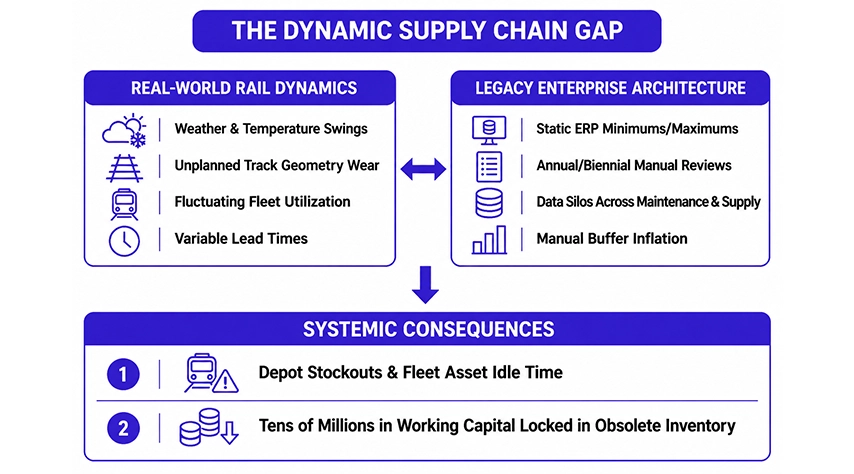
In typical railway organizations, maintenance planning systems and railway procurement management functions often operate as disconnected silos alongside supply chain planning modules.
Maintenance teams schedule overhauls based on telemetry, runtime hours, and distance traveled, while procurement teams order parts based on historical consumption averages.
Recalibrating thousands of stock keeping units across dozens of maintenance nodes requires labor-intensive data extraction, complex offline spreadsheet modeling, and manual system re-entry. Supply chain planners rarely have the operational bandwidth to audit baseline metrics continuously, leading to systemic inertia and frozen rules.
To eliminate this friction, railway organizations must move beyond disconnected point solutions and transition toward unified operating models. Frameworks like the Zero Friction Enterprise™ model integrate intelligent automation, real-time analytics, and governed machine learning across enterprise platforms, maintenance operations, and supply chain networks.
Structural Breakdown of Static vs Dynamic Material Management
To understand why traditional ERP configurations fail modern rail networks, enterprise leaders must examine how legacy planning models handle real-world disruption compared to an automated, AI-driven feedback architecture:
| Operational Variable |
Legacy ERP Static Planning |
Dynamic Closed-Loop Planning |
Enterprise Business Impact |
| Reorder Point Logic |
Fixed numerical thresholds set during system deployment or annual audits. |
Automatically adjusted based on real-time consumption velocity and fleet telemetry. |
Eliminates depot stockouts while preventing over-ordering during low-utilization periods. |
| Lead-Time Calculation |
Static supplier lead times entered into master data fields. |
Dynamic lead-time tracking derived from live vendor performance and logistics data. |
Prevents buffer stock erosion caused by unexpected supply chain delays. |
| Safety Stock Allocation |
Uniform buffer percentages applied across broad component categories. |
Granular buffer calculations tailored to asset criticality and failure probability. |
Reduces working capital lockup by rightsizing safety stock for non-critical parts. |
| Data Integration |
Batched, manual data exports sent to offline spreadsheets for analysis. |
Continuous, automated data streams between asset telemetry, maintenance systems, and ERP. |
Liberates supply chain planners from manual administrative overhead. |
Modernizing railway material management requires shifting from static parameter management to dynamic, closed-loop AI supply chain intelligence. As organizations invest more heavily in AI in railway supply chain operations, inventory decisions can be continuously refined using real-world maintenance, utilization, and supplier data.
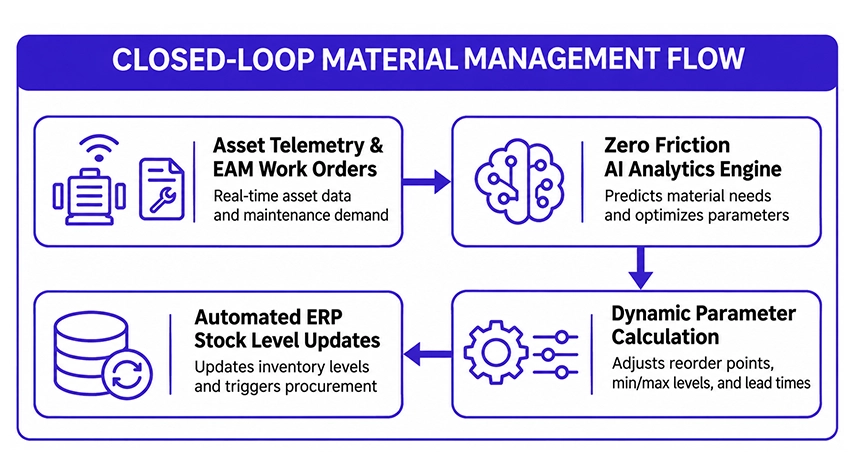
A closed-loop architecture continuously captures operational data from maintenance execution, asset telemetry, and external supply channels, evaluates parameter accuracy using advanced machine learning models, and updates target stock levels within the underlying ERP system without introducing manual handoffs.
Key Pillars of Dynamic Material Optimization
1. Predictive Maintenance Telemetry Integration
By feeding predictive maintenance telemetry from trainsets and track infrastructure directly into inventory forecasting solutions, material requirements can be forecast based on actual component degradation rather than generic time-based schedules.
When sensor data indicates accelerated wheel wear or elevated bearing temperatures across a specific fleet corridor, the system calculates the exact lead time required to deliver replacement assemblies to the correct depot prior to scheduled maintenance.
2. Adaptive Lead-Time and Variability Modeling
Instead of assuming fixed lead times from component manufacturers, dynamic systems continuously calculate supplier reliability, transport lead times, and customs processing delays.
Safety stock buffers automatically expand or contract based on active supplier performance trends, protecting operational readiness during supply shocks while stripping out excess inventory during periods of vendor stability.
This approach also strengthens inventory replenishment planning by ensuring that stock levels adjust automatically as supplier performance and demand patterns change.
3. Agentic AI and Autonomous Automation
Leveraging agentic AI automation operating under the Zero Friction Enterprise™ framework allows enterprise teams to deploy specialized AI agents capable of evaluating complex multi-echelon inventory networks.
These autonomous agents analyze consumption patterns, detect regional demand anomalies, calculate optimal reorder points, and propose parameter adjustments directly to supply chain planners or execute approved updates automatically within ERP workflows.
The outcome is AI-driven railway inventory management that can respond to changing operational conditions without relying on periodic manual reviews.
4. Grounded Enterprise Knowledge Engineering
Unlocking legacy code, undocumented domain practices, and fragmented business rules within long-established enterprise management software is essential for safe automation.
Platforms like Zerovity™ enable enterprises to inspect legacy application logic, map software dependencies, inspect embedded business rules, and streamline digital transformations without risking core operational disruptions or uncoordinated system changes.
Realizing the Business Impact: High Yields and Operational Agility
Transitioning from static inventory parameters to adaptive, closed-loop AI material management delivers immediate operational and financial returns across rail transportation and logistics ecosystems:
- Working Capital Reduction: Optimizing inventory locations across central hubs and regional depots reduces total inventory holding costs while eliminating stock obsolescence through precise ERP inventory optimization.
- Maximized Railway Fleet Availability: Aligning parts availability directly with maintenance schedules eliminates asset downtime caused by missing components, maximizing revenue-generating railway fleet availability.
- Planner Productivity: Automating routine parameter adjustments liberates supply chain teams from tedious spreadsheet exercises, enabling them to focus on strategic supplier relationships and mitigating rail supply chain risk.
- Systemic IT Modernization: Utilizing platform intelligence like Zerovity™ accelerates the modernization of legacy application code, reducing technical debt and enabling enterprise IT teams to deliver functional updates in weeks rather than months.
By combining artificial intelligence in railways with real-time operational and supply chain data, organizations can reduce inventory waste while improving material availability where it is needed most.
Deep Dive: Overcoming Technical Debt in Legacy Rail Software
A major barrier preventing rail operators from implementing closed-loop AI material management and modern predictive inventory management capabilities is the accumulation of technical debt inside core software applications.
Over decades of continuous operation, enterprise rail applications accumulate custom modifications, undocumented patch layers, and deeply embedded business logic. Modifying replenishment parameters or connecting external AI platforms to these legacy core platforms often carries high technical risk.
By leveraging Zerovity™, enterprise technology teams gain complete visibility into legacy code bases before initiating structural changes. Zerovity™ analyzes source code, extracts embedded business rules, maps dependencies, and assists in decoupling monolithic architectures into agile, API-driven services.
This automated intelligence ensures that real-time telemetry inputs and agentic AI automation models can interact cleanly with core ERP modules without disrupting daily transaction processing or risking master data integrity.
Strategic Implementation Roadmap for Rail Leaders
For enterprise technology executives, supply chain leaders, and operations managers looking to modernize material management, the path forward requires a phased, risk-mitigated approach:
Stage 1: Target High-Value Safety-Critical SKUs
Begin by identifying the top 10 to 15 percent of safety-critical components that drive the majority of maintenance delays and inventory holding costs. Validate dynamic parameter models against these high-impact items to demonstrate quick ROI before expanding network-wide.
Stage 2: Establish Secure Unified Data Pipes
Break down data silos by creating secure, event-driven integrations between maintenance scheduling platforms, fleet telemetry systems, and central ERP inventory modules and broader AI in railway supply chain initiatives.
Ensure data feeds provide clean, standardized operational metrics.
Stage 3: Deploy Governed AI Automation
Implement agentic AI automation under the Zero Friction Enterprise™ framework. Establish clear operational guardrails, ensuring AI generated parameter updates operate within defined approval thresholds while maintaining complete audit trails.
Stage 4: Expand Across the Multi-Echelon Network
Scale closed-loop parameter optimization across all central distribution facilities, regional storehouses, and line-of-route depots to achieve full network visibility and balanced material distribution.
The Path Forward: Transforming Supply Chain Friction into Competitive Advantage
In an era defined by rising operational costs, expanding freight volumes, and heightened passenger expectations, rail operators can no longer afford to leave material replenishment on autopilot using decades-old static assumptions.
By modernizing enterprise software landscapes and introducing closed-loop frameworks, such as Hexaware’s Zero Friction Enterprise™ initiative and the Zerovity™ application intelligence platform, transportation organizations can convert supply chain friction into sustained competitive advantage.
The future of railway material management is dynamic, intelligent, and friction-free. Enterprise leaders who embrace closed-loop AI supply chain intelligence today will secure the fleet reliability and working capital efficiency required for tomorrow.
Find out where static ERP rules are costing your rail network in stockouts and idle capital. Talk to our experts about closed-loop AI for railway material management.