This is the first article of Reimagined ITOps, a series about what IT operations becomes when AI stops assisting and starts operating. I lead product strategy and innovation for Hexaware’s Tensai® Agentic ITOps platform. My teams build it, our customers run it, and this series reports what that work is teaching us. It will run in seasons, with many articles in each. Season 1 is 14 articles on why the current operating model stalls and what replaces it. Stay with it. There is a lot coming.
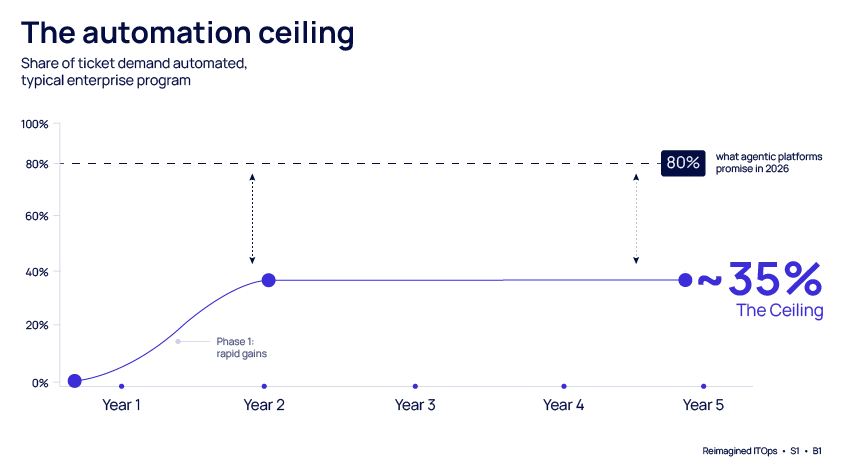
Infographic 1: The automation ceiling (Reimagined ITOps)
Every IT operations automation program I have reviewed in recent years has the same shape. Year one is a success story. Year three is a plateau that nobody puts on a slide.
This year, agentic AI platforms are being marketed with claims of 80% automation coverage. The estates I actually walk into sit between 30 and 40%, and have for a long time. That gap deserves precision: what exactly is the wall made of, and why has a decade of tooling investment not moved it?
My claim: the ceiling is a category error, not a maturity problem. The work below roughly 35% coverage and the work above it are two different problems, and the second cannot be solved with more of what solved the first.
Why the First 35% Was the Easy Part
The first phase of any automation program harvests decisions that have already been made. A script is a decision, frozen. Someone worked out that when condition X appears, action Y is safe, and encoded it. The script decides nothing. It replays a judgment a human made months ago, at speed.
That works well for demand where the judgment is stable: same symptom, same cause, same fix, every time. And there is real volume there. In compute operations, 80% of incidents boil down to the same fixes: restart, resize, reallocate. Yet humans still log in and do it by hand.
But the moment reality deviates from the state the script assumed, the script either fails or does damage. And nobody decommissions automation. The estate accumulates scripts whose preconditions no longer hold, and the maintenance cost of the script estate starts eating the savings it produced.
Why the Remaining 65% Is a Different Problem
Three things sit above the ceiling, and none of them yields to another script.
First, trapped knowledge. The information needed to resolve most non-trivial tickets lives in engineers’ heads, in ticket work notes, in chat threads, and in a knowledge base nobody trusts. It exists, but it is not machine-usable. You cannot script your way through knowledge you cannot access.
Second, judgment under incomplete information. The demand above the ceiling requires someone to form a hypothesis, weigh evidence, and choose. The trap of phase one is that it creates the belief that the remaining work is the same problem at larger scale. It is a different problem class entirely.
Third, the economic defect underneath everything: effort scales linearly with tickets. Add volume, add people. Scripted automation bends that line slightly and temporarily. It never breaks it, because every exception falls back to a human.
And the human is doing more than resolving tickets. In most estates, monitoring does not talk to the ITSM tool, which does not talk to the CMDB, which does not reflect what is actually deployed. More than 70% of tickets require manual triage. The human is not the intelligence in the system. The human is the API between systems that were never designed to speak.
What This Means for Your Program
If your automation coverage has been flat for four quarters, the answer will not come from a bigger script backlog, a new orchestration tool, or a harder push on the same program. We do not lack tools. We lack system-level intelligence: the ability to bring context together and reason over it before acting.
Crossing the ceiling means adding the thing scripts cannot contain, which is reasoning over live context. What is this ticket really about? What does the estate look like right now? What worked the last 40 times? What is safe to do about it? That is a different architecture, a different operating model, and a different conversation with your CFO, because the business case stops being fewer keystrokes and starts being a different shape of demand.
One concession before anyone accuses me of selling the same 80% promise with different words: reasoning does not take you to 100% either. There is a second ceiling above this one, and it is structural rather than technical. We have measured it in live estates. That is a later article in this season, and it is the one most vendors will not write.
The Question for IT Leaders
Look at your own automation coverage number for the last four quarters. If it moved, I want to know what moved it. If it did not, you have hit the ceiling I am describing, and the honest next question is not which tasks to script next. It is which decisions you are prepared to let a system make, and under what governance.
Next week: your operation measures how fast you clear demand. Nobody owns whether that demand should exist at all.
Sanjesh Rao leads product strategy and innovation for Hexaware’s Agentic ITOps platform.