In an era defined by the urgent need for sustainable energy solutions, energy storage optimization has emerged as a critical enabler for integrating renewable resources and ensuring grid reliability. As the global energy landscape rapidly evolves, the convergence of Internet of Things (IoT) technologies and advanced data analytics is poised to revolutionize how we manage and optimize energy storage systems. By harnessing real-time data and intelligent connectivity, IoT energy storage applications are transforming the battery management system from a static process into a dynamic, predictive, and highly efficient operation.
Energy storage technologies, ranging from lithium-ion batteries to innovative alternatives such as sodium-ion and solid-state batteries, are at the forefront of this transformation. These technologies are essential for balancing supply and demand, smoothing the intermittency of solar and wind power, and enabling decentralized energy networks, such as microgrids and smart grid technology integration, including vehicle-to-grid systems. However, maximizing the lifespan and utilization of these storage assets remains one of the industry’s biggest challenges.
This is where IoT and data-driven approaches make a profound difference. Through continuous battery health monitoring, environmental condition monitoring, and usage patterns, IoT-enabled systems provide actionable insights that help prevent premature battery degradation, optimize charge-discharge cycles, and enhance overall operational efficiency. Coupled with artificial intelligence (AI) and machine learning, these systems can predict failures before they occur, proactively schedule maintenance, and dynamically adjust energy flows to align with grid demands and market signals.
The result is not only extended battery life but also improved return on investment and a more resilient energy infrastructure. As the energy storage market scales to meet soaring demand with projections reaching trillions of dollars globally, leveraging IoT and battery data analytics is no longer optional but imperative for businesses aiming to thrive in this competitive and rapidly evolving sector.
Battery Management Systems (BMS) are critical components in modern energy storage solutions, electric vehicles, and renewable energy infrastructures. A BMS ensures the safe, efficient, and reliable operation of battery packs by continuously monitoring and managing various battery parameters.
Let’s examine the internal structure of a BMS, covering its architecture, sensor types, critical parameters monitored, and the detailed technical specifications required for its design and operation.
Understanding the Role of a Battery Management System
The primary responsibility of a BMS is to monitor battery state and optimize performance while ensuring safety and longevity. Without an effective BMS, batteries risk overcharging, deep discharging, overheating, or premature failure, posing safety hazards and reducing efficiency.
Key functions of a BMS include:
- Monitoring electrical and environmental parameters through IOT battery monitoring
- State-of-charge (SoC) and state-of-health (SoH) estimation
- Cell balancing for uniform charge distribution
- Thermal management to prevent overheating
- Fault detection and alarm generation
- Data reporting and predictive maintenance
Comprehensive Architecture of a BMS
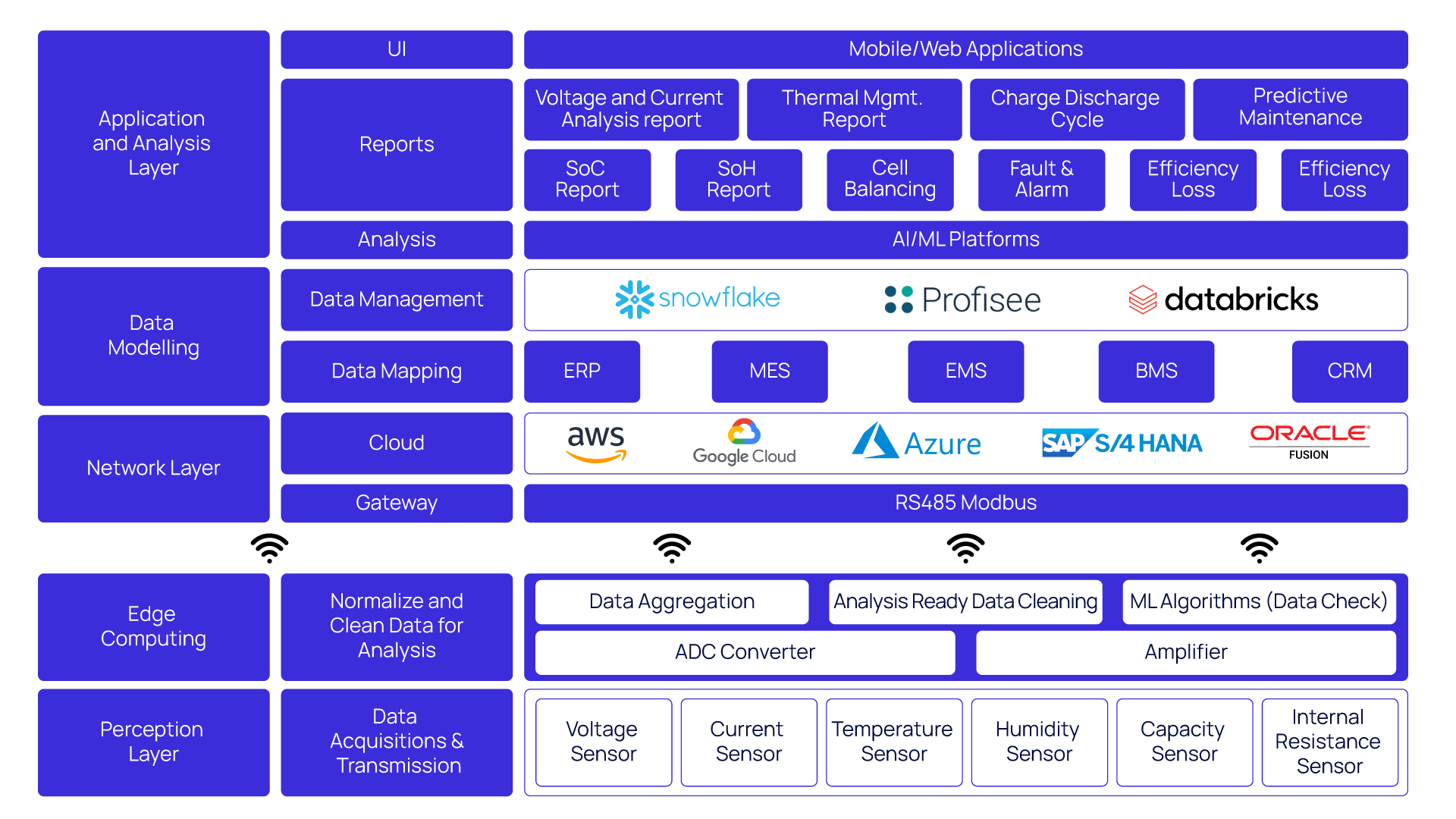
The architecture of a BMS can be divided into three primary layers, which work together to acquire, transmit, analyze data, and control the battery system:
Perception Layer: Data Acquisition and Sensors
This is the sensing core of the BMS, responsible for real-time battery monitoring. The layer includes various sensors and signal conditioning components, such as ADC converters and amplifiers. The detailed components include:
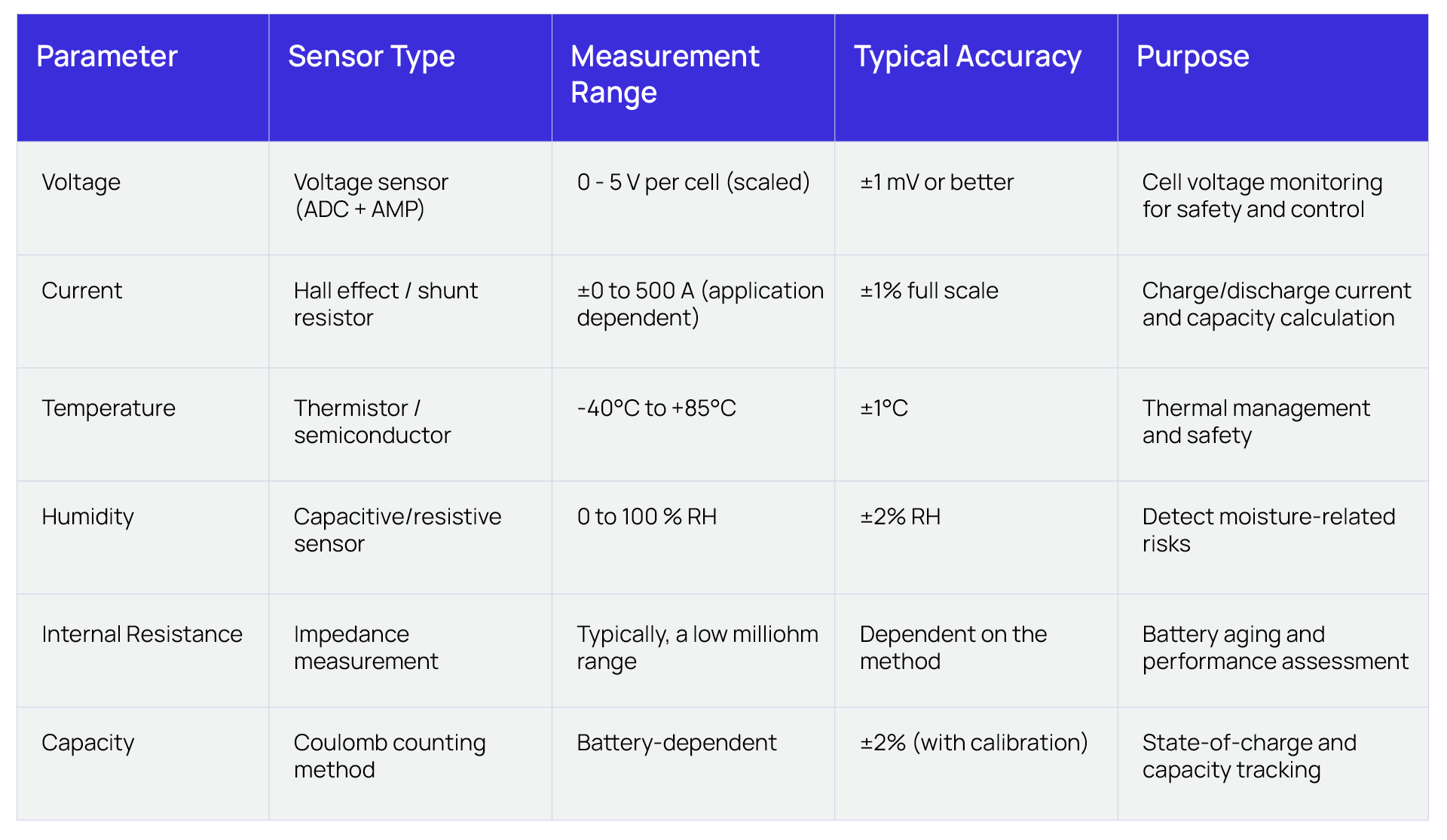
- Voltage Sensors: Measure cell voltage with high precision (typically ±1 mV or better) to detect overvoltage and undervoltage conditions. For example, using high-accuracy differential amplifiers paired with 16-bit ADCs.
- Current Sensors: Utilize Hall effect sensors or shunt resistors to measure charge and discharge currents typically in the range of milliamps to hundreds of amps, with typical accuracy ±1% of full scale.
- Temperature Sensors: Often, thermistors (NTC/PTC) or semiconductor temperature sensors are placed at critical cell locations. The operating temperature range is commonly -40°C to +85°C, with ±1°C accuracy.
- Humidity Sensors: Used in some BMS designs to detect moisture ingress; accuracy ranges around ±2% RH.
- Internal Resistance Sensors: Measure impedance to estimate battery aging and SoH using electrochemical impedance spectroscopy (EIS) or DC pulse methods.
- Capacity Sensors: Calculate charge capacity by integrating current over time (coulomb counting), often combined with voltage and temperature data for accuracy.
Network Layer: Communication and Data Handling
The network layer facilitates seamless communication and data transport between the perception layer and the application layer. Core elements include:
- Gateways: Devices that consolidate sensor data and transmit via industrial protocols like RS485 with MODBUS, CAN bus, or proprietary communication standards.
- Edge Computing Units: Devices that preprocess and filter data to reduce noise, normalize it, and perform initial analytics before sending data to the cloud.
- Cloud Services: For scalable data storage and advanced analytics.
Application and Analysis Layer
This layer empowers the BMS with intelligence and actionable insights through software platforms:
- AI/ML Platforms: Apply machine learning algorithms for predictive maintenance, anomaly detection, and performance optimization.
- BMS Software: Implements algorithms for SoC and SoH estimation, fault detection, cell balancing, and thermal control.
- Enterprise Integration: Connects with CRM, MES, ERP, and EMS platforms to provide comprehensive battery lifecycle and asset management.
Key Parameters Monitored by BMS Sensors
The following table summarizes critical battery parameters, sensor types, measurement ranges, and typical technical specifications:
Data Processing and Analytics in BMS
Data from sensors first passes through signal conditioning components, such as amplifiers and ADC converters. Once digitized, the data moves to edge computing units where it undergoes:
- Noise filtering and normalization
- Outlier detection using ML algorithms
- Data aggregation for easier transmission and analysis
In the cloud or local servers, advanced analytics are performed:
- Predictive maintenance identifies when cells or the battery system require servicing, minimizing unexpected failures.
- Thermal management algorithms regulate cooling systems based on temperature sensor data.
- Cell balancing algorithms redistribute charge to ensure all cells maintain optimal charge levels, preventing over-stressing of individual cells.
Advanced Features Enabled by the BMS Architecture
- Fault and Alarm Management: Immediate detection and alarm signals for faults such as overtemperature, overvoltage, or short circuits.
- Efficiency Loss Analysis: Tracks battery degradation over time and identifies causes of energy loss.
- State-of-Charge (SoC) and State-of-Health (SoH) Reporting: Provides continuous assessment of battery performance optimization to users and maintenance systems.
- Reports and Dashboards: Interactive reports on all key parameters that can be accessed via mobile and web applications.
Benefits of Implementing a Battery Management System
Implementing an effective BMS delivers numerous advantages essential for various applications involving battery technology:
- Enhanced Safety: Continuous monitoring prevents hazardous conditions like overcharging, deep discharge, and thermal runaway, greatly reducing the risk of fire and explosions.
- Extended Battery Life: By managing charge/discharge cycles, cell balancing, and thermal profiles, a BMS prolongs battery lifespan and reduces replacement costs.
- Improved Reliability: Early fault detection and predictive maintenance enable timely interventions, minimizing system downtime.
- Optimized Performance: Accurate SoC and SoH estimation help in maximizing battery usage and efficiency tailored to specific application needs.
- Cost Savings: Reduced maintenance and extended battery service life translate into lower total cost of ownership.
- Data-Driven Insights: Integration with enterprise systems and AI/ML platforms enables strategic decision-making through detailed reports and analytics.
Conclusion
A sophisticated battery management system integrates multiple sensors and a layered architecture to maintain battery safety, performance, and longevity. The system relies on accurate data acquisition, robust communication, intelligent analytics, and integration with enterprise systems to maximize battery asset value and user confidence.