The financial services industry is entering a transformational era where agentic AI workflows are rapidly replacing traditional, linear automation. Organizations are no longer satisfied with systems that merely respond—they need intelligent, orchestrated ecosystems capable of reasoning, analyzing, and acting with precision. This shift is being accelerated by platforms like Databricks Mosaic AI, which is redefining what’s possible with multi-agent AI through a suite of powerful capabilities known as Databricks Agent Bricks.
As wealth management enterprises grapple with complex data, regulatory demands, and market volatility, the need for AI systems that can make grounded, auditable, and compliant decisions has never been greater. This is where AI agent orchestration becomes a strategic differentiator. By coordinating specialized agents—ranging from analytical engines like Genie Spaces to compliance validators and real-time market data connections, firms can build intelligent, domain-aware assistants that elevate the standard of advisory services. At the center of this innovation is the multi-agent supervisor (MAS), a breakthrough pattern that enables organizations to operationalize multi-step reasoning across governed datasets in the Databricks Unity Catalog. When applied to use cases such as an AI-powered wealth management assistant, the multi-agent supervisor can integrate structured analytics, sentiment intelligence, deterministic financial logic, and external market signals—all while ensuring transparency and compliance. ‑management enterprises grapple with complex data, regulatory demands, and market volatility, the need for AI systems that can make grounded, auditable, and compliant decisions has never been greater. This is where
Why Now: From Chat to Coordinated Intelligence
Financial institutions don’t just need answers—they need grounded answers with lineage, risk controls, and auditability. Traditional LLM “chatbots” are helpful for summaries, but they struggle with complex multi-step workflows, policy checks, and real-time data. Agentic AI workflows solve this by delegating to the right capability—analytics, rules, reasoning, or external systems—at the right moment.
As generative AI accelerates, the industry is quickly moving beyond basic “chatbot” interactions toward sophisticated agentic architectures. While a single large language model (LLM) can execute isolated tasks such as summarizing content, a multi-agent system can coordinate specialized capabilities to execute complex, multi-step business workflows with far greater precision and intelligence.
Platforms like Databricks Mosaic AI bring this to production by unifying data, models, and governance, so teams can build reliable, Multiagent AI systems that are explainable and cost-efficient.‑Agent AI systems that are explainable and cost-efficient.
This blog discusses how Databricks Agent Bricks and multi-agent AI from Databricks Mosaic AI are advancing AI in wealth management, shifting from basic automation to reliable, enterprise-level intelligence.
What is Agent Bricks?
Agent Bricks is a Databricks platform product designed to build, optimize, and deploy domain-specific AI agents with minimal “manual” plumbing. Instead of writing thousands of lines of orchestration code, you define the task, point to your data in Unity Catalog, and let the framework handle the rest.
Agent Bricks currently supports the following use cases :
- Information Extraction (Beta): Transform unstructured content into structured insights such as entity extraction, classification, and more.
- Knowledge Assistant: Convert your documents into a grounded, enterprise-grade chatbot that answers questions with citations.
- Custom LLM (Beta): Build custom text-generation agents for tasks such as summarization, rewriting, transformation, or tailored text generation over enterprise data.
- Multi-Agent Supervisor (Beta): Orchestrates systems where multiple agents collaborate—including Genie Spaces, endpoints, and tools—to solve complex tasks.
- Code Your Own Agent: Bring your own agent using open-source libraries together with the Agent Framework, fully integrated with Databricks
The Multi-Agent Supervisor Pattern
The most powerful “brick” in this toolkit is the Multi-Agent Supervisor; in simple terms, it is an orchestration layer that understands user intent, decomposes work into subtasks, routes each subtask to the best agent/tool, and synthesizes the results into a single response with citations.
This mirrors how real organizations work: analysts, compliance officers, and systems collaborate—supervised, explainable, and governed.
What the Multi-Agent Supervisor Really Is:
The multi-agent supervisor is an orchestration layer that acts as the control plane for an enterprise AI system. Instead of relying on a single large language model to understand, reason, retrieve data, and produce outputs, the supervisor coordinates a network of specialized agents, tools, and services, each optimized for a specific domain or capability.
In practical terms, the supervisor:
- Understands the user’s intent
- Breaks a complex business request into discrete sub-tasks
- Routes each sub-task to the most appropriate agent or system
- Collects, validates, and synthesizes the results into a single, coherent response
This design mirrors how complex organizations operate—by delegating work to specialists rather than expecting a single generalist to do everything.
Key Building Blocks Coordinated by the Supervisor
Genie Spaces (Analytical Intelligence)
Genie Spaces are Databricks’ conversational interfaces to structured data—primarily SQL tables in the Lakehouse. When the supervisor identifies a need for quantitative or analytical reasoning, it delegates tasks to a Genie Space agent.
Typical responsibilities:
- Ad-hoc SQL queries
- Metric calculations (ROI, P/E ratios, churn, volatility)
- Aggregations over “Bronze / Silver / Gold” tables
Because these agents work directly on governed data in Unity Catalog, results are trusted and auditable.
Agent Endpoints (Specialized Reasoning)
Agent endpoints are purpose-built LLMs tuned for narrow responsibilities—such as summarization, reasoning, classification, or regulatory rule-checking.
The supervisor uses them when:
- A task requires domain-specific logic (e.g., compliance checks)
- The reasoning pattern is repeatable and well-defined
- Strong guardrails or fine-tuned prompts are required
This avoids overloading a single LLM with conflicting instructions and reduces hallucination risks.
Unity Catalog Functions (Action & Determinism)
Unity Catalog functions serve as deterministic, governed “tools” that agents can invoke. These are not probabilistic LLM outputs, but explicit business logic—such as:
- Risk scoring algorithms
- Eligibility checks
- Pricing or valuation formulas
- Internal policy enforcement
The supervisor decides when to call a function versus when to reason with an LLM, ensuring that critical calculations are handled by traceable, testable code.
MCP Servers (External & Enterprise Systems)
Model Context Protocol (MCP) servers provide standardized access to external tools and enterprise services, such as:
- Market data APIs
- Internal financial systems
- ERP, CRM, or risk platforms
The supervisor uses MCP servers when a task requires real-time data or external actions, while still maintaining structured communication and security boundaries.
Orchestration Patterns Used by the Supervisor
The sophistication of the Multi-Agent Supervisor comes from the orchestration patterns it applies.
- Task Decomposition: A single business question is decomposed into analytical, contextual, compliance, and reasoning sub-tasks, each handled independently.
- Delegation & Routing: The supervisor dynamically selects which agents to invoke based on data type, urgency, and risk—SQL-heavy tasks go to Genie, rules go to functions, interpretation goes to LLM agents.
- Parallel Execution: Multiple agents can run in parallel (e.g., quantitative analysis and sentiment scanning), significantly reducing latency versus a monolithic LLM.
- Result Synthesis: The supervisor merges structured outputs, narrative explanations, and rule-based validations into a single grounded response, often with source attribution.
Why This Matters for Complex, Regulated Domains
In fields like finance, healthcare, and legal operations, “mostly right” answers are unacceptable. The Multi-Agent Supervisor pattern delivers:
- Higher accuracy through specialization
- Auditability via Unity Catalog and function calls
- Compliance-by-design, not post-hoc filtering
- Lower cost and latency by avoiding long-context prompts
Use Case: The AI-Powered Wealth Management Assistant
The finance sector is the perfect playground for Multi-Agent Systems because it requires high precision, data from diverse sources (market feeds, PDFs, SQL databases), and strict compliance.
Goal: Provide grounded, compliant investment guidance to wealth-management clients by coordinating specialized agents over governed data and external market feeds, with the multi-agent supervisor decomposing the request, delegating tasks, running them in parallel, and synthesizing the final answer with citations.
Actors & Building Blocks (Agent Bricks primitives)
- Supervisor (Agent Bricks MAS): Interprets intent, decomposes the question, routes subtasks, and merges results.
- Genie Space: Analyst Agent (analytical intelligence over Lakehouse/Unity Catalog): Performs SQL on Gold tables for KPIs (ROI, P/E, volatility), aggregations, and metrics with governed lineage.
- Agent Endpoints: Sentiment & Compliance Agents (Specialized reasoning): Sentiment Agent: parses filings/news; Compliance Agent: applies KYC/SEC/SEBI rules via tuned prompts/guardrails.
- Unity Catalog Functions – Deterministic Tools: Risk scoring, eligibility checks, pricing formulas, and policy enforcement are executed as deterministic functions.
- MCP Servers – External/Enterprise Systems: Standardized access to market data APIs and internal finance systems when real-time data or actions are needed.
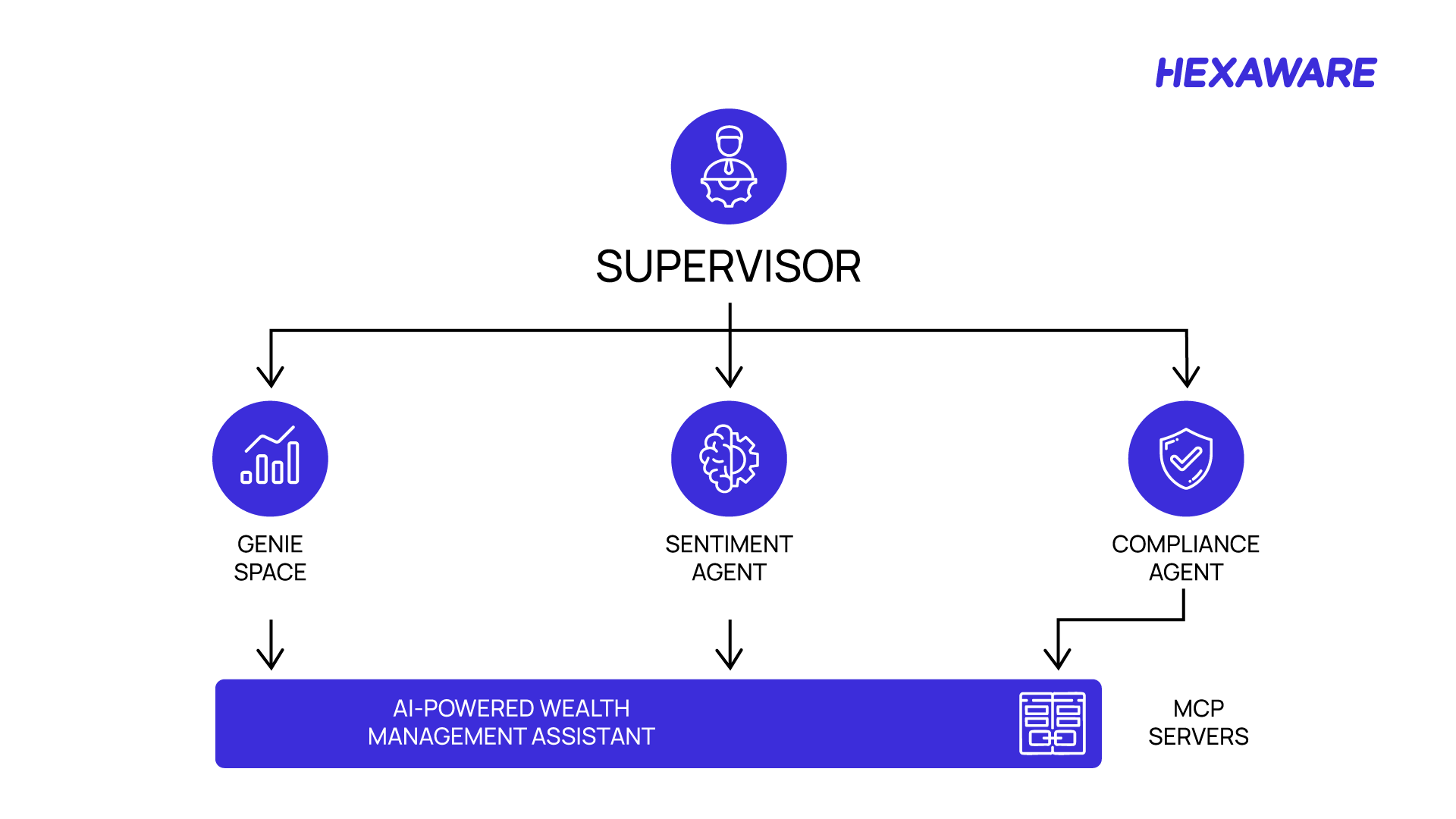
Supervisor (top)
Interprets the client’s investment question, decomposes it into analytical, qualitative, and compliance subtasks, and orchestrates execution.
Genie Space (left)
Queries governed Unity Catalog Gold tables to compute KPIs such as ROI, volatility, exposure, and portfolio concentration.
Sentiment Agent (center)
An Agent Endpoint that analyzes earnings calls, filings, and news to extract qualitative insights and risk signals.
Compliance Agent (right)
A specialized Agent Endpoint that validates recommendations against regulatory rules (KYC, suitability, exposure limits).
MCP Servers (right, bottom)
Provide secure, standardized access to external market feeds and internal financial systems when real-time data is required.
AI-Powered Wealth Management Assistant (bottom)
The synthesized output layer, where the supervisor merges structured analytics, narrative insights, and compliance checks into a single, auditable recommendation.
Example Client Question
“Should I increase exposure to semiconductor stocks given the recent quarterly results?” The document uses this exact scenario to illustrate the workflow.
Orchestrated Workflow (end-to-end)
Step A — Intent Understanding & Task Decomposition (Supervisor)
- Breaks the query into (i) quantitative analysis, (ii) qualitative context, and (iii) compliance validation
Step B — Delegation & Routing
- Routes the quantitative part to Genie Space, qualitative scanning to Agent Endpoint (Sentiment), and rule checks to Agent Endpoint (Compliance)/Unity Catalog functions.
Step C — Parallel Execution
- Runs quantitative metrics and sentiment scanning in parallel to reduce latency.
Step D — Result Synthesis & Guardrails
- Supervisor merges structured outputs (tables/metrics from Genie), narratives (sentiment summary), and validations (risk/eligibility via Unity Catalog functions)—producing a single grounded answer with source attribution.
Why these choices:
- Genie Space for SQL/KPIs on governed data; outputs are trusted/auditable.
- Sentiment via specialized endpoint to keep prompts/policies tight and reduce hallucinations.
- Critical calculations and rule checks via deterministic Unity Catalog functions.
- External market feeds and internal systems via MCP.
- Supervisor applies decomposition, routing, parallelism, and synthesis patterns.
AI-Powered Wealth Management Assistant (Agent Bricks MAS): The Supervisor decomposes the client’s investment question into quantitative, qualitative, and compliance subtasks; Genie Space queries governed Unity Catalog data to compute KPIs; Agent Endpoints perform sentiment extraction and regulatory checks; Unity Catalog functions enforce deterministic risk and policy rules; and MCP servers fetch real-time market information. Tasks run in parallel and are synthesized into a single, auditable recommendation with citations, meeting accuracy and compliance needs for finance.
Limitations of Multi-Agent Supervisor
- AI Guardrails and rate limits must be disabled on the Databricks-gte-large-en model endpoint.
- A single supervisor system cannot use more than 20 agents.
- Workspaces with Enhanced Security and Compliance enabled are not supported.
- For tracing to work, you need to have production monitoring for MLflow (Beta)
To read more about the limitations of a multi-agent supervisor, click here.
Conclusion
Multi-agent systems represent the “Gold Standard” for enterprise AI. With Agent Bricks, the barrier to entry has dropped significantly. You no longer need a team of 50 researchers to build an autonomous system; you need a clear problem, high-quality data in Unity Catalog, and the right “Bricks” to build your solution.
Measuring Impact (What Good Looks Like)
- Advice quality: Higher recommendation acceptance, fewer post-trade adjustments.
- Efficiency: Lower time‑to‑answer; parallel tasks trim latency vs. long single‑LLM prompts.
- Compliance: Reduced manual exceptions; traceable rule checks per decision.
- Cost: Less context stuffing; more deterministic computation.
Ready to pilot a compliant, auditable Wealth Management Assistant?
Let’s co-design your blueprint—data model, agents, guardrails, and KPIs—and stand up a working prototype in weeks, not months. Contact our experts to get started!