A guest arrives at a hotel after a six-hour flight.
They are tired. Their phone battery is almost dead. They have an early meeting the next morning and would rather not spend ten minutes explaining that they need a quiet room, a charger, and a wake-up call.
Now imagine the hotel can anticipate some of those needs because relevant preferences and stay details are already available in its systems.
The room is ready. A charger is waiting based on a previous request or known preference. The guest receives a message with the fastest route to their room, breakfast hours, and an option to schedule a wake-up call. If they need something later, they can ask without searching for a phone number or waiting at the front desk.
Nothing about the experience feels particularly futuristic.
That is precisely the point.
The most valuable applications of AI in guest experience may be the ones guests barely notice. AI can remove unnecessary steps, connect information across the guest journey, help employees respond with better context, and anticipate potential needs when relevant signals are available.
For hotel executives and hospitality technology leaders, this creates a bigger opportunity than simply adding another chatbot or recommendation engine. AI can become part of how the entire guest journey works.
The question is how hotels can use it without losing human judgment and warmth that make hospitality memorable.
AI in Hospitality Is Moving from Response to Anticipation
Hotels have always tried to understand their guests.
Loyalty programs remember previous stays. Front-desk teams remember preferences. CRM platforms capture booking history. Guest feedback reveals what people value and where experiences fall short.
The challenge is turning all that information into useful action.
A returning guest may have stayed at the same property five times, consistently requested a high floor, ordered room service late at night, and asked for late checkout. That information may exist across different systems and interactions, but connecting those signals at the right moment can be difficult.
AI can help.
Instead of waiting for the guest to repeat a preference, AI can analyze relevant information already available to the hotel, identify useful patterns, and surface them when they matter. A hotel could use those insights to support room-assignment decisions, pre-arrival communication, service recommendations, or employee prompts.
This changes the role of personalization.
The goal is not to send more personalized messages. It is to make the hotel guest experience feel more relevant with less effort from the guest.
That is where AI in hospitality becomes particularly interesting. The technology can move from simply responding to requests toward anticipating what might make the next interaction easier.
The Guest Journey Is Full of Friction We Have Learned to Accept
Think about everything a guest may have to do during a typical stay.
Search for a property. Compare rooms. Ask questions. Book. Change a reservation. Provide information again. Find transportation. Check in. Locate the restaurant. Request towels. Ask about Wi-Fi. Make a reservation. Report a maintenance issue. Request late checkout. Find their receipt.
Individually, none of these tasks seems especially difficult.
Together, they create friction.
And friction accumulates.
A guest who waits five minutes for a simple answer may tolerate it. A guest who has to repeat information to three different employees may become frustrated. An employee who has to search through several systems before resolving a request experiences friction too.
The opportunity for AI in guest experience enhancement is to identify these moments and remove unnecessary work.
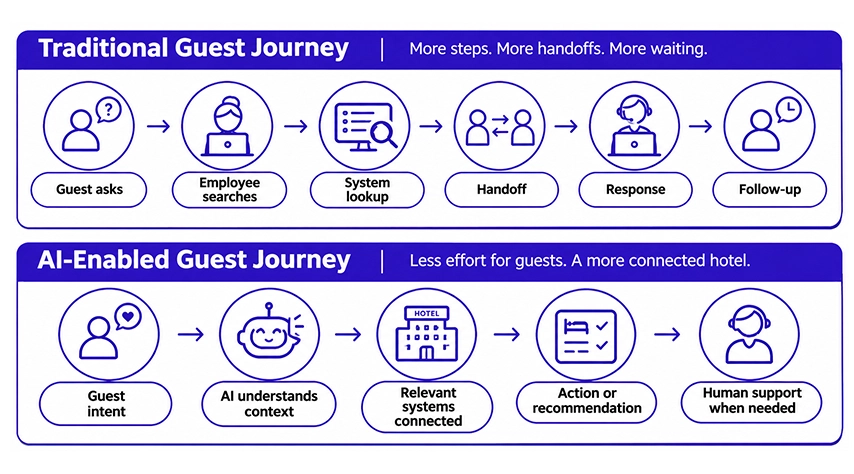
Four Places Where AI Can Improve the Guest Experience
The strongest opportunities for AI for hotels appear across the entire journey, rather than in a single digital touchpoint.
Before The Stay: Make Preparation Feel Effortless
Pre-arrival is an overlooked opportunity.
Guests may have questions about transportation, check-in, dining, facilities, room options, accessibility, or local activities. AI can help answer routine questions quickly and use available context to make recommendations more relevant.
A family traveling with children could receive information about suitable dining options and activities. A business traveler could receive practical information about transportation, meeting facilities, workspace, or breakfast hours.
The principle is simple: give guests information that helps them accomplish something.
During The Stay: Make Requests Disappear Into The Workflow
During a stay, guests often need small things.
Extra towels. A room adjustment. A restaurant booking. Maintenance assistance. Directions. A recommendation.
AI can help make these interactions conversational while connecting requests to the operational systems and teams that need to act on them.
Instead of simply answering, “Where is the gym?”, a more capable system could understand that the guest wants to use it before breakfast and provide the relevant opening hours and location.
The interaction becomes more useful because the system understands intent rather than just keywords.
After The Stay: Turn Feedback Into Action
Post-stay feedback contains valuable information, but reviewing it manually at scale can be difficult.
AI can analyze large volumes of feedback to identify recurring issues, emerging themes, and differences between properties, guest segments, or services.
A hotel group might discover that guests consistently praise a property’s service but experience delays during a particular part of the check-in process.
That insight can feed directly into operational improvement.
Across The Journey: Connect The Signals
The bigger opportunity comes when these interactions are connected.
A pre-arrival preference can inform the stay. An in-stay request can inform future personalization. Feedback can influence operational decisions. Loyalty information can give employees better context when a returning guest arrives.
This is where hospitality digital transformation moves beyond individual technology projects and starts reshaping the experience itself.
The Best AI in Guest Experience May Be Invisible
There is a temptation to measure AI adoption by counting visible features.
How many chatbots? How many AI assistants? How many automated interactions?
Those numbers can be useful, but they do not tell hotel leaders whether the experience is actually better.
Consider two hotels.
Hotel A has a highly visible AI assistant, but the guest still has to repeat information; requests still move manually between teams, and employees still have to search multiple systems.
Hotel B has fewer visible AI features, but guest preferences flow into relevant workflows; requests are routed automatically, employees receive useful context, and common problems are identified before they escalate.
Which hotel has created the better AI-powered guest experience?
The answer is clear.
AI should be measured by the friction it removes and the outcomes it creates.
AI Should Make Employees Better at Hospitality
Guest experience does not happen only through guest-facing technology.
Employees remain at the center of hospitality.
A front-desk associate may need to understand a guest’s previous interactions before resolving an issue. A manager may need to identify why service requests are increasing. Housekeeping may need better visibility into changing room priorities.
When employees have to search across disconnected systems, valuable time disappears.
AI can help create a different experience for the employee.
Instead of searching for information, an employee could receive a concise summary of the relevant guest context.
Instead of manually categorizing every request, AI could identify the issue and route it to the right team.
Instead of reviewing hundreds of comments individually, a manager could receive a summary of recurring themes and emerging problems.
The result is important because employee experience and guest experience are closely connected.
Give employees better context, and they can spend more time using judgment, empathy, and hospitality.
Where Agentic AI in Hospitality Changes the Game
Generative AI can answer questions.
Agentic AI can potentially do much more.
An AI agent can be designed to understand an objective, determine the steps required, interact with systems, and complete actions within defined boundaries.
Imagine a guest saying:
“I need dinner for two tomorrow night, somewhere quiet, and we’ll need transportation.”
A basic assistant might recommend restaurants.
In a suitably integrated environment, an agentic system could potentially interpret the request, use relevant guest context, check availability across connected systems, and coordinate the required actions within defined boundaries.
The guest experiences one simple interaction.
Behind it, several systems may have been involved.
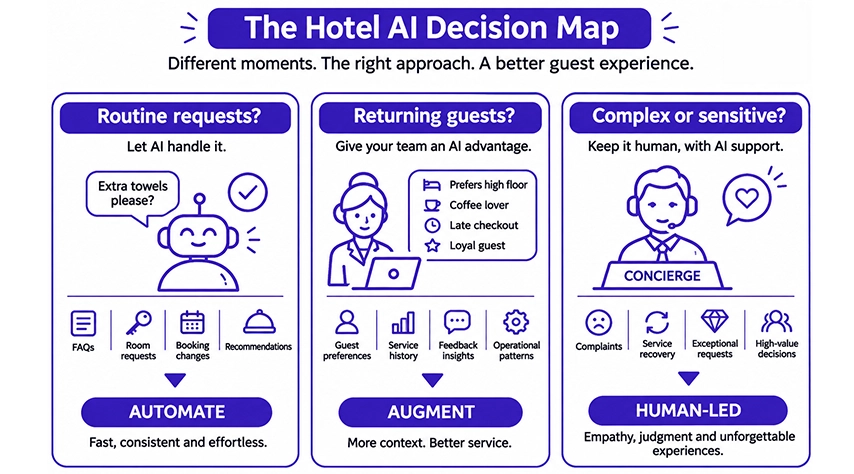
The rule: Automate the predictable. Augment the judgment heavy. Keep people at the center of the moments that matter most.
This distinction is important.
Hotels do not need to automate every interaction. They need to decide where automation improves the experience and where human involvement creates more value.
The Technology Behind the Experience Matters
A sophisticated AI experience depends on what sits underneath it.
Hotels may operate property management systems, central reservation systems, CRM platforms, loyalty platforms, point-of-sale systems, housekeeping applications, contact-center technology, payment systems, digital channels, and other hospitality technology.
Each system may contain part of the guest story.
If those systems cannot share relevant information securely, AI will have limited context.
This is why AI adoption cannot be treated solely as a front-end experience initiative.
Data quality matters. Integration matters. Security matters. Governance matters.
The AI may be impressive, but if it cannot access accurate information or safely execute an action, the guest experience will still break down.
For hotel leaders, this means evaluating AI alongside the technology foundation that supports it.
Five Questions Hotel Leaders Should Ask Before Scaling AI
1. What guest problem are we solving?
Start with the experience.
Are you reducing waiting time? Making requests easier? Improving personalization? Helping employees resolve issues faster? Increasing direct bookings?
Define the outcome before selecting the technology.
2. What context does the AI need?
Identify the information required to deliver the experience.
Guest profiles, booking history, preferences, property information, availability, service history, and operational data may all matter.
3. Where does human judgment belong?
Define which interactions AI can handle and where employees need to review, approve, or take over.
Human oversight should be part of the design rather than an emergency fallback.
4. Can it work across the hotel estate?
A solution that works beautifully at one property may become difficult to manage across dozens or hundreds of properties.
Hotel groups should consider how capabilities will work across brands, geographies, operating models, and technology environments.
5. Can guests trust it?
AI may interact with sensitive information and make decisions that affect the guest experience.
Privacy, security, transparency, access controls, observability, and governance therefore need to be considered alongside convenience.
The Bigger Opportunity: A Zero Friction Enterprise
There is a larger lesson here.
A hotel can build an excellent AI assistant and still leave significant friction elsewhere in the enterprise.
An employee may still wait for an application change. A legacy platform may still make integration difficult. A recurring IT issue may still generate another support ticket. A defect may still reach production. A technology team may still spend more time maintaining old systems than creating new experiences.
Every one of those problems eventually affects the ability to innovate.
This is the thinking behind Hexaware’s Zero Friction Enterprise™.
Zero Friction Enterprise™ looks beyond individual AI use cases toward the friction that accumulates across the enterprise. Its focus areas include Zero Tech Debt, Zero Backlog, Zero Tickets, Zero Vulnerability, Zero Defects, and Zero License, with agentic AI addressing different sources of operational and technological resistance. Zerovity™, Hexaware’s AI delivery layer, provides a governed command center across the estate.
For hospitality organizations, that creates an important connection.
Guest experience is an enterprise outcome.
- If technology debt makes new experiences difficult to launch, that creates friction.
- If operational issues repeatedly generate support tickets, that creates friction.
- If defects reach customer-facing systems, that creates friction.
- If disconnected systems prevent employees from getting the information they need, that creates friction.
Reducing those barriers can give hotel teams more room to improve the experiences guests actually notice.
The ambition is therefore bigger than adding AI to the guest journey.
It is creating an enterprise where technology, operations, employees, and AI can work together with less resistance.
The Next Competitive Advantage May Be Less Friction
Hotels have spent years competing on location, rooms, amenities, loyalty programs, design, dining, and service.
Those things will continue to matter.
But as AI becomes embedded across hospitality, another dimension will become increasingly important: how effortlessly the hotel can respond.
- Can the guest get what they need without explaining it three times?
- Can the employee find the right information without searching five systems?
- Can the hotel identify a problem before the guest complains?
- Can a new AI capability be introduced without months of technology remediation?
- Can the experience scale across the enterprise?
These questions connect AI in guest experience to something much bigger than personalization.
They point toward a hospitality organization designed to reduce friction wherever it appears.
What If Your Guests Never Had to Wait for Your Technology to Catch Up?
That is the opportunity with AI: making the experience move at the speed your guests expect, while giving your teams the technology and context to keep up.
Explore Hexaware’s Travel & Hospitality solutions to see how AI, data, digital experience, and modernization can help you create more connected guest journeys.
And when legacy technology, operational complexity, or disconnected systems are getting in the way, explore Zero Friction Enterprise™ to see how AI-led transformation can help remove those barriers.
Because your guests came for the experience, not the wait.
Talk to Hexaware