The equation most CIOs are trying to solve
As annual planning cycles get underway, CIOs face an increasingly difficult equation. The business plan calls for meaningful year-over-year growth, and expectations around AI continue to accelerate. Meanwhile, the IT budget is flat, or growing only modestly at most.
The gap between those two lines is what IT is expected to close. Closing it means creating more capacity, moving faster, and modernizing an estate that was not designed for any of this. And it means doing so while still carrying the weight that has accumulated over years: legacy platforms, fragmented architectures, technical debt, run costs that keep creeping upward, and data scattered across systems that were never meant to talk to one another.
IT has to make every technology dollar work harder.
Doing that means creating more capacity, moving faster, and modernizing an estate that was not designed for any of this. And it means doing so while still carrying the weight that has accumulated over years: legacy platforms, fragmented architectures, technical debt, run costs that keep creeping upward, and data scattered across systems that were never meant to talk to one another.
North Star Architecture
A well-defined North Star Architecture gives that effort a direction. It describes where the technology estate needs to end up so that every modernization decision, every platform retirement and every new capability moves the organization toward the same destination rather than adding to the sprawl.
In an AI-enabled world, the obvious move is to use AI to get there faster. Better productivity, better customer experience, better decisions, better business performance. Few would argue with the ambition.
According to the Stanford AI Index 2026, 88% of organizations now use AI in at least one business function. Yet the same report notes that deployment of AI agents remains in the single digits across nearly every individual function. Adoption is broad. Depth is another story.
Which points to the actual problem. Getting AI into the enterprise is no longer the hard part. Turning that presence into value at enterprise scale is.
Adoption is not the bottleneck. Value is.
The distance between 88% adoption and single-digit agent deployment tells you something about how most enterprises got here. AI arrived function by function, pilot by pilot, often because a vendor offered it or because a competitor announced something. Each deployment was defensible on its own terms. Very few were designed to change a business outcome that someone was accountable for.
That pattern has a predictable result. When the driving motivation is not being left behind, the natural question becomes “Where can we deploy AI?” Every process starts to look like a candidate. Pilots multiply. Individually they work. Collectively they rarely add up to a result the CFO can see, and the ones that do work stay stuck in the function where they started because nothing about their design anticipated scale.
The technology is seldom the issue in those cases. The fit between the technology and the problem is.
Start with the problem, not the technology
The alternative isn’t to apply less AI. It’s to change the order of the questions.
Understanding the problem comes first: the current state, the pain points, the dependencies, the constraints, and above all the business outcome that has to change. Only once that picture is clear can an enterprise define a credible to-be state and decide what combination of architecture, automation, intelligence and human expertise will get it there.
That reorders the central question from “Where can we deploy AI?” to “What is the most effective way to apply AI and other technologies to deliver the outcome we need?”
The distinction sounds small. In practice it changes what gets built. An AI-enabled process does not require probabilistic AI at every step. Some steps are best executed deterministically; others require prediction, generation, reasoning, or autonomous action. Treating all of them as the same kind of problem guarantees that some will be over-engineered and others under-served.
Even when AI is the answer, size it to the problem
Deciding that AI belongs in a solution opens a second set of choices that are often skipped.
Not every AI problem requires the most powerful or expensive model available. A complex reasoning task that draws on incomplete information and multiple enterprise systems may justify a frontier model. A narrowly scoped enterprise task, such as classifying a document type or extracting a set of known fields, can often be handled just as well by a smaller or domain-specific model, with lower latency and far better unit economics.
The economics matter more than they used to, in both directions. The Stanford AI Index 2025 found that the cost of inference for a system performing at GPT-3.5 level fell more than 280-fold between late 2022 and late 2024. Capability that was premium two years ago is now commodity. Paying frontier prices for commodity tasks is a choice, not a necessity, and at enterprise transaction volumes it’s an expensive one.
The same logic applies one level up, at the solution architecture. Depending on the problem, the right answer might be predictive machine learning, generative AI, agentic AI, deterministic automation, or a deliberate combination. The objective is to right-size the intelligence to the problem and to the value at stake.
Klarna offers a useful reminder that this includes deciding where humans belong. In early 2024 the company reported that its AI assistant was handling two-thirds of customer service chats in its first month. By mid-2025, its CEO was publicly saying the company would bring human agents back into the mix because service quality had suffered in places where AI was doing work better suited to people. Neither decision was wrong on its own. Together they show what happens when the level of intelligence gets matched to the problem after deployment rather than before.
Three problems, three very different answers
Consider an insurer looking at three operational challenges. On the surface, each looks like an AI opportunity. Understanding the underlying problem changes the architecture in each case.
Policy servicing. A customer submits an address change. The inputs are structured, the rules are known, and the outcome is predictable. This doesn’t require reasoning. Deterministic automation or RPA will deliver the result more reliably and more cheaply than any model, and it will do so without introducing probabilistic behavior into a process that should never have any.
Commercial underwriting. A complex submission arrives with multiple documents, gaps in the information, references to several enterprise systems and a decision that unfolds iteratively as the underwriter learns more. This is where an AI agent backed by a capable, frontier-class model earns its cost. The task genuinely requires reasoning, tool use and judgement across an unbounded set of situations.
Claims document intake. AI is clearly appropriate here. But the task is narrow and repeatable: identify the document type, extract the relevant fields, route accordingly. A smaller or specialized model, potentially fine-tuned on the insurer’s own document corpus, will typically perform this faster, more consistently and at a fraction of the cost of the most sophisticated LLM on the market. Read this case study: AI in Insurance Claims Processing for End-to-End Transformation
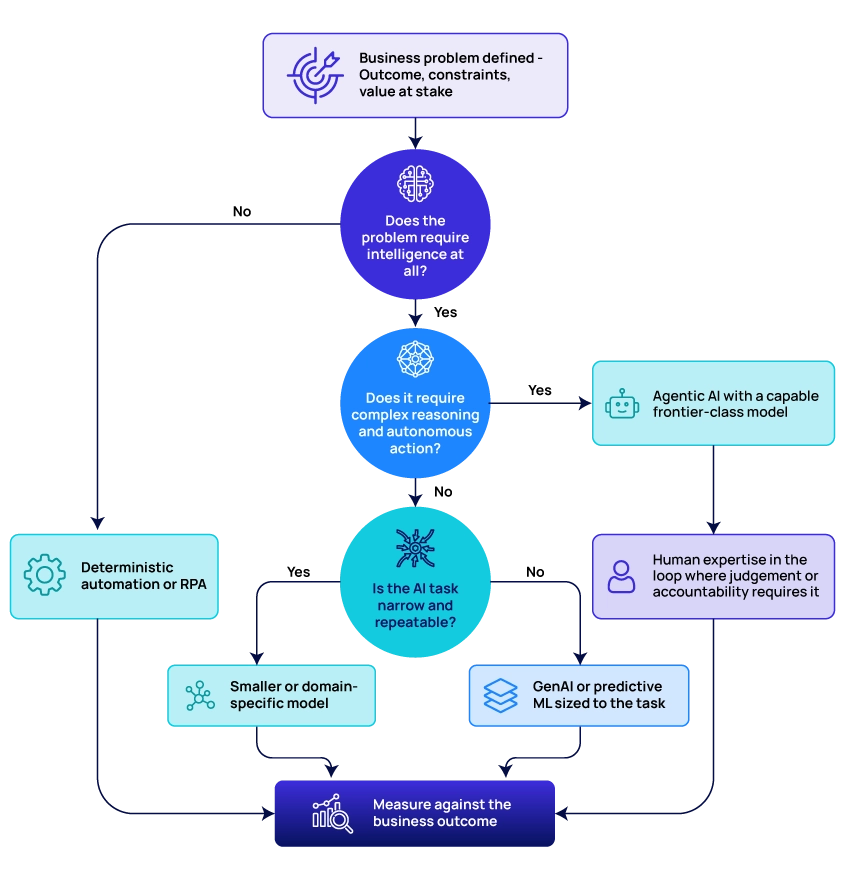
The decision logic behind those three answers can be expressed simply.
None of this is complicated. What makes it hard in practice is that the first question, whether the problem needs intelligence at all, is the one that gets skipped when the mandate is “deploy AI.” Answering it honestly is where most of the value is protected.
Where a partner adds value: from assessment to scaled outcomes
Most enterprises don’t lack access to models, platforms or automation tools. What they tend to lack is a disciplined way of working back from the business outcome to the appropriate technology, and a target architecture that keeps individual decisions coherent.
That’s where Hexaware tends to focus with clients. The starting point is the current state: which processes are actually costing money or slowing growth, where the dependencies and data constraints sit, and what outcome the business needs to change. From there, the work is to define the to-be state against a North Star Architecture and select the fit-for-purpose combination of automation, predictive AI, generative AI, agentic AI and human expertise for each problem, with the economics and risk of each option made explicit before anything is built.
For a CIO working within a flat budget, the practical effect is that spend goes where the value is. Frontier-model costs are reserved for problems that need them. Commodity tasks run on commodity infrastructure. Processes that should be deterministic stay deterministic. And every initiative carries a measurable outcome that can be reported back to the business in its own terms.
Precision, not proliferation
The next phase of enterprise AI maturity won’t be won by whoever deploys the most AI. It will be won by organizations that connect AI to specific business problems, choose the appropriate level of intelligence for each, and hold themselves to measurable results.
That makes the winning architecture hybrid by design. Automation, predictive AI, generative AI, agentic AI and human judgement each have a place, and the place is determined by the complexity of the problem, the economics of the solution and the risk involved, not by what’s newest.
The question facing leaders is no longer whether AI belongs in the enterprise. It’s how intelligently AI is designed into it. “AI everywhere” is only worth pursuing if it translates into value everywhere, with every technology decision traceable to growth, productivity, speed, cost, risk reduction or customer experience.
Enterprises that build that discipline into their 2027 plans will find the equation between flat budgets and growth targets easier to balance. Those that don’t will keep adding pilots that work in isolation and never quite reach the P&L.
Ready to turn AI adoption into measurable business value?
Connect with Hexaware to assess your current state, define your North Star Architecture, and identify where automation, GenAI, agentic AI, and human expertise can deliver the greatest impact. Schedule an AI Value Assessment