Are you a Snowflake Data Engineer and do a lot of SQL development?
Or have you ever wondered how to make your data models more intuitive, governed, and AI-ready—without sacrificing the flexibility of SQL?
Let’s dive into the world of Snowflake Cortex Analyst experience and the game-changing Cortex Semantic Search functionality!
How Semantic Models and Natural Language Search Are Transforming Analytics in the Snowflake Era
In today’s digital economy, data is more than just a resource—it is the lifeblood of innovation, competitive advantage, and operational excellence. Yet, as organizations accumulate ever-greater volumes of data, a paradox emerges: the more data we have, the harder it becomes to extract actionable insight, ensure governance, and make knowledge accessible to all. Traditional SQL-based development, as robust and flexible as it is for technical teams, often creates a barrier between business users and the information they need, while also increasing the maintenance burden for data engineers. What if there was a way to make your data both more governed and more intuitive, more AI-ready and more flexible, all while preserving the power of SQL? What if everyone—not just your SQL power users—could ask complex business questions in natural language and receive accurate, context-aware answers, powered by a unified, governed semantic layer? This is not a distant dream; it is the emerging reality with Snowflake’s Cortex Analyst and Semantic Search. Let’s explore how this paradigm shift is transforming the data landscape and why every data engineer and analytics leader should take notice.
What is the Semantic Layer—and Why Does It Matter Now?
As organizations adopt AI-powered analytics, the semantic layer offers a unified, business-friendly connection between raw data in your data warehouse and actionable insights. It makes data more discoverable, governed, and understandable—enabling both humans and AI tools to ask complex questions in natural language and get accurate, context-aware answers.
The Semantic Layer: The Missing Link in AI-Powered Analytics
The semantic layer is a unified, business-centric bridge between the raw data in your warehouse and the intelligent insights that drive action. It abstracts technical complexity, harmonizes disparate data sources, and encodes business logic, so both humans and AI tools can interact with data in a consistent, governed, and meaningful way. Put simply, it makes data discoverable, understandable, and trustworthy—unlocking the true potential of your data warehouse. Snowflake’s vision for the semantic layer is built on two foundational concepts: semantic models and semantic views.
Snowflake’s semantic layer is built on two foundational concepts
- Snowflake semantic models are your business blueprints. They define key entities, relationships, dimensions, facts, and metrics in a way that’s decoupled from any single table or SQL query. Think of them as the authoritative source of business logic, curated and maintained independently from the raw data structures.
- Semantic views are the interfaces that operationalize those models. They make semantic definitions queryable, governed, and accessible—not only to SQL and BI tools, but also to AI-powered applications and natural language interfaces.
This architecture is not just a technical improvement; it is a fundamental shift in how organizations think about, manage, and use their data.
|
Semantic Models |
Semantic Views |
|
Semantic Models are the business blueprints (Maintained in STAGE) —defining your entities, relationships, dimensions, facts, and metrics in a way that’s independent of any single table or SQL query. |
Semantic Views are the interfaces (Snowflake Object Type) —making those definitions queryable, governed, and accessible to both SQL, BI, and AI-powered tools. |
How does this map to SQL and SQL Developer
Rethinking SQL Development: From Queries to Business Logic
For data engineers and SQL developers, the semantic layer may sound abstract at first. But at its core, it’s about making explicit what you already do—just in a way that scales across teams, tools, and use cases. Let’s break it down in familiar terms:
- Dimensions are the columns you use in SELECT and GROUP BY—the “who,” “what,” “where,” and “when” of your data.
- Facts are the raw numeric columns—quantities, amounts, occurrences—that you aggregate or analyze.
- Metrics are the aggregations you calculate—sums, averages, ratios—often encoded in SQL as SUM(), AVG(), etc.
Summary Table
|
Concept |
SQL Analogy |
Example in SQL Query |
|
Dimension |
Columns in SELECT/GROUP BY |
GROUP BY customer_name, order_date |
|
Fact |
Raw value in each row |
o_totalprice, measure_value |
|
Metric |
Aggregation of a fact |
SUM(o_totalprice) AS total_revenue |
To sum up, one can say that the dimensions are what you group by, facts are the numbers you aggregate, and metrics are the results of those aggregations.
Consider a classic sales analytics use case. Suppose you have a sales table and want to analyze performance by customer and date:
A Practical Example:
Suppose you have a sales table:
SELECT
customer_name,
order_date,
SUM(order_value) AS total_revenue,
AVG(order_value) AS avg_order_value
FROM sales
GROUP BY customer_name, order_date;
In the semantic model:
- customer_name and order_date are dimensions.
- order_value is a fact.
- total_revenue and avg_order_value are metrics.
By defining these concepts once in your semantic model, you unlock consistent, reusable business logic across every team and every tool. No more copy-pasting SQL fragments, no more debates over metric definitions, and no more risk of “multiple versions of the truth.”
Meet Cortex Analyst: Natural Language for Structured Data
The real magic happens when you combine a robust semantic layer with the power of natural language understanding. Enter Cortex Analyst, Snowflake’s natural language interface for structured data. Imagine this: instead of writing the SQL above, a user simply asks, “Show me total revenue by customer for the last quarter.” Cortex Analyst leverages your semantic models to translate this request into the precise SQL needed, using the correct definitions for dimensions, facts, and metrics. It’s not just a query generator; it’s a context-aware AI that understands business logic, organizational vocabulary, and intent. The implications are profound:
- Faster time to insight: Business users get answers instantly, without waiting for a data engineer to write or modify queries.
- Greater consistency: Everyone uses the same definitions, reducing confusion and rework.
- Broader accessibility: Data becomes available to everyone, not just SQL experts.
Cortex Analyst is not just a tool; it’s a glimpse into the AI-first future of analytics, where the boundary between human questions and machine answers dissolves.
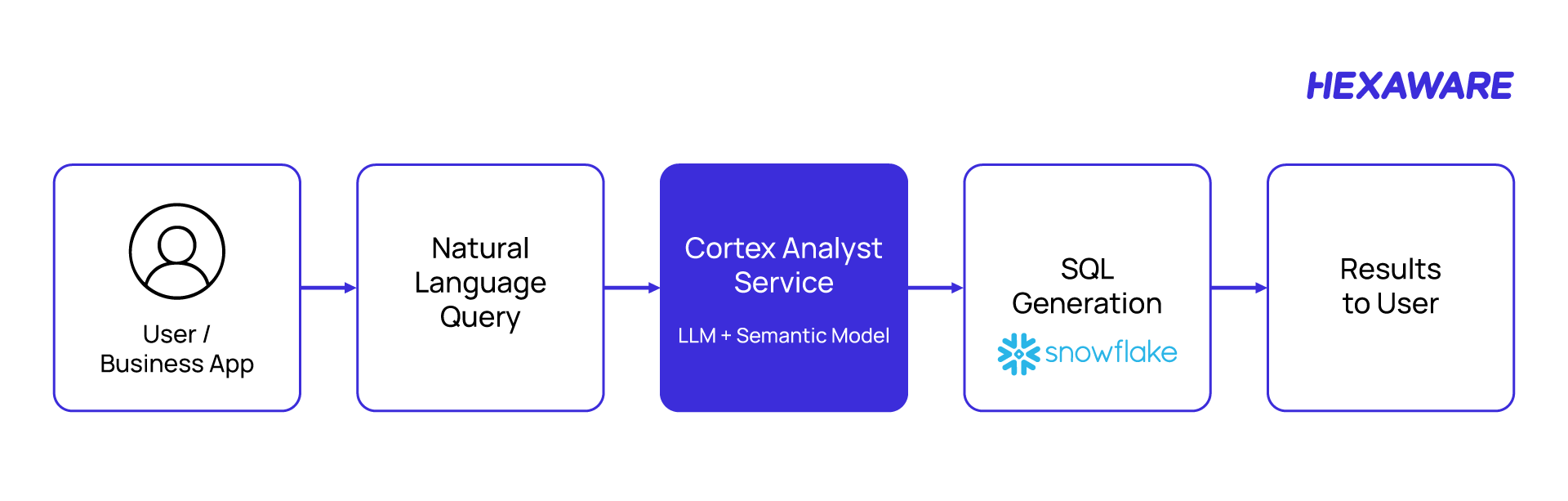
Picture 1: Cortex Analyst conceptual diagram
With Cortex Analyst, you can ask any simple query in the most human or natural way possible, and Snowflake will translate that into the right SQL, using semantic model definitions.
No more manual query writing for every business question! It won’t be wrong to say that natural language analytics with Cortex Analyst is the next AI leap.
Unleash the Power of Snowflake Cortex Search Service
Snowflake Cortex Search Service is a breakthrough capability designed for the AI-first era, enabling users to search and discover data across their Snowflake data warehouse using natural language. Powered by semantic views and models and seamlessly integrated with Cortex Analyst, Cortex Search understands business context and intent—so users can ask complex questions without knowing table or column names. According to Snowflake documentation, Cortex Search enables low-latency, high-quality “fuzzy” search over your Snowflake data, powering a broad array of search experiences, including Retrieval Augmented Generation (RAG) applications that leverage Large Language Models (LLMs). By bridging raw data and intelligent analytics, Cortex Search makes AI-powered, conversational data discovery accessible to everyone in your organization.
No need-to-know table names or column names. Just ask what you want to know!
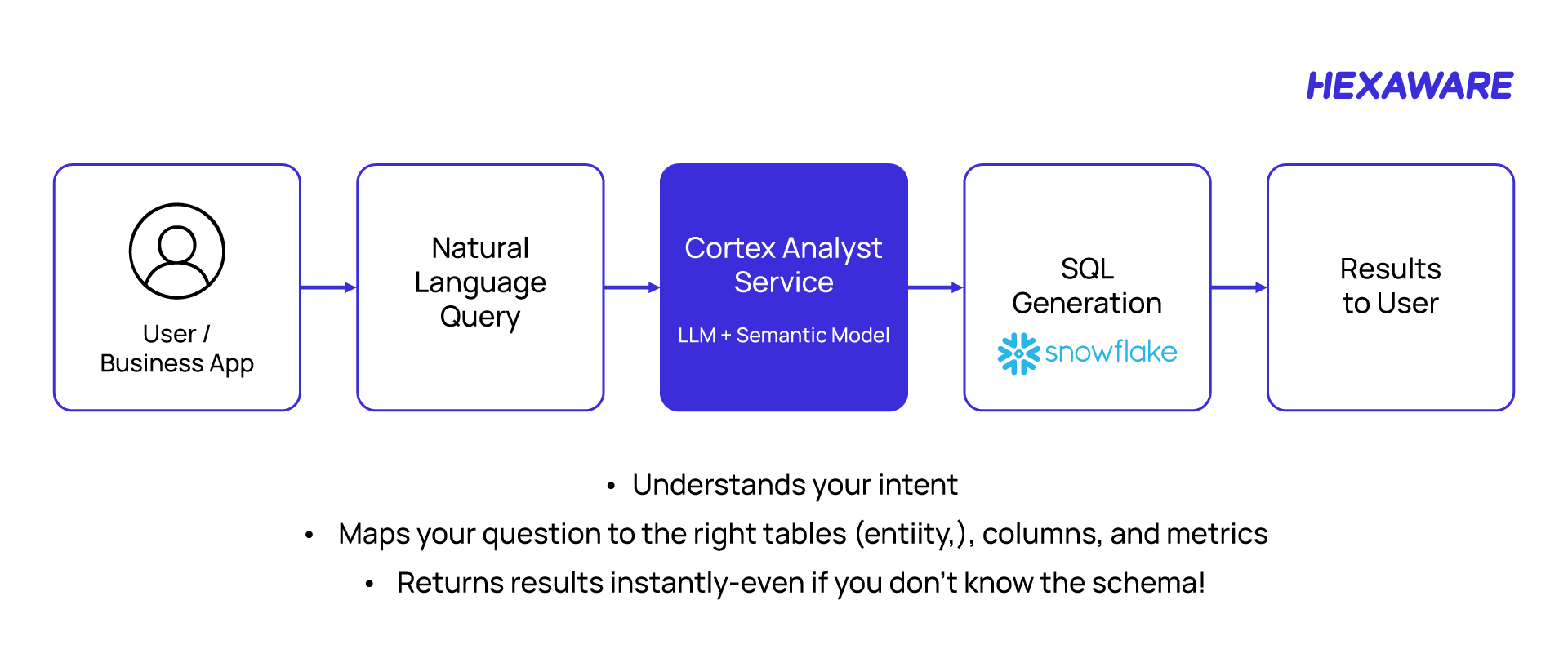
Picture 2: Cortex Analyst Service
Pro Tip: Use SYSTEM$ Functions for YAML & Semantic Models
For modern data teams, agility and repeatability are essential. Snowflake recognizes this, offering seamless movement between YAML files (for code-based modeling) and live semantic models, using built-in SYSTEM$ functions. Snowflake makes it easy to move between YAML files and semantic models using built-in functions:
Convert a YAML File to a Semantic Model:
CALL SYSTEM$IMPORT_SEMANTIC_MODEL(‘my_db.my_schema.my_semantic_model_yaml’);
Convert a Semantic Model Back to YAML:
SELECT SYSTEM$EXPORT_SEMANTIC_MODEL(‘my_db.my_schema.my_semantic_model’);
This round-trip workflow enables you to design models in YAML, deploy them, and extract them for documentation or migration purposes.
Takeaway for SQL Developers
- You already know the building blocks: If you can write SQL, you can understand semantic models.
- Start thinking in business terms: Define your dimensions, facts, and metrics once—then let everyone (and every tool) use them.
- Embrace the future: With semantic models, Cortex Analyst, and Semantic Search, you’re not just writing queries—you’re building a governed, AI-powered analytics
- Leverage SYSTEM$ functions: Move seamlessly between YAML and Snowflake objects for true DevOps-style analytics engineering.
- Empower everyone: With semantic search, anyone can find insights—no SQL required.
Getting Started: Your Next Steps
Ready to level up your Snowflake skills and unlock the full potential of your data warehouse?
- Start modeling your data semantically: Identify your key entities, relationships, dimensions, facts, and metrics. Encode them in semantic models.
- Leverage YAML and SYSTEM$ functions: Move seamlessly between code and platform, adopting DevOps best practices for analytics.
- Explore Cortex Analyst and Semantic Search: Pilot natural language analytics and universal search in your organization. See how it transforms the user experience.
- Educate your stakeholders: Help business users, analysts, and AI developers understand the power of semantic models and the new possibilities they unlock.
Now is the time to invest in the skills and platforms that will define the next decade of data-driven innovation. The future of analytics belongs to those who make data intuitive, governed, and universally accessible. Will your organization lead, or lag behind?
Would you like a hands-on demo, a YAML template, or a more in-depth exploration of semantic modeling best practices? Hexaware can help! Learn more about our Snowflake capabilities to get started today.