Databricks Unity Catalog Metric Views deliver a unified approach to data analytics by standardizing metrics across teams. With Unity Catalog Metrics, organizations achieve centralized data governance, ensuring accuracy and trust in every report. These reusable views simplify customer loyalty analysis, enhance collaboration, and support data-driven decision-making on a scale. By leveraging Databricks Unity Catalog, businesses can eliminate fragmented definitions and unlock actionable insights, empowering faster and smarter decisions in today’s data-driven world. In this blog, let’s explore how Unity Catalog Metric Views unlock consistent metrics for data-driven insights for businesses.
Introduction to Unity Catalog Metric Views
In today’s digital-first landscape, the ability to make fast, accurate, and unified decisions from data is a defining factor that separates industry leaders from laggards. As organizations grapple with an ever-expanding universe of data sources, analytic tools, and end users, a universal challenge emerges: how do we ensure that everyone speaks the same “data language”? How do we avoid costly discrepancies, misaligned strategies, and the erosion of trust in our analytics? Databricks’ Unity Catalog Metric Views (UC Metric Views) offer a compelling solution to these questions, not only ensuring technical consistency but also catalyzing cultural and operational transformation. This article explores why standardizing metrics is the next frontier for organizational intelligence and how UC Metric Views can serve as the cornerstone for building a truly data-driven enterprise.
The Fragmentation Problem: Why Consistency Matters
Data-driven decision-making is only as strong as the data foundation it rests upon. Yet, in most organizations, the proliferation of custom metrics—created ad hoc in dashboards, notebooks, and applications—leads to a maze of definitions, calculations, and interpretations. One team’s “Active Customer” might not match another’s, and KPIs drift subtly across departments. This lack of standardization breeds confusion, slows down collaboration, and erodes trust in analytics outputs. It’s not merely a technical problem; it’s an organizational risk. Inconsistent metrics lead to misaligned business strategies, wasted resources, and missed opportunities in competitive markets.
Unity Catalog Metric Views: The New Standard in Metrics Governance
Enter Databricks Unity Catalog Metric Views—a game-changing capability designed to centralize, standardize, and scale the way organizations define and consume metrics. UC Metric Views serve as reusable, centrally governed definitions for measures, dimensions, and business logic, ensuring that all teams, regardless of function or tool, are aligned in how they interpret and act on data.
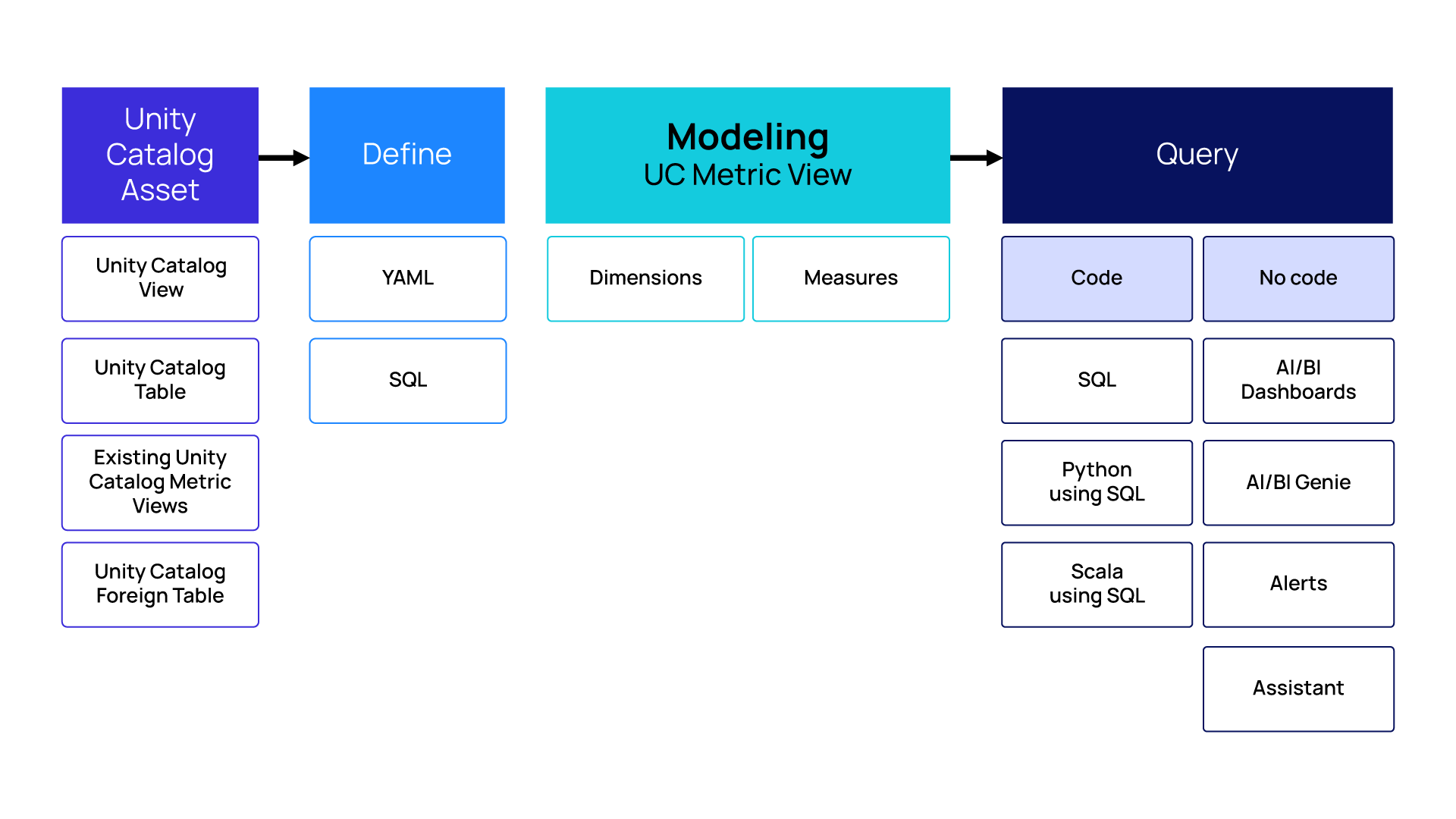
Picture 1: Databricks Data Intelligent Platform
Key Benefits of UC Metric Views
By leveraging Unity Catalog Metric Views, organizations can ensure that their data analytics processes are not only efficient but also reliable, paving the way for informed decision-making. By centralizing intricate business rules into metric views, teams can define KPIs once and reliably surface the same calculations in dashboards, Genie spaces, and alerts.
- Consistency: UC Metric Views establishes a single source of truth by standardizing metrics and dimensions across the organization. This eliminates conflicting definitions and ensures every report, dashboard, and model is built on a unified foundation.
- Reusability: Defined metric views can be applied across multiple analytic tools and use cases, reducing duplication, saving time, and guaranteeing insights are based on accurate, up-to-date logic.
- Enhanced Collaboration: Shared definitions enable seamless cross-team collaboration, allowing business, analytics, and engineering teams to work from a common understanding.
- Scalability: Built to handle complex calculations and large-scale datasets, UC Metric Views deliver the robustness required for modern data environments.
- Centralized Governance: Metrics, views, and metadata are centrally managed within a structured catalog hierarchy, enriched with descriptions, ownership, and tags—making them easily discoverable and reducing reliance on tribal knowledge.
- Actionable Insights: A consistent framework empowers teams to quickly uncover trends and patterns, driving faster and more confident data-driven decisions.
From Theory to Practice: Optimizing Customer Loyalty Programs
To appreciate the transformative potential of UC Metric Views, let’s consider a practical scenario: optimizing customer retention and loyalty programs. Imagine your organization has a rich customer dataset containing personal details, geographic information, order history, and purchasing behavior. The business goal is clear: improve customer retention by optimizing loyalty programs—understanding who your loyal customers are, where they’re located, and how they behave.
The provided dataset includes valuable information, such as `loyalty segment`, `units purchased`, and geographic data (`state`, `city`, `postcode`, etc.). By analyzing the above data, organizations can identify patterns in customer behavior and optimize their loyalty programs. The customer dataset also has rich information that can be harnessed to address various business challenges. For example, these insights can also drive targeted marketing campaigns, personalized offers, and operational improvements.
Business Questions Include
- Which regions have the highest concentration of loyal customers?
- What purchasing trends exist among different loyalty segments?
- How can shipping efficiency be improved for loyal customers in specific geographies?
Historically, answering these questions might involve different teams independently building their own calculations, leading to varying results and fragmented strategies.
Leveraging UC Metric Views to Address the Problem
UC Metric Views can be used to define consistent metrics and dimensions that help analyze customer loyalty and purchasing behavior. By creating reusable metric views, organizations can ensure that their analyses are accurate and standardized across all teams.
Create UC Metric View
Select UC Table (customers) -> Click Create -> Metric View.
(YAML editor with your metrics, dimensions, and fields defined as below)
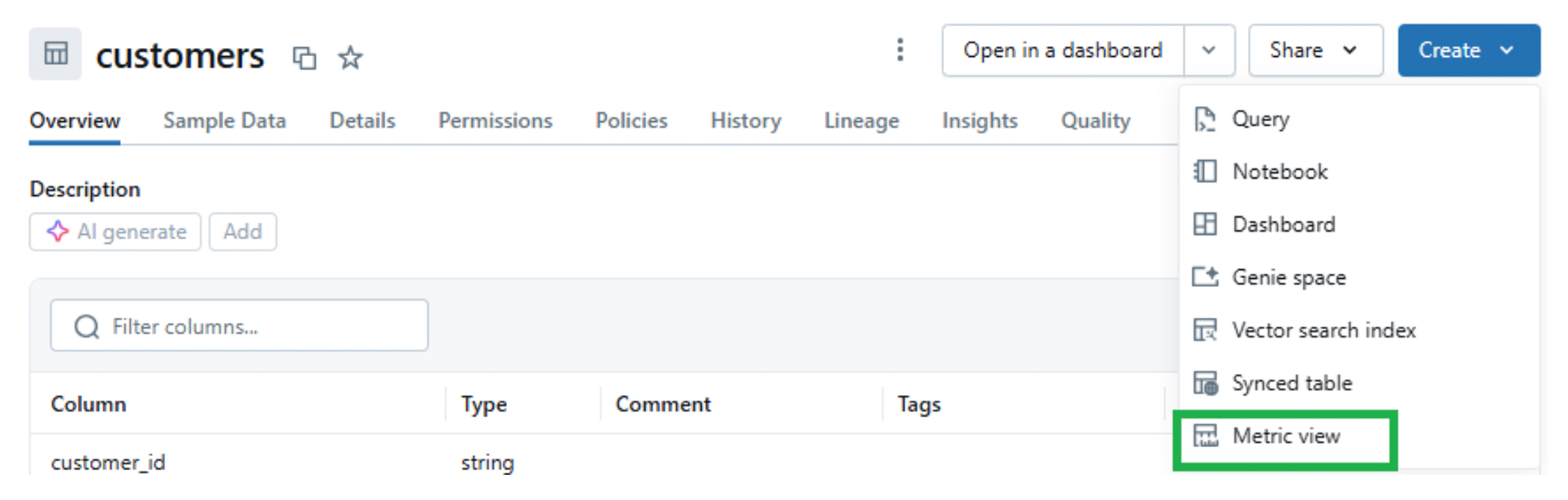
Picture 2: UC Metric View
- Define Metrics: Metrics represent quantifiable measures. For the customer dataset, relevant metrics include:
- Total Units Purchased: Sum of `units_purchased` for each customer.
- Loyalty Segment Count: Count of customers in each `loyalty_segment`.
- Average Units Purchased: Mean of `units_purchased` for each customer.
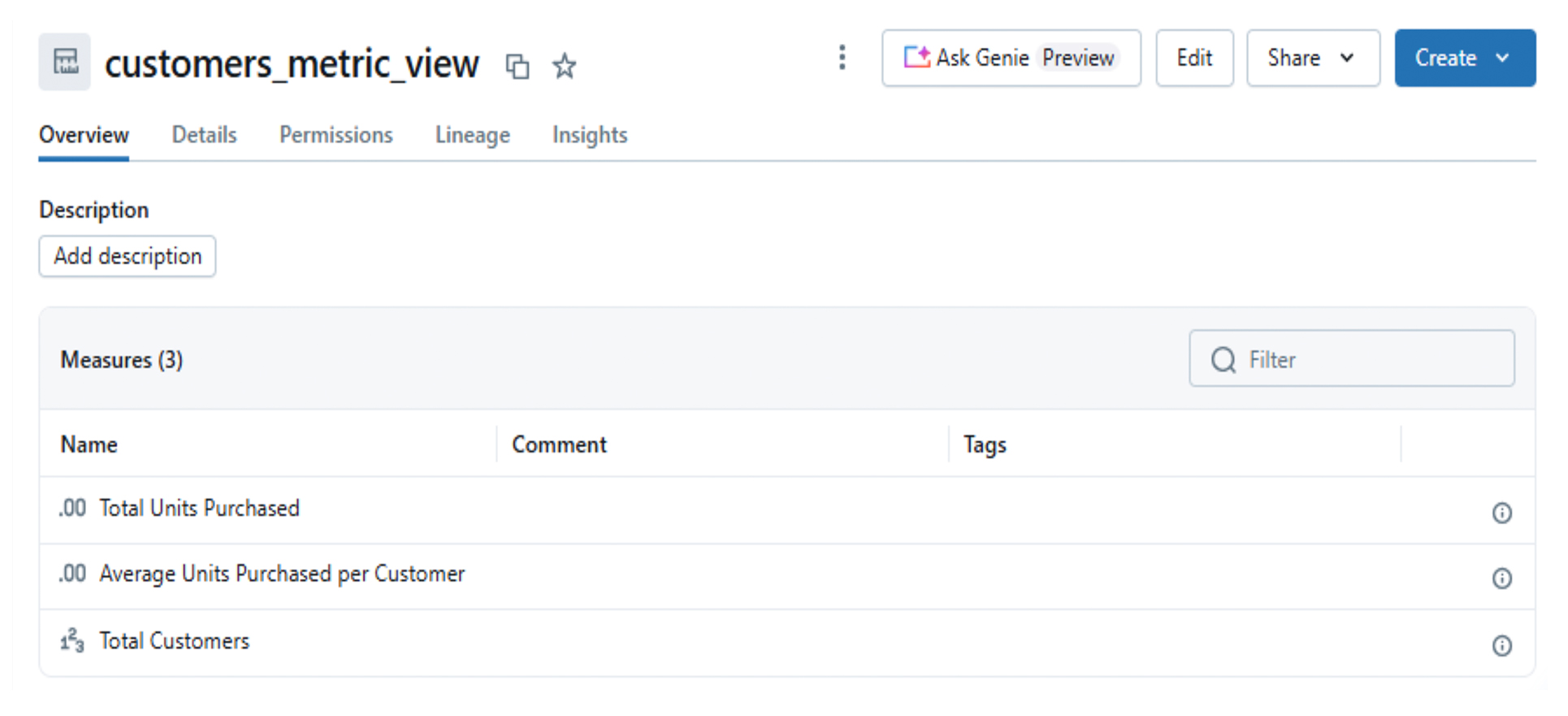
Picture 3: Customer Metric View
- Define Dimensions: Dimensions are attributes that describe the metrics. For our dataset, dimensions might include:
- Geographic Dimensions: `state`, `city`.
- Customer Attributes: `customer_name`.
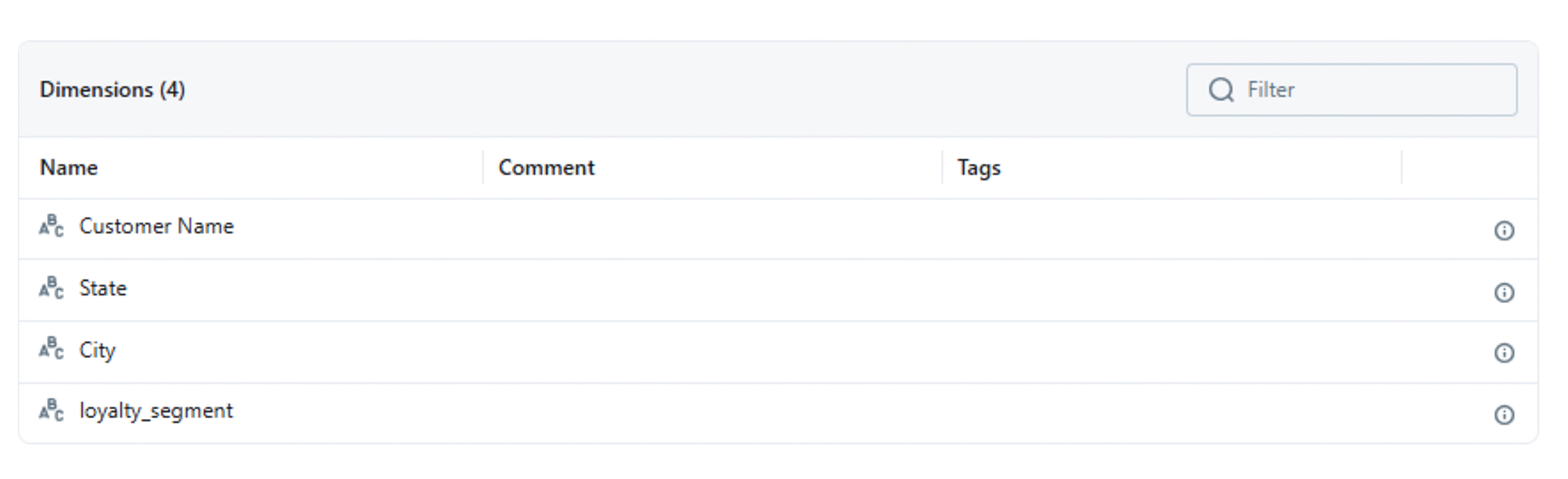
Picture 4: Dimensions
- Define Logic: The logic combines metrics and dimensions to create meaningful insights. For example:
- Calculate the average units purchased by loyalty customers.
- Calculate the total customers per loyalty segment.
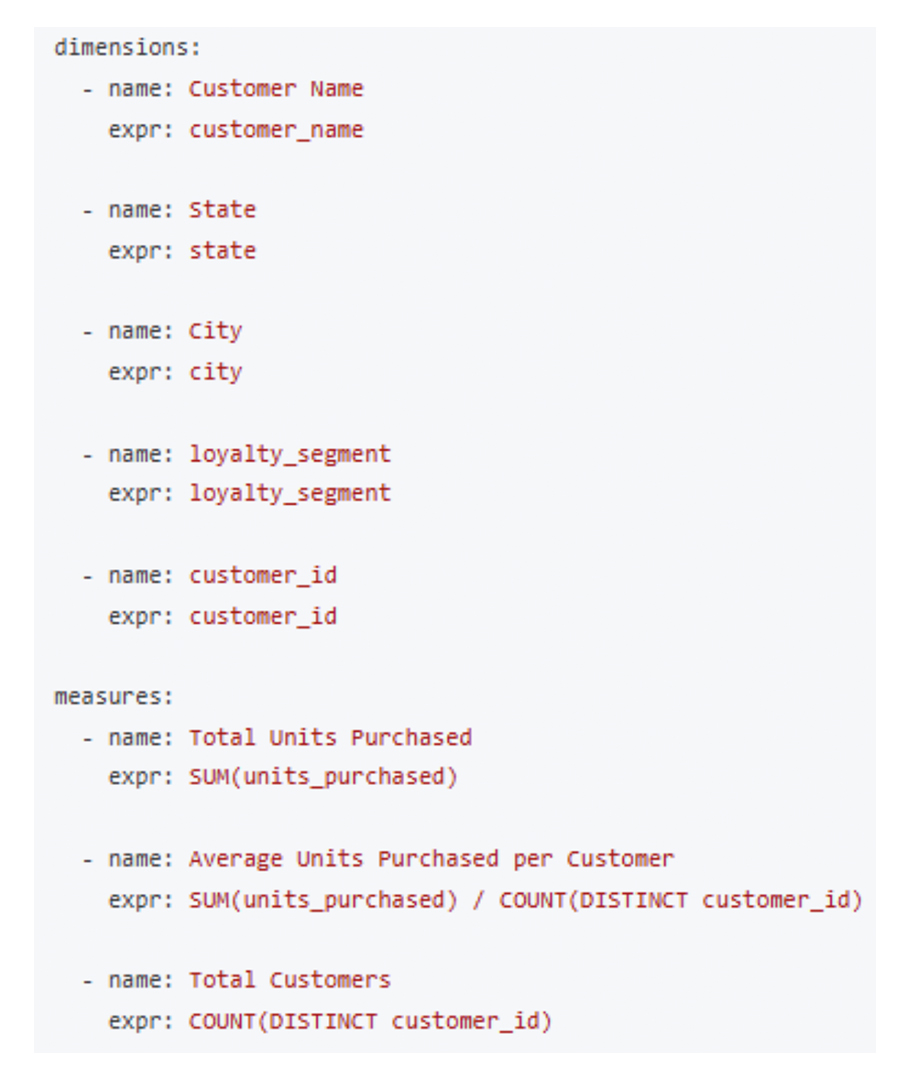
Picture 5: Logic
Unity Catalog Metric Views empower organizations to establish consistent metrics, dimensions, and logic across their data analytics processes. By leveraging these businesses can address critical challenges, such as optimizing customer loyalty programs, with greater accuracy and efficiency.
This demonstrates how UC Metric Views can be used to analyze customer behavior and improve decision-making. As organizations continue to embrace data-driven strategies, the importance of standardized metrics cannot be overstated. With Unity Catalog Metric Views, Databricks provides the tools needed to unlock the full potential of data analytics and business intelligence (BI).
Strategic Implications: From Data Consistency to Business Agility
Adopting UC Metric Views is not just a technical upgrade; it’s a strategic move toward business agility and resilience. Here’s why:
- Speed to Insight: With standardized metrics, teams spend less time reconciling definitions and more time generating insights and driving actions.
- Trust and Transparency: A single source of truth builds confidence across the organization, enabling data to be the backbone of strategic decisions.
- Regulatory Compliance: Centralized governance and metadata make it easier to comply with data policies and audits.
- Cultural Transformation: By removing ambiguity and fostering shared understanding, organizations can move from siloed decision-making to a collaborative, data-driven culture.
The Road Ahead: Building a Data-Driven Future
As organizations continue to embrace digital transformation, the importance of standardized, governed metrics will only grow. Databricks Unity Catalog Metric Views provide the framework and tools to unlock the full potential of analytics and business intelligence.
The call to action is clear—it’s time for organizations to move beyond fragmented, ad hoc analytics and embrace a new standard in metrics governance. By investing in tools like UC Metric Views, leaders can ensure that every decision is powered by consistent, reliable, and actionable data—fueling innovation, operational excellence, and sustained competitive advantage.
Are you ready to unify your data language and unlock the next era of data-driven growth with Hexaware? Visit our Databricks partner page to learn more and get started.