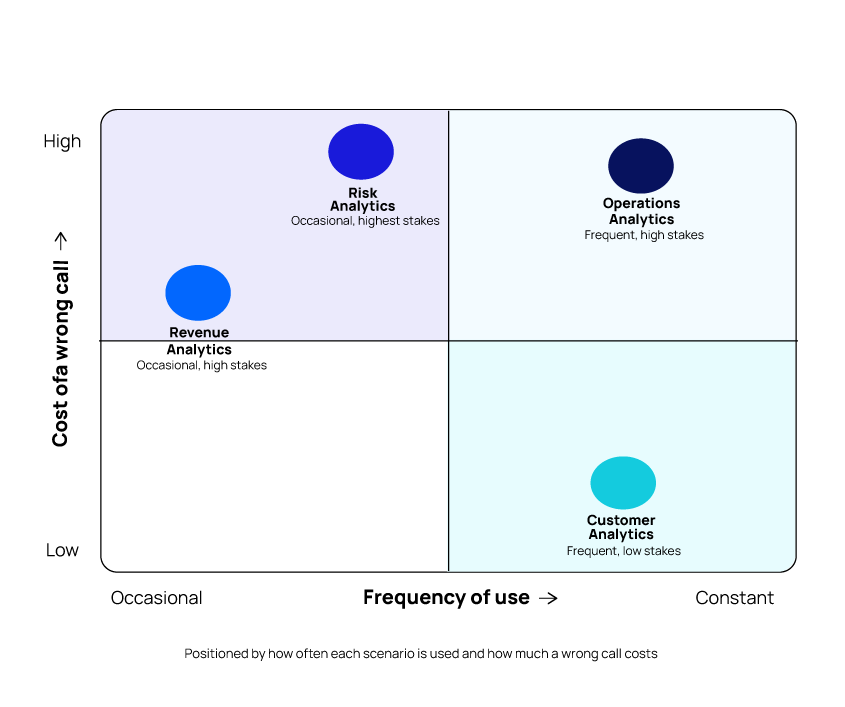
Most write-ups of enterprise analytics treat every use case as roughly the same kind of problem with a different label stuck on it. Churn prediction, demand forecasting, pricing, fraud detection, all filed under the same heading. They’re not the same problem. What separates them is how often a business acts on the output and how much it costs when the output is wrong. Put those two questions on a simple grid and four common data analytics services scenarios land in four different places, which is a better way to think about them than a list ever was.
Whether commissioned as data analytics as a service or as a bespoke project, the four scenarios below tend to look nothing alike in practice.
Four Data Analytics Services Scenarios, Mapped
Customer Analytics: Frequent Use, Forgiven Easily
Customer analytics sits in the corner of the map where things happen all the time and mistakes don’t cost much on their own. A churn model runs every day. A recommendation engine fires on every visit. If one prediction is wrong, a customer gets an offer they didn’t need, or a warning sign gets missed for a week before someone notices. Annoying, not catastrophic.
That low individual cost is exactly why this is where a lot of enterprises begin their business analytics services investment. The ISG Provider Lens® Advanced Analytics and AI Services – Large and Midsize 2025 U.S. Quadrant Report lists customer experience enhancements among the most valuable AI use case clusters enterprises report, and it’s not hard to see why: the volume of interactions means even a modest improvement adds up fast, and the downside of getting an individual prediction wrong stays small. It’s a forgiving place to build confidence in data analytics services before tackling something less forgiving.
Operations Analytics: Just as Frequent, Much Less Forgiving
Operations analytics gets used about as often as customer analytics does, sometimes more, but a miss here costs a lot more than an ill-fitting offer. A demand forecast that’s terribly wrong leaves a warehouse full of the wrong inventory, or a shelf empty of what people want, and either becomes visible in the numbers within a few weeks.
This is the use case ISG points to when it discusses predictive operations as one of the clearest sources of value enterprises report from their data programs. The report’s finding that large enterprises now run application portfolios approaching 2,000 systems on average carries more weight here than in most other scenarios because a forecast is only as good as the sources feeding it, and pulling a clean signal out of that many systems is most of the actual work. Operations analytics rewards enterprises that have already done serious data integration work, more than it rewards a clever model.
Revenue Analytics: Occasional Use, Expensive to Get Wrong
Move down the frequency axis and revenue analytics, a familiar territory for advanced analytics services engagements, shows up somewhere quite different. Pricing decisions, promotional planning, revenue forecasts, and these don’t happen constantly. A pricing change might get revisited monthly, not hourly. But when the underlying call is wrong, or worse, when nobody can prove whether it was right, the cost is significant and hard to walk back quietly.
This is where ISG’s data on value attribution becomes the most relevant of anywhere on the map. Enterprises expect to get roughly 15 percent more value out of their data initiatives within two years, yet attribution of specific financial outcomes to specific programs remains one of the persistent gaps the report identifies, and revenue is exactly where that gap tends to hit hardest. A pricing model that works but can’t prove it worked ends up with a shorter shelf life than the model deserves, because finance teams become skeptical of gains they can’t independently verify.
Risk Analytics: Rare Use, the Highest Stakes on the Map
Risk and compliance analytics sit furthest from customer analytics on this map in every direction. Historically it’s been a quarterly exercise, reviewed a handful of times a year, and the cost of missing something isn’t an annoyed customer or a bad quarter. It’s regulatory exposure, and that’s a different category of consequence entirely.
The caution built into this corner of the map is visible in ISG’s findings on data retention. Security risk concerns cause a meaningful share of organizations to limit how they retain and use data in the first place, which is a constraint that barely registers in the customer analytics corner and dominates everything in this one. Any data analytics services engagement in this space has to work inside that caution rather than around it. In data analytics consulting services engagements in regulated industries, the organizations that get this right tend to treat access controls and monitoring as the foundation the analytics sits on, not as a compliance tax paid afterward.
What This Map Means for Data Analytics Services Buyers
An organization still finding its footing with data usually does better starting with customer analytics, since mistakes there are cheap and confidence builds without much risk attached. Jumping straight into risk analytics tends to go worse, given how little room there is for error and how much caution already surrounds that data. It’s fair to be a little skeptical of any analytics as a service provider whose pitch treats these four scenarios as interchangeable, because they aren’t.
What operations analytics needs mostly comes down to integration work. Revenue analytics comes down to whether the numbers can be proven after the fact. Risk analytics comes down to access governance more than anything else. Customer analytics mostly just needs enough volume for small gains to add up. Whatever form a data analytics services engagement takes, it should look different depending on which of these problems it’s solving.
Explore Hexaware’s data and analytics services.