Blog
The Merger of AI and Data Analytics
Understanding the Shift Toward Enterprise AI Analytics
- Last Updated: Jan 20, 2026
- 20 min read
Share on



For business intelligence in today’s hyperconnected digital age, data is the fuel and artificial intelligence (AI) is the spaceship to a new future. According to Gartner, by 2027, 50% of business decisions will be augmented or automated by AI agents for decision intelligence, highlighting the rising importance of bringing together AI and data analytics.
However, the journey from data to intelligence in an AI-first era requires a strategic approach that aligns people, platforms, and governance to achieve or accelerate real impact from business outcomes. With AI-first strategies, enterprises are modernizing their outlook on data, which also modernizes their business. Now the question is how to accelerate AI’s adoption.
This blog dives into the key roles of AI in data analytics that amplify core themes driving the future of enterprise AI analytics. Explore how enterprises can use AI and advanced analytics to reimagine their operations and drive transformative business value.
The future is AI-first—let’s prepare for hyperdrive.
Demystifying Enterprise AI Analytics
In enterprise AI analytics, both the terms ‘data analytics’ and ‘AI analytics’ are crucial elements. While we anticipate that ‘AI analytics’ will gradually take precedence in the analytics landscape, Hexaware’s strategies currently address these functions under the umbrella of ‘advanced analytics’ within business intelligence.
At Hexaware, we use the term enterprise AI analytics to encompass all three: ‘data analytics’, ‘AI analytics’ and ‘advanced analytics’. Our primary focus being business intelligence as an outcome.
However, in this post, we will talk about the merger of AI and data analytics, exploring how artificial intelligence improves data analytics for your enterprise.
How AI is Used in Data Analytics for Enterprises
In today’s lightning-fast business environment, foresight and speed are two differentiators in business intelligence. To win at going from data to impact is the ability to enable your enterprise to act on insights in real time at scale.
But really, it’s just people being equipped to drive change in real time and adapting to new ways of acting on this influx of information.
Businesses now respond to market changes, seize opportunities, and mitigate risks before they escalate. However, achieving this level of agility requires more than advanced tools—it demands people ready for speed, the right platforms to achieve the results, and governance frameworks to ensure that enterprise analytics don’t falter at any scale.
Let’s explore some examples of AI’s numerous applications with data analytics.
What’s New: The Shift Toward Enterprise AI Analytics
Data analytics is the practice of turning raw data into meaningful insights that drive action. At its core, it rests on four key pillars: descriptive, diagnostic, predictive, and prescriptive analytics.
Today, artificial intelligence has redefined how enterprises approach these pillars—making decisions not only faster, but also smarter, more scalable, and more impactful. By weaving AI into traditional analytics, organizations can unlock new depths of understanding and efficiency that were once out of reach.
Before diving into real-world examples of how AI enhances each pillar, it helps to sum up its impact in four simple words: faster, larger, better, smarter. Together, these qualities capture how AI is reshaping the way data drives enterprise outcomes.
The Four Types of Data Analytics and AI’s Impact on It
At its heart, data analytics is built on four simple principles:
- Descriptive analytics tells us what has happened,
- Diagnostic analytics uncovers why it happened,
- Predictive analytics forecasts what is likely to happen next, and
- Prescriptive analytics recommends the best actions to take.
With AI stepping in, these principles are being taken to the next level — data gets cleaned and organized faster, insights surface in real time, and decisions become smarter and more forward-looking than ever before.
Predictive Analytics: Anticipating What Will Happen
|
Dimension |
AI Type/Model |
How It Fits |
|
Faster |
AutoML (e.g., Google AutoML) |
Rapidly builds and tunes predictive models for quick forecasts. |
|
Larger |
Deep Learning (e.g., LSTM, Transformers) |
Processes large, complex datasets for broad trend prediction. |
|
Better |
Ensemble Methods (e.g., XGBoost) |
Improves prediction accuracy and robustness. |
|
Smarter |
Real-Time Predictive AI (e.g., Prophet, RNNs) |
Continuously refines predictions with live data. |
|
Generative AI |
GenAI (e.g., GPT-4, Gemini) |
Generates plausible future scenarios, stress tests, and narrative forecasts. |
|
Agentic AI |
Autonomous Forecasting Agents (e.g., LangChain agents) |
Continuously update models, ingest new data, and autonomously adjust forecasts. |
Prescriptive Analytics: Recommending What to Do
|
Dimension |
AI Type/Model |
How It Fits |
|
Faster |
Optimization Algorithms (e.g., Gurobi) |
Instantly simulates scenarios and recommends optimal actions. |
|
Larger |
Hybrid AI Systems (e.g., FICO Xpress Insight) |
Combines ML, optimization, and simulation for comprehensive recommendations. |
|
Better |
Reinforcement Learning (e.g., OpenAI Gym) |
Learns and improves optimal strategies over time. |
|
Smarter |
Cognitive AI & NLP (e.g., IBM Watson, GPT-4) |
Dynamically adapts recommendations to changing data and context. |
|
Generative AI |
GenAI (e.g., GPT-4, Claude) |
Drafts action plans, policy documents, and personalized recommendations |
|
Agentic AI |
Autonomous Prescriptive Agents (e.g., multi-agent systems) |
Execute recommended actions, adapt strategies in real time, and coordinate multi-step plans autonomously. |
Descriptive Analytics: Understanding What Happened
|
Dimension |
AI Type/Model |
How It Fits |
|
Faster |
NLP (e.g., GPT-4, Gemini) |
Instantly summarizes and visualizes data, enabling real-time reporting. |
|
Larger |
ML for Data Integration |
Aggregates and harmonizes data from diverse sources for a unified view. |
|
Better |
Augmented Analytics Platforms (e.g., Tableau with Einstein AI) |
Automates data cleaning and monitoring, reducing errors. |
|
Smarter |
LLMs (e.g., Claude, GPT-4) |
Identifies hidden correlations and generates narrative explanations. |
|
Generative AI |
GenAI (e.g., GPT-4, Gemini) |
Creates new content, such as automated reports, synthetic datasets, and tailored summaries, making insights more accessible and actionable |
|
Agentic AI |
Autonomous Data Agents (e.g., LangChain agents, Microsoft Autogen) |
Autonomously collects, cleans, and summarizes data, continuously updating dashboards and insights with minimal human intervention. |
Diagnostic Analytics: Explaining Why It Happened
|
Dimension |
AI Type/Model |
How It Fits |
|
Faster |
Supervised ML (e.g., Random Forests) |
Rapidly identifies key factors behind outcomes. |
|
Larger |
Deep Learning (e.g., CNNs, Autoencoders) |
Analyzes data from multiple sources and modalities for system-wide insights. |
|
Better |
Causal Inference Models (e.g., Bayesian Networks) |
Pinpoints causal relationships for precise diagnostics. |
|
Smarter |
LLMs (e.g., GPT-4, Claude) |
Synthesizes findings and generates hypotheses for complex relationships. |
|
Generative AI |
GenAI (e.g., GPT-4, Gemini) |
Produces diagnostic narratives, visualizations, and scenario explanations, making root causes clearer. |
|
Agentic AI |
Autonomous Diagnostic Agents (e.g., multi-agent frameworks) |
Investigates incidents, traces data flows, and interactively troubleshoots issues, refining diagnostics in real time. |
AI transforms data analytics across all stages by making data-to-value faster with real-time actionable insights and predictions, better with more accurate and personalized predictions, larger by handling vast datasets and democratizing insights at scale, and smarter by uncovering hidden patterns and providing advanced recommendations.
This evolutionary move from using AI for data analytics to enterprise AI analytics being built for AI empowers businesses to move from data to impact with unprecedented efficiency and precision.
What’s Most Important in Your Data to AI Value Journey
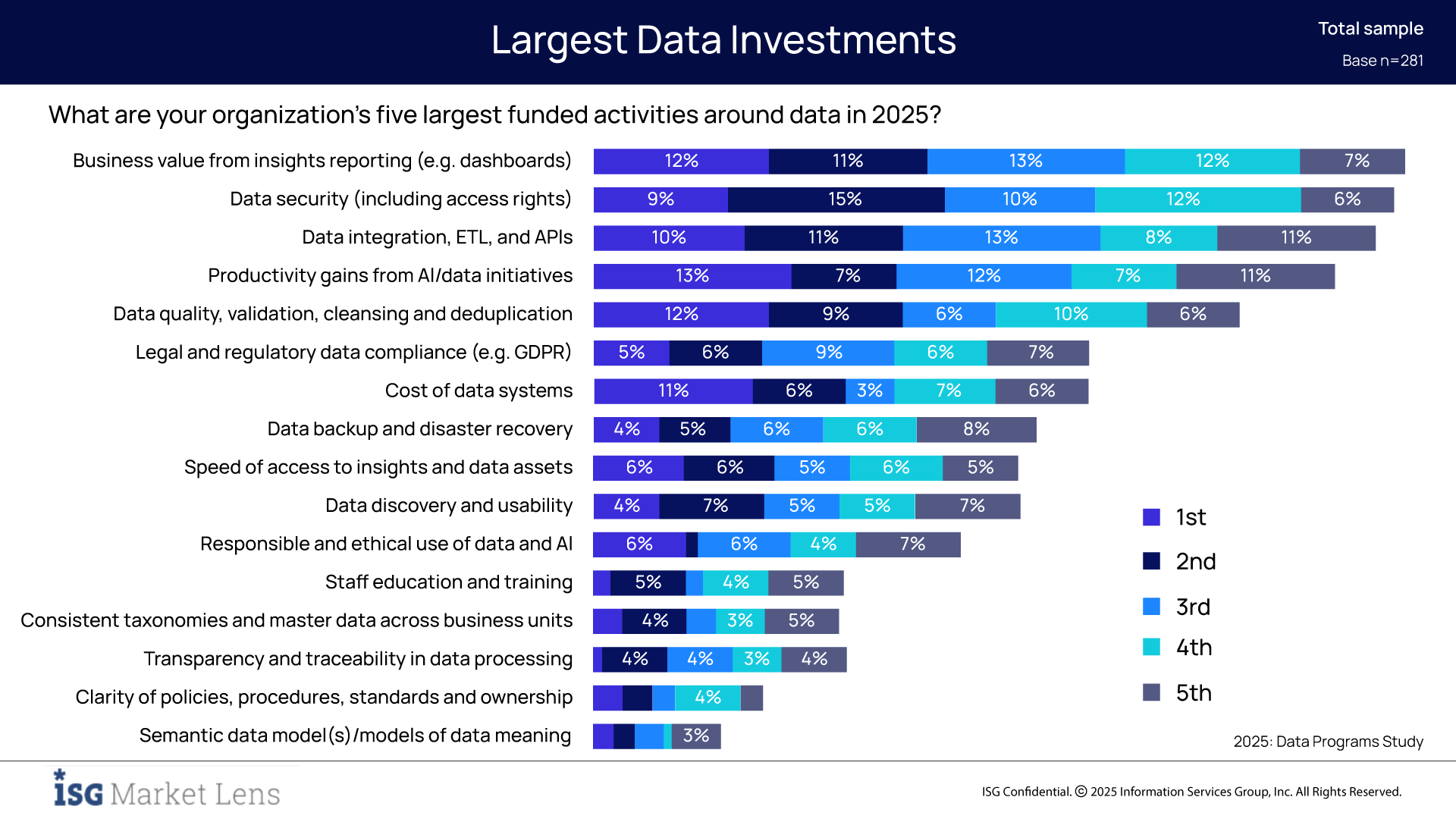
ISG’s 2025 Data and AI Programs Study reveals that AI-driven gains from business intelligence insights are at the heart of enterprise data investments. This focus underscores the transformative potential of AI for actionable insights.
How Other Investments Support AI’s Role in Data Analytics
However, the success of AI in data analytics environments depends heavily on other foundational investments, which collectively create the conditions for AI to thrive.
Business Value from Insights Reporting (12%)
Dashboards and reporting tools provide actionable insights that AI systems can further refine and enhance, ensuring decision-makers have the clarity they need.
Data Security (9%)
AI systems rely on secure, well-managed data environments to operate effectively. Investments in data security protect sensitive information and ensure compliance, enabling AI to function without risk.
Data Integration, ETL, and APIs (10%)
Seamless data integration ensures that AI systems have access to unified, high-quality datasets, which are essential for accurate analytics and predictions.
Data Quality, Validation, and Cleansing (11%)
AI’s effectiveness hinges on clean, validated data. Poor data quality can lead to inaccurate insights, making this investment critical for AI-driven analytics.
Legal and Regulatory Compliance (6%)
Compliance frameworks ensure that AI operates within ethical and legal boundaries, fostering trust and accountability in AI-driven decisions.
While AI-driven productivity gains are a standout priority, the other investments—such as data security, integration, and quality—are essential enablers.
Together, they create a robust foundation for AI to deliver its full potential in enterprise data analytics, driving innovation and competitive advantage.
Key Business Functions Enterprise AI Analytics Serves
Hexaware sees this primarily from an industry perspective, focusing on how we can really add value with data analytics across value chains and streams.
- Customer Analytics and Experience
Segment customers and personalize experiences to boost satisfaction and loyalty. - Operations and Supply Chain
Optimize inventory and logistics to enhance efficiency and reduce costs. - Financial Analytics
Analyze financial data for budgeting, forecasting, and risk management. - Marketing and Sales
Evaluate campaign performance and improve conversion rates through data insights. - Employee and HR Analytics
Enhance talent acquisition and employee engagement through performance metrics. - Product and Innovation
Identify market trends and improve product offerings based on analytics feedback.
AI-powered Data Analytics in Different Industries: Key Applications
From retail to healthcare, manufacturing to finance, AI-powered analytics enables businesses to derive actionable insights from vast amounts of unstructured data, streamline operations, and enhance decision-making processes.
Retail
Retailers embracing AI are pulling far ahead of their peers. McKinsey reports that companies leading in digital and AI deliver three times greater shareholder returns than competitors. According to Gartner, 91% of retail IT leaders now rank AI as their top technology priority for 2026, with a focus on accelerating digital transformation. PwC further highlights how AI enables hyper-customization, from dynamic pricing to real-time promotions, unlocking personalized experiences that drive growth.
Hexaware’s use case: We used GenAI-powered data analytics to enrich 61,000+ product SKUs for a global home improvement wholesaler. By turning raw data into SEO-optimized, audience-specific content, we cut manual effort by 75% and delivered 25% higher search rankings and a 20% lift in conversions.
Healthcare
AI is reshaping healthcare by cutting through complexity and waste. McKinsey notes that AI helps reduce administrative inefficiencies while enabling holistic patient care by connecting disparate data sources. Gartner’s latest Hype Cycle places AI among the most impactful technologies in healthcare analytics, underscoring its growing influence. Yet, as IDC points out, the success of AI and ML in life sciences hinges on access to large volumes of high-quality data—a challenge providers must overcome to realize AI’s full potential.
Hexaware’s use case: We built a domain-driven data hub for a Medicaid Managed Care provider, unifying member, provider, and claims data. This clean, governed foundation now powers real-time analytics and AI/ML use cases like predictive care and faster regulatory reporting—delivering 50% quicker data access and 30% cost savings.
Manufacturing
In manufacturing, AI is unlocking efficiency without additional capital investment. McKinsey cites a biopharma case where AI-driven analytics increased vaccine yield significantly, proving the power of data in process optimization. IDC predicts that by 2027, 30% of top manufacturers will adopt AI for advanced planning, pushing purchase order rates above 95%. Supporting this momentum, Gartner has already identified over 250 AI use cases tailored to the unique challenges of manufacturing, from predictive maintenance to intelligent supply chains.
Hexaware’s Use Case: We helped a global mining leader unlock value from real-time IoT sensor streams across 600 haul trucks by migrating to Snowflake and applying AI/ML models for anomaly detection, predictive maintenance, and operator behavior analytics. This AI-driven system delivered insights in under 30 seconds, cutting SOP violations by 50%, improving safety KPIs, and saving $1.3M annually in OpEx.
Banking & Finance
The financial services industry is harnessing AI to manage data at unprecedented scales. McKinsey highlights JPMorganChase, which uses AI to manage over an exabyte of data, fueling sharper, faster decision-making. Still, Gartner reports that 70% of finance organizations fail to fully capture AI’s benefits—though leaders who do are seeing strong returns. Forrester adds that Generative AI is rapidly transforming fraud detection and personalization, creating a new era of intelligent, customer-centric finance.
Hexaware’s Use Case: Hexaware reengineered a global bank’s payment investigations with AI-driven automation and analytics, deploying 15 bots to handle duplicate checks, error detection, and case tracking. This reduced costs by 48% ($7.95M savings), lifted productivity by 27%, and created a scalable man–machine model to manage surging transaction volumes with speed and accuracy.
Marketing
AI is redefining marketing strategy and execution, particularly in the B2B space. Forrester finds that leading marketers are leveraging AI to reinvent processes, improving productivity and better aligning teams around customer goals. Yet challenges remain Gartner reveals that 30% of CDAOs struggle to measure AI’s direct impact on business outcomes. Despite this, AI’s ability to surface insights, predict customer behavior, and automate campaign execution continues to push marketing into a new age of intelligence.
Hexaware’s Use Case: Softcrylic’s (a Hexaware company) audience targeting solution on Adobe Experience Platform unified fan data and delivered hyper-targeted experiences across channels. With MDF-driven messaging, the team optimized partner marketing spend while deepening fan loyalty—transforming digital engagement into a true growth engine for modern sports entertainment.
Energy
As AI adoption accelerates, energy implications are becoming critical. McKinsey projects that global data center demand could triple by 2030, largely driven by AI workloads. On the other hand, PwC notes that AI could help reduce overall energy consumption by 0.3% to 1.3% outside of data centers by 2035, offsetting some of this surge. Gartner predicts that by fusing IT, OT, and ET investments, 15% of asset-intensive firms will create intelligent assets, striking a balance between efficiency, resilience, and sustainability.
Hexaware’s Use Case: We helped a global oil & gas major cut costs and emissions by building AI/ML models and a digital twin of its gas compression operations. The solution forecasted electricity demand with 50% higher accuracy and identified optimal configurations to minimize energy use. This delivered significant cost savings, reduced CO₂ emissions equal to 600 UK households, and accelerated the adoption of future AI/ML initiatives for sustainable operations.
Challenges and Ethical Considerations
As artificial intelligence accelerates the pace at which businesses operate, the challenges and ethical considerations tied to its adoption are becoming more stringent. Companies are increasingly aware of the implications of accountability when using AI, from ensuring fairness and bias prevention to addressing the risks of inaccurate outputs or model hallucinations.
The cost of failing to get AI implementations right—whether through compliance violations, reputational harm, or financial losses—underscores the critical need for robust governance frameworks and strategic planning.
Addressing the Challenges
The future of AI in data analytics offers immense potential, but organizations must overcome several key challenges to achieve successful adoption and implementation. According to ISG’s 2025 Data and AI Programs Study, businesses anticipate a range of hurdles in areas such as data quality, talent availability, ROI demonstration, and technology coordination.
These challenges impact the effectiveness of AI initiatives and require decisive actions to address them.
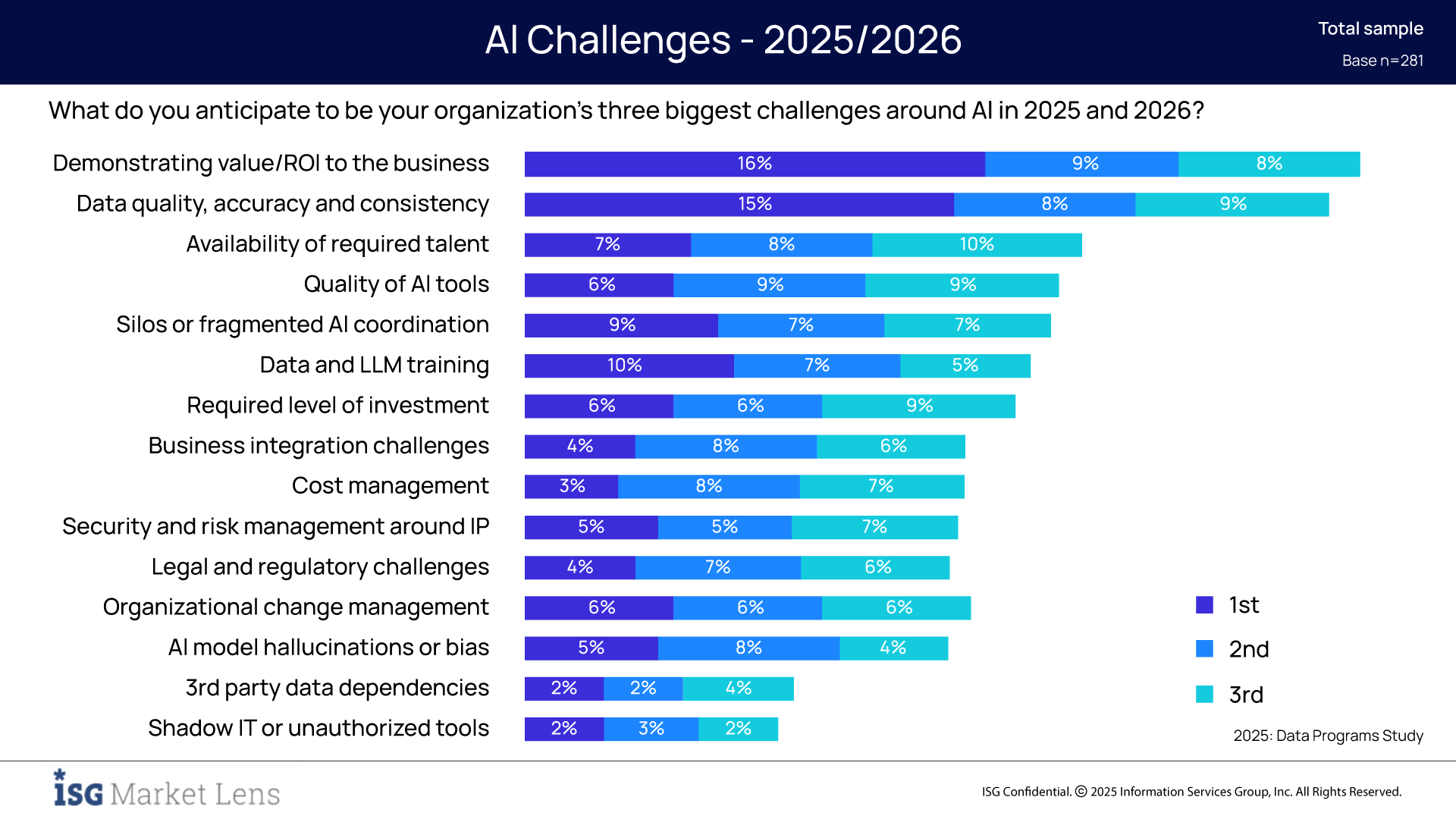
Demonstrating Value/ROI to the Business (16%)
- Challenge: Many organizations struggle to measure and communicate the tangible value of AI investments. Without a clear ROI, AI initiatives risk losing executive support and funding.
- Decisive Action: Establish robust frameworks for tracking AI-driven business outcomes such as revenue growth, cost reduction, and operational efficiency. Align AI projects with strategic business goals to ensure measurable impacts and stakeholder buy-in.
Data Quality, Accuracy, and Consistency (15%)
- Challenge: Poor data quality undermines AI models, leading to inaccurate insights and flawed decision-making. Data silos and fragmented sources amplify the issue.
- Decisive Action: Implement comprehensive data governance frameworks to ensure data accuracy, consistency, and completeness. Utilize AI-powered data profiling and cleansing tools to maintain high-quality datasets for analytics.
Availability of Required Talent (9%)
- Challenge: The shortage of skilled AI professionals, such as data scientists, machine learning engineers, and AI ethicists, limits organizations’ ability to implement and scale AI initiatives.
- Decisive Action: Invest in upskilling programs for existing employees and collaborate with academic institutions to nurture AI talent pipelines. Consider leveraging third-party AI expertise through partnerships or outsourcing.
Silos or Fragmented AI Coordination (9%)
- Challenge: Disconnected AI efforts across departments lead to inefficiencies and limit the ability to scale AI solutions enterprise-wide.
- Decisive Action: Foster cross-functional collaboration by establishing centralized AI governance and coordination teams. Adopt data mesh or data fabric architectures to enable seamless data integration across business units.
Data and LLM Training Costs (9%)
- Challenge: Training large language models (LLMs) and advanced AI systems demands significant computational resources, driving up costs.
- Decisive Action: Optimize AI training processes using distributed computing and cloud-based resources. Implement cost-efficient AI techniques like transfer learning and federated learning.
Business Integration Challenges (8%)
- Challenge: AI solutions often face hurdles when integrating with legacy systems and existing workflows, slowing adoption.
- Decisive Action: Modernize legacy systems and ensure APIs and middleware support seamless integration. Involve key stakeholders early to align AI solutions with operational workflows.
The Benefits of AI in Data Analytics
To align your enterprise AI analytics strategy with AI integration, focus on enhancing operational efficiency, scalability, and decision delivery at scale. By doing so, your enterprise can achieve a competitive edge, foster innovation, and adapt to the evolving demands of the digital age.
However, the journey from data to impact is a careful and deliberate process that requires strategic decisions that align with business outcomes, a vision for what you need from business intelligence, and accelerated action on all fronts. Here’s what to aim for.
Enhanced Data Processing and Automation
AI significantly accelerates the processing of vast datasets by automating tasks such as data cleansing, preparation, and analysis.
This reduces the time and resources required for manual efforts while improving accuracy. For instance, AI-driven tools can identify and correct errors in datasets, ensuring consistency and reliability.
Additionally, AI automates the entire data processing pipeline, from data extraction to transformation, saving time and reducing the likelihood of errors.
Faster Predictive and Prescriptive Analytics
AI empowers organizations to move beyond descriptive analytics (what happened) to predictive (what will happen) and prescriptive analytics (what should be done).
By analyzing historical data and identifying trends, AI-powered algorithms can forecast future outcomes and recommend optimal strategies. This enables businesses to make proactive, data-driven decisions, enhancing their ability to adapt to changing conditions.
Democratization of Real-Time Insights at Scale
AI processes data in real time, providing instant insights that allow organizations to respond quickly to dynamic conditions. For example, companies can monitor customer behavior or market trends in real time and adjust their strategies accordingly.
Furthermore, AI-powered tools, such as those leveraging natural language processing (NLP), make data analytics accessible to non-experts. These tools enable professionals without technical expertise to analyze complex datasets and derive actionable insights, reducing reliance on specialized data scientists.
Hyper-Personalization for Data Users and Customers
AI facilitates hyper-personalization by analyzing user behavior and preferences. Businesses can leverage these insights to tailor products, services, and marketing efforts, thereby improving customer satisfaction and loyalty.
This is particularly impactful in industries like retail and e-commerce, where personalized experiences drive engagement and revenue.
A More Dynamic Outlook on Security and Compliance
AI enhances and identifies unusual patterns and anomalies in data. Its ability to analyze large datasets in real time makes it a powerful tool for detecting fraudulent activities and improving data security.
This capability is especially critical in industries like healthcare and finance, where compliance and precision are paramount.
Scalability of the Benefits of Enterprise AI Analytics
AI systems are highly scalable, capable of handling growing datasets without compromising performance. This makes them ideal for organizations managing large volumes of data, such as logistics companies or financial institutions.
The scalability of AI ensures that businesses can continue to derive value from their data as their operations expand.
New Parameters for Enterprise Data Governance
As AI becomes more integrated into data analytics, ethical concerns such as bias in algorithms and transparency in decision-making are gaining attention.
Organizations must address these challenges to ensure fairness and accountability in their AI-driven analytics processes. This includes implementing robust governance frameworks to oversee AI applications and mitigate risks.
Transformation of Developer and Analyst Roles
AI is reshaping the roles of data analysts and developers. While routine tasks are increasingly automated, analysts are now focusing on higher-level activities such as interpreting AI-generated insights, defining problems, and applying domain expertise. This shift emphasizes critical thinking and strategic decision-making, allowing professionals to add greater value to their organizations.
How Hexaware Can Help with AI-first Enterprise Analytics?
Hexaware empowers businesses to thrive in the AI era by combining an AI-first approach with enterprise analytics. With scalable platforms, strong governance frameworks, and a relentless focus on innovation, Hexaware ensures enterprises unlock the full potential of their data in every industry.
Curious about our AI-first approach for enterprise analytics? Learn more here.
FAQs
AI processes unstructured data—such as text, images, and videos—using advanced techniques like Natural Language Processing (NLP), computer vision, and machine learning. These methods extract patterns, insights, and relationships from raw, unorganized data, enabling businesses to analyze customer behavior, trends, and operational efficiency effectively. AI-ready data frameworks ensure that unstructured data is cleaned, structured, and accessible for analytics applications.
AI enables real-time data analysis by automating data collection, processing, and interpretation at high speeds. Predictive analytics and real-time monitoring tools powered by AI allow businesses to detect anomalies, forecast trends, and make instant decisions. For example, AI systems can analyze live data streams to optimize supply chains or monitor customer interactions, ensuring businesses stay agile and responsive to market changes.
Industries such as healthcare, finance, retail, and manufacturing benefit significantly from AI in data analytics.
- Healthcare uses AI for predictive diagnostics and personalized care.
- Finance leverages AI for fraud detection and risk management.
- Retail applies AI for hyper-personalization and dynamic pricing.
- Manufacturing benefits from predictive maintenance and process optimization. AI-powered analytics transforms operations across these sectors, driving efficiency and innovation.
Businesses can start by focusing on data readiness for AI—ensuring their data is clean, structured, and governed. They should identify key challenges, invest in scalable AI platforms, and align AI initiatives with business goals. Training teams to use AI tools and adopting frameworks like Enterprise AI Readiness with Data can help organizations integrate AI seamlessly into their analytics strategies.
The future of AI in data analytics is marked by a transformative shift toward AI analytics, where artificial intelligence becomes the core driver of insights and decision-making. This evolution moves beyond traditional data analytics, integrating generative AI and agentic AI to create a seamless flow from data to intelligence and intelligence to action.
Generative AI enhances the ability to process and synthesize vast datasets, enabling deeper insights and predictive capabilities. Meanwhile, agentic AI takes this intelligence further by autonomously acting on insights, making decisions, and executing tasks in real time. This shift empowers businesses to move from reactive analytics to proactive, self-sustaining systems that deliver measurable impact at scale.
As enterprises adopt AI analytics, they will experience faster, smarter, and more scalable solutions, enabling them to respond to market changes, optimize operations, and innovate continuously. The future lies in embedding AI across the data value chain, ensuring ethical governance, and aligning AI initiatives with business outcomes to unlock unprecedented value.
Author

Joy Maitra
Principal Consultant - Data & AI Practice
Joy Mitra is a lead architect for Hexaware’s Amaze® platform, passionate about designing innovative solutions for real-world business challenges. He excels at engaging with clients to deeply understand their pain points and crafting optimized, scalable solutions that blend human expertise with intelligent automation. He firmly believes in AI for humans, not instead of humans. This philosophy drives him to build secure, compliant, and human-centric AI ecosystems that empower people rather than replace them. His work consistently reflects this balance—leveraging technology to enhance human capability while ensuring trust, transparency, and responsible implementation.
Read more


Prashant Dahalkar
Senior Vice President - Data & AI Practice
Prashant Dahalkar, Hexaware’s Senior Vice President of Data & AI and Center Head for Hexaware Pune, excels in leading data delivery, consulting, presales, and solution development. His strategic oversight has empowered businesses to evolve their tech stacks and data capabilities, transforming business intelligence and fostering innovation. Formerly the Director and Center Head for AI and Analytics, Prashant has enabled enterprises to establish robust Data Platforms, Agentic AI & Governance frameworks using cutting-edge solutions. A trusted advisor to major enterprise CDAOs and Heads of Data, he is dedicated to creating secure, compliant, and impactful Nextgen platforms. In his leisure time, Prashant enjoys playing badminton and practicing yoga.
Read more

Related Resource
Blog
Telecom Data Analytics: Why Most Operators Are Still Underusing Their Biggest Asset
Blog
What’s Changed in Microsoft Fabric for Responsible AI at Scale
Blog
Snowflake-Powered Deep Learning: Predicting Housing Prices in the Cloud
Blog
Industry-Specific ESG Strategies: From Finance to Logistics
Blog
Exploring How Snowflake Cortex Code (CoCo) works with SnapLogic Migration
Blog
Building an Intelligent ADF to Snowflake Migration Skill with Snowflake CoCo
Blog
Audit Automation: A Complete Guide for Tax & Accounting Firms
Blog
Smart Grid Innovation: IT Solutions for Modern Utilities
Blog
AI-powered Risk Intelligence for Banking and Financial Services
Blog
Real Case Studies: Digital Campus Transformation with Hexaware