Gartner, Magic Quadrant for Custom Software Development Services, By Jaideep Thyagarajan, Ryan McKinney, Nathan Davie, 7 October 2026. Gartner and Magic Quadrant are trademarks of Gartner, Inc. and/or its affiliates.
Gartner does not endorse any company, vendor, product or service depicted in its publications, and does not advise technology users to select only those vendors with the highest ratings or other designation. Gartner publications consist of the opinions of Gartner’s business and technology insights organization and should not be construed as statements of fact. Gartner disclaims all warranties, expressed or implied, with respect to this publication, including any warranties of merchantability or fitness for a particular purpose. This graphic was published by Gartner, Inc. as part of a larger research document and should be evaluated in the context of the entire document. The Gartner document is available upon request from Hexaware.
Blog
Insights Into Workplace Costs During COVID-19
Last Updated: Apr 13, 2020
3 min read
Share on
– Enabling remote work can save companies up to $11,000 per employee per year, per one estimate.
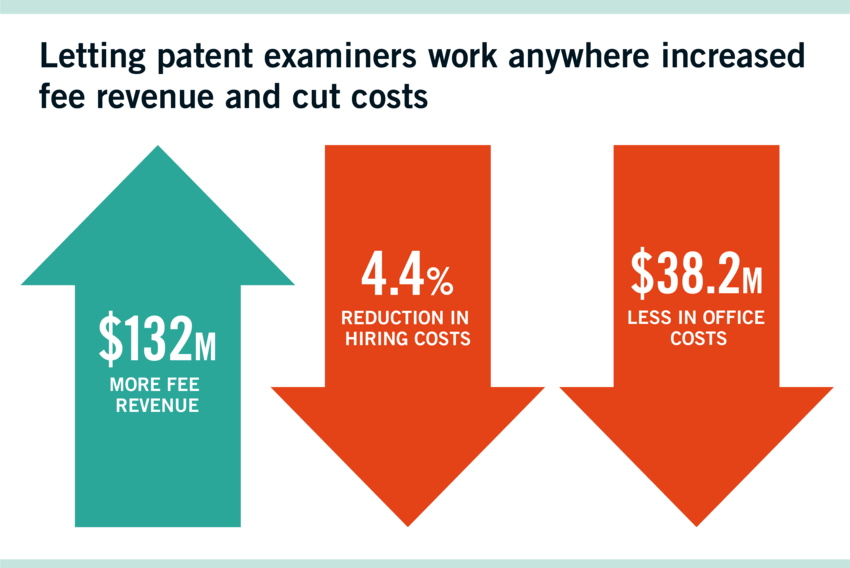
– USPTO saved $38.2 million by letting patent examiners work from anywhere.
– Fixed workplace costs include rental, security, and maintenance regardless of remote work levels.
– A what-if utility dashboard enables finance teams to model cost savings from different remote work mixes.
The current COVID pandemic has created a new normal, remote work or work from home. Typically it is estimated that companies can save up to $ 11, 000 dollars per employee per year by enabling remote work. A recent study with the USPTO (US Patent and Trademark Office), as shown in the chart below, shows $38.2 million dollar savings for the organization by enabling remote working.
Post COVID, cost management will be a top priority for enterprises. It is appropriate for the management to come up with a mix of on-premise and remote working capability. However, before taking a call on the right mix, a clear understanding of cost break ups in maintaining office premises vis a vis costs for working from home must be arrived at.
It is important for the CFO to understand different cost implications of a workplace facility to take a right decision. Also, it is important to understand new working models like Hot Desks and its cost, and new software that might be required for better employee engagements – like Yammer.
In hot desking, office workers aren’t assigned a desk, but by prior booking they take any unoccupied seat when they need it. This concept has been around for almost a decade and has been successfully implemented by large corporates, and are of interest now for even smaller enterprises.
Some of the questions that organizations need to answer:
What is the cost impact of having employees in work from home model?
What is the cost impact of running the workplaces with lesser strength?
Post COVID, what percentage of workforce should I plan for ‘work from home’ to manage cost?
Which of my workplace variable cost can be controlled effectively?
Getting insights into workplace cost
Facility costs includes fixed and variable costs. Following are some of the points to be considered:
Determine the fixed and variable cost-
Fixed cost consists of costs like rental, security and maintenance costs that must be borne irrespective of whether all employees work from premise or otherwise
Variable costs are those that are impacted by the proportion of employees in office or otherwise – this includes costs like HVAC, electricity, data card & collaboration software like Webex
Determine the per employee cost for the variable cost
The per employee cost for the variable cost has to be derived to assess the impact of ‘work from home’ on the variable cost
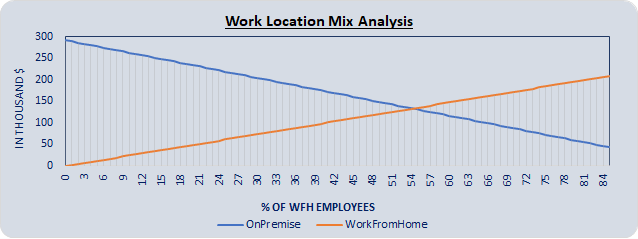
A what-if utility dashboard will need to be created which the finance team can use to manipulate the percentage of employees working from home to achieve the targeted cost savings.
Chart depicting the Work location mix and its cost impact from Hexaware framework for workplace cost management
Conclusion
In the current scenario, getting a quick understanding of potential workplace costs under different circumstances will help us stay productive and profitable. Also, do share with us your thoughts on sustainable workplace cost management and how we can overcome these testing times effectively with minimal disruption.
Author
Aruna Narayanan
Aruna is a Data and Analytics professional with more than 15 years of experience and has delivered analytics for enterprises in Healthcare and Insurance. She is currently focused on bringing automation in adopting cloud modern architecture and in leveraging data analytics for cost optimization.



 Source: https://www.weforum.org/agenda/2019/08/companies-benefit-when-employees-work-remotely/