Supply Chain of Information
Supply Chain essentially is considered to be the flow of goods and services across the manufacturing / retail value chain in order to deliver the desired goods/service to the end-customer. With the proliferation of information technology, supply chain in addition to the above mentioned components is essentially the flow of information between the different entities – Suppliers, OEMs, Manufacturers, Distributors and Retailers.
Interestingly these entities have varied touch points outside enterprise boundaries – web (social, videos, blogs etc..) handheld devices (EOBRs), RFIDs etc that makes it a challenge to control the bullwhip effect. This necessitates for a strategy to handle unstructured data (Big Data).
What the Research Says?
Organizations have realized this importance and are focusing on Big Data initiatives, but according to a research by Supply Chain Insights LLC – deriving intelligence from sources outside enterprise boundaries still remains to be a challenge.
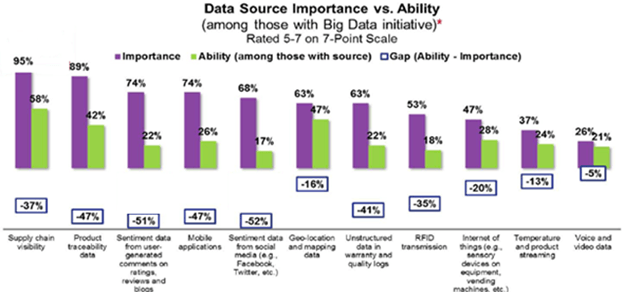
Source: Supply Chain Insights
The Landscape
Big Data initiatives cannot be standalone rather they must be planned around the existing DW/BI infrastructure to derive meaningful insights. Following is an illustration of the big data landscape for supply chain:
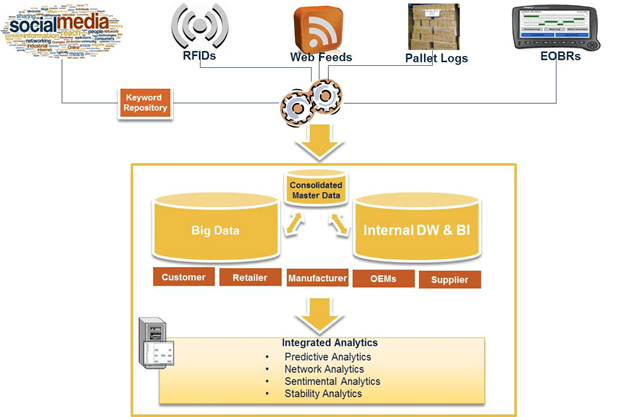
Key aspects of the Big Data landscape are as detailed below:
- Identify the Data Source – Web clickstreams, social media, new feeds, weather reports, Pallet Tags, GPS, Electronic On-Board Recorder (EOBRs) that provides valuable information on the Supply Chain entities
- Consolidate Master Data – Link the Supply Chain entity’s (Customer/Customer group, supplier, distributor, manufacturer) in-house master data with their Social/web presence and create a consolidated Master Data
- Determine Keywords – Keywords play a critical part in garnering information from the WWW e.g.: Supplier/distributor health check, location/route transit check. In accordance to the objective right keywords has to be chosen
- Define Extraction Patterns – Accurate patterns have to be implemented to extract relevant information. Feeds from external data sources should be analyzed for the patterns. Patterns can be <<Supplier_Name + Keyword>> or <<Product_Name + Keyword>>
Once the data from the sources outside enterprise boundaries are brought within the enterprise, data modeling can be done w.r.t the key supply chain entities and analytics performed on top of these models.
Having seen the landscape of Big Data, let’s explore how Big Data can bring about a difference in key Supply Chain areas: Demand Planning, Supply Planning and Order Fulfillment:
Demand Planning
Current Process: Traditional process based on past sales data and any specific factors (e.g.: seasonality) influencing sales
Envisioned Process with Big Data: Critical inputs for demand planning from Web clickstreams, Videos, Facebook, Twitter feeds, News article shared, Enquiry (web, email, CRM)
Supply Planning
Current Process: Traditional process takes into consideration past supplier performance – lead time to delivery, quality, and proximity
Envisioned Process with Big Data: Make the current process robust by bringing in the supplier stability quotient from Emails, News Feeds on Supplier w.r.t R&D, Re-Structure, Financials, Technology etc.
Order Fulfillment
Current Process: Traditional process focusing on distributor’s past performance and location proximity
Envisioned Process with Big Data: Assess the Political, Economic, Social and Technological’ (PEST) factors, environmental factors and identify probable delays in delivery, suggest alternate routes. Key data sources such as News Feeds – Geographic, Political, XML feeds (weather.gov), Trailer/Pallet Tags, Electronic On-Board Recorder (EOBRs), Geographic Positing System, Mapping data
As seen in the above use-cases (a sample) identifying and processing big data will bring in new perspectives to an organization that when integrated with the existing BI environment can bring about valuable insights. I would appreciate your thoughts on this article and additional use cases for Big Data in Supply Chain.
Thanks for reading!